Challenges in Soil Sample Analysis
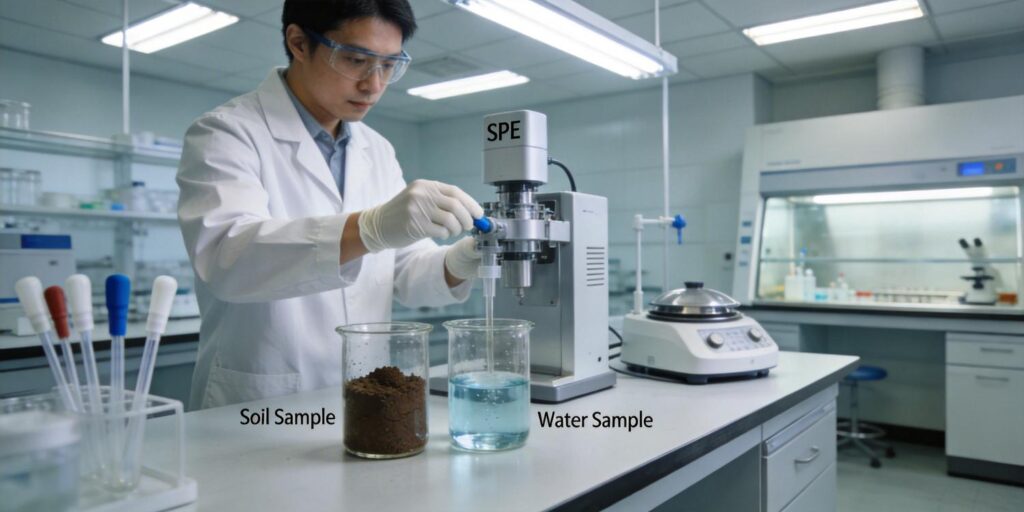
Soil analysis presents unique challenges that distinguish it from other environmental matrices. Unlike aqueous samples, soil contains complex mixtures of inorganic minerals, organic matter, and biological components that can interfere with analytical determinations. The primary challenge lies in the heterogeneous nature of soil samples, which often contain particulates, dissolved organic matter (DOM), and humic substances that can bind to target analytes and complicate extraction processes.
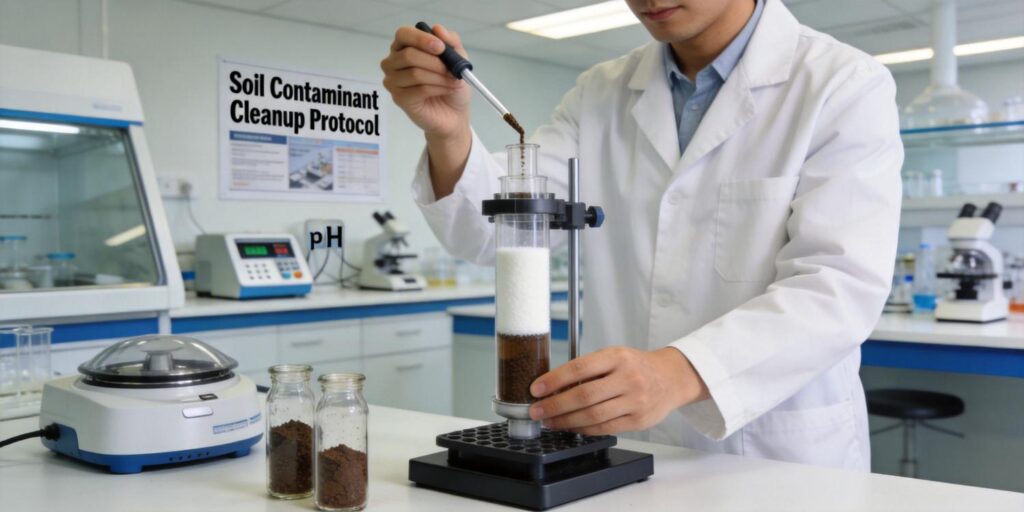
According to environmental chemistry literature, soil samples require liberation of analytes from solid matrices into liquid forms before SPE processing can begin. Traditional methods like Soxhlet extraction, homogenization in extraction buffers, or other physical manipulations are often necessary, but careful selection of conditions is crucial to minimize co-extraction of biological debris and inorganic matrix components. Even with optimized primary extraction, additional cleanup is frequently required prior to analysis.
The U.S. Environmental Protection Agency’s Statement of Work for determining chlorinated pesticides and other chlorinated organic species in sludge and soil samples highlights the complexity of soil analysis. These extracts are typically rich in humic and fulvic acids and may contain high levels of sulfurous compounds and other inorganics, necessitating multiple cleanup steps including gel permeation, desulfurization, and SPE extraction on Florisil.
Extraction of Contaminants from Soil Matrices
The first critical step in soil analysis involves converting solid samples into liquid form suitable for SPE processing. Effective strategies for extracting solid environmental matrices like soil involve turning them into “water” samples before processing. When soil samples are extracted with water-miscible organic/buffer mixtures, several milliliters of sample may result. This volume is then further diluted with water to reduce the eluotropic strength of the sample, making it compatible with SPE procedures.
Research indicates that a prerequisite for successful extraction of soil or sludge samples is the liberation of analytes from solid matrices into liquid ones. The choice of extraction mechanism significantly impacts the amount of biological debris and inorganic matrix co-extracted. Even with careful selection, considerable additional cleanup is often required prior to analysis.
Environmental chemists face a philosophical dilemma: should they measure total toxicant levels in a sample, or only the portion that could leach into water supplies? If focusing on leachable fractions, the Toxicity Characteristic Leaching Procedure (TCLP) offers a simpler approach involving tumbling samples in aqueous media or passing water through samples, then extracting the resulting leachate using LLE or SPE.
SPE Sorbents Suitable for Soil Extract Cleanup
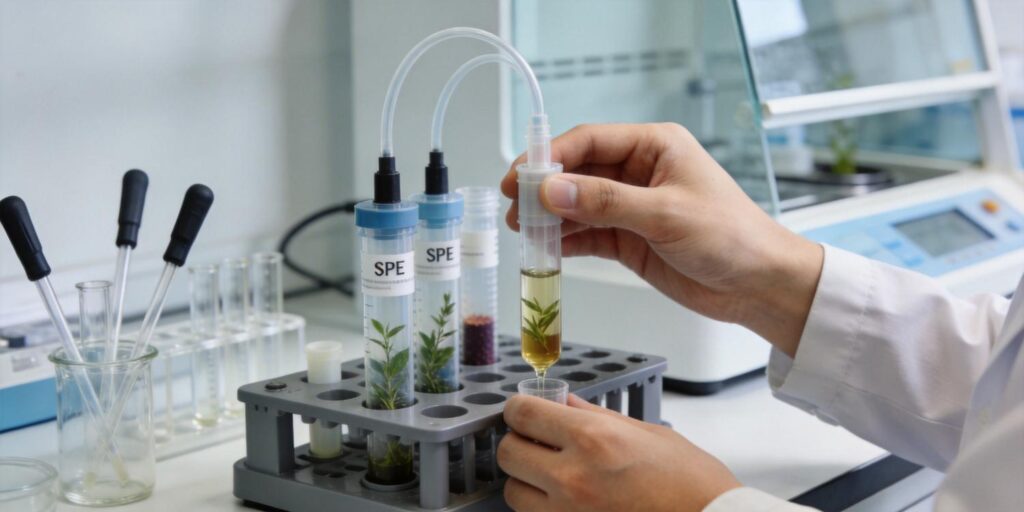
Selecting appropriate SPE sorbents for soil extract cleanup depends on the target analytes and the specific interferences present in the soil matrix. Several sorbent types have proven effective for soil applications:
Reversed-Phase Sorbents
Octadecyl (C18) bonded silica sorbents are commonly used for non-polar to moderately polar compounds. However, research by Nakamura et al. (1996) established guidelines showing that analytes with log Pow below approximately 4 when using alkyl-bonded silicas are not significantly influenced by the presence of 1 ppm humic acid. For more hydrophobic compounds, polystyrene sorbents may offer better performance.
Florisil
Historically, SPE using Florisil cartridge cleanup has been employed in environmental analysis, particularly for chlorinated pesticides and other chlorinated organic species. The U.S. EPA Contract Laboratory Program has utilized Florisil SPE as part of comprehensive cleanup procedures for soil and sludge samples.
Mixed-Mode Sorbents
For complex soil matrices containing both acidic and basic compounds, mixed-mode sorbents combining reversed-phase and ion-exchange functionalities offer superior selectivity. These sorbents can simultaneously retain compounds based on hydrophobicity and ionic interactions.
Graphitized Carbon Black
Strongly positively charged, graphitized carbon black has been successfully used for determination of compounds like benzene and naphthalene sulfonates in wastewater. This technique permanently retains negatively charged humic substances, which are almost absent in final extracts.
Removal of Humic Substances During Washing
Humic substances represent one of the most challenging interferences in soil extract analysis. These complex organic molecules can bind to target analytes, reducing recovery and complicating quantitation. Several approaches have been developed to address humic interference:
pH Optimization
Research by Senseman et al. (1995) demonstrated that effects of humic acid on pesticide recovery are greater at pH 6 than at pH 8, possibly due to increased neutral character of DOC as pH is lowered. Adjusting sample pH can therefore influence humic-analyte interactions and improve recovery.
Oxidative Destruction
Bonifazi et al. (1994) approached the problem by destroying humic acids prior to SPE to obtain good recovery of polychlorinated dibenzodioxins (PCDDs) and polychlorinated dibenzofurans (PCDFs). Samples acidified with sulfuric acid were treated with potassium permanganate to oxidize humic substances, with excess permanganate reduced with hydrogen peroxide and final pH adjusted with sodium hydroxide.
Selective Washing Protocols
Proper washing steps can remove humic substances while retaining target analytes. The choice of wash solvents depends on the hydrophobicity of target compounds and the nature of humic-analyte interactions. Research indicates that pesticides within chemical families react similarly to humic acid presence, allowing for class-specific optimization of washing conditions.
Filtration and Centrifugation
For soil extracts containing particulate matter, centrifugation followed by filtration can reduce plugging of SPE devices. Depth filters consisting of diatomaceous earth (Hydromatrix®) have been found preferable to nylon depth filters for SPE of non-homogeneous samples. When filter aids are used, care must be taken to elute analytes from the filter surface, though this may increase overall elution volume.
Elution Conditions for Environmental Pollutants
Optimal elution conditions for environmental pollutants from soil extracts depend on the chemical properties of target analytes and the sorbent used. Several factors must be considered:
Solvent Selection
Traditional elution solvents include methanol, acetonitrile, and various solvent mixtures. For hydrophobic compounds, solvents like dichloromethane or hexane-dichloromethane mixtures may be more effective. Research has shown that using pentane/methylene chloride for elution from silica cartridges can yield near-quantitative recoveries with good precision for moderately polar compounds.
Elution Volume Optimization
Minimizing elution volume is crucial for achieving adequate concentration factors. Typically, 200 μL to 2 mL (depending on tube size) or 5-10 mL (for disk formats) of elution solvent provides effective analyte recovery while maintaining concentration.
Supercritical Fluid Elution
Innovative approaches like supercritical fluid elution of SPE devices can provide better elution of analytes than typical liquid eluents. This technique is particularly useful when SPE is used to trap semivolatile compounds from water, as SFE elution offers “solvent-free” desorption advantages.
Sequential Elution
For complex soil extracts containing multiple analyte classes, sequential elution with solvents of increasing strength can fractionate compounds based on polarity, simplifying subsequent analysis.
Integration with LC-MS Analysis
SPE cleanup of soil extracts is particularly valuable when coupled with LC-MS analysis, as it removes matrix components that can cause ion suppression or enhancement. Proper SPE cleanup significantly increases LC column life while reducing downtime on sensitive instruments for source cleaning.
Matrix Effect Reduction
Dissolved organic matter in soil extracts can enhance “matrix effects” that result in spuriously high signals in LC-MS. SPE cleanup removes these interferences, improving quantitation accuracy and precision.
Compatibility Considerations
The final eluate from SPE must be compatible with LC-MS mobile phases and injection conditions. This often requires solvent exchange or evaporation/reconstitution steps to ensure optimal chromatographic performance and ionization efficiency.
Automation Potential
SPE procedures can be readily automated, improving throughput and reproducibility for high-volume soil analysis laboratories. Automated systems can handle multiple samples simultaneously, reducing analyst exposure to potentially hazardous samples and solvents.
Case Example in Pesticide Monitoring
A practical example of soil extract cleanup using SPE involves pesticide monitoring in agricultural soils. Research by Sutherland (1994) examined the recovery of simazine and 2,4-D from soil extracts using octadecyl bonded silica sorbents.
Method Development
The study compared spiked extracts of field-weathered soils collected prior to pesticide treatment with pure water spikes to determine if DOM present in soil samples had adverse effects on SPE extraction. Blank, pretreatment soil extracts were spiked, extracted by SPE, and analyzed to assess matrix effects.
Results and Implications
No detrimental effect of DOM presence on recovery of 2,4-D or simazine was observed in this specific case. The log Pow values (1.94 for simazine and approximately 2.6-2.8 for 2,4-D) fell below the threshold where humic acid interference becomes significant for alkyl-bonded silica sorbents.
Practical Considerations
This case highlights the importance of testing with spiked “real-world” blanks whenever possible and comparing SPE and LLE results on split-samples. It also demonstrates that not all soil-pesticide combinations will experience significant humic interference, particularly for compounds with moderate hydrophobicity.
Method Validation
For regulatory applications, method validation should include recovery studies using soil samples with representative organic matter content. When pretreatment samples matching soil type and DOC composition are unavailable, commercially available humic substances can serve as substitutes for controlled studies, though they may not perfectly represent natural organic matter.
Soil extract cleanup using SPE techniques represents a critical step in environmental analysis, enabling accurate determination of contaminants at trace levels. By understanding the challenges specific to soil matrices and optimizing SPE protocols accordingly, analysts can achieve reliable results while minimizing solvent usage and improving laboratory efficiency.