Influence of Flow Rate on Analyte Adsorption
Flow rate is a critical parameter in solid phase extraction (SPE) that directly impacts the kinetics of analyte adsorption onto the sorbent surface. According to established SPE literature, the interaction between analytes and sorbent functional groups is time-dependent, requiring sufficient contact time for effective binding. When flow rates are too high, analytes may not have adequate residence time to diffuse into the sorbent pores and establish proper interactions with the functional groups.
The relationship between flow rate and adsorption efficiency is particularly important for ion-exchange mechanisms, which are more sensitive to flow rate variations than polar or non-polar extractions. Research indicates that SPE flow characteristics are relatively crude compared to HPLC due to greater variation in sorbent packing and particle size distribution. This variability makes flow rate optimization even more crucial for achieving consistent results.
Studies have shown that the steps most sensitive to flow rate variations are typically the loading and elution steps. During sample application, diffusion of analytes through the sorbent bed for binding to functional groups requires controlled flow to ensure complete interaction. Excessive flow rates can lead to incomplete adsorption, resulting in analyte breakthrough and reduced recovery.
Recommended Loading Flow Rates for Different Sorbents
Optimal flow rates vary significantly depending on the sorbent chemistry and the specific extraction mechanism. Here are general guidelines based on extensive SPE research:
Reversed-Phase Sorbents (C18, C8, C2)
For hydrophobic bonding mechanisms, which occur via van der Waals forces or dispersion forces (1-5 kcal/mol bond strength), recommended flow rates typically range from 1-3 drops per second (approximately 1-2 mL/min for standard cartridges). These sorbents generally tolerate slightly higher flow rates than ion-exchange materials due to the nature of their interaction mechanisms.
Ion-Exchange Sorbents (SCX, SAX, WCX, WAX)
Ion-exchange extractions are significantly more sensitive to flow rates than polar or non-polar extractions. Recommended flow rates for these sorbents are typically slower, often in the range of 0.5-1.5 mL/min. The ionic interactions require more time for proper binding, and excessive flow rates can severely compromise recovery.
Mixed-Mode Sorbents
Mixed-mode sorbents combining reversed-phase and ion-exchange mechanisms require careful flow rate optimization. Generally, it’s advisable to use the more conservative flow rates recommended for ion-exchange phases to ensure complete interaction with both hydrophobic and ionic functional groups.
Polymer-Based Sorbents
Polymer sorbents like PS-DVB often have different flow characteristics than silica-based materials. While they may tolerate slightly higher flow rates due to their physical structure, the same principles of adequate contact time apply. Starting with 1-2 mL/min and optimizing based on recovery is recommended.
Impact of High Flow Rates on Recovery
Excessive flow rates can significantly compromise SPE recovery through several mechanisms. Research demonstrates that recovery is inversely proportional to flow rate (recovery ∝ 1/flow), particularly for ion-exchange extractions. When flow rates are too high:
1. Insufficient Contact Time: Analytes don’t have adequate time to diffuse into sorbent pores and interact with functional groups. This is particularly problematic for larger molecules or those with complex interaction requirements.
2. Channeling Effects: High flow rates can create preferential pathways through the sorbent bed, allowing analytes to bypass interaction sites entirely. This is especially problematic in poorly packed cartridges or those with inconsistent particle size distribution.
3. Reduced Mass Transfer: The kinetics of adsorption require time for analytes to move from the mobile phase to the stationary phase. Excessive flow rates limit this mass transfer, particularly for analytes with strong matrix interactions.
4. Increased Variability: High flow rates magnify inconsistencies in sorbent packing and cartridge manufacturing, leading to poor reproducibility between samples and batches.
Experimental data consistently shows that decreasing flow rates from 1.5 mL/min to 0.33 mL/min can increase recovery from approximately 80% to 95% for certain applications. This demonstrates the significant impact that flow rate optimization can have on extraction efficiency.
Controlling Flow with Vacuum or Positive Pressure
SPE workstations utilize various methods to control fluid flow through cartridges, each with distinct advantages and considerations:
Vacuum Control
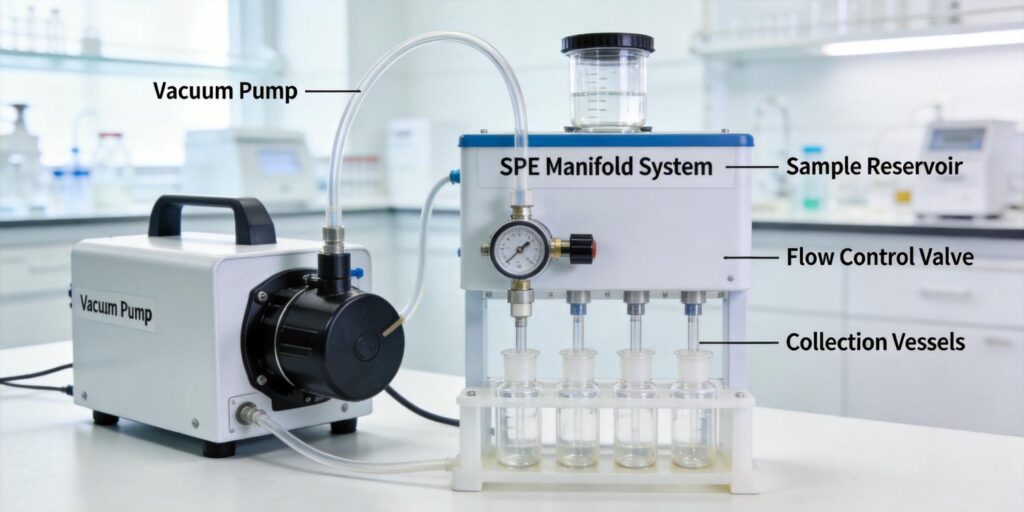
Vacuum manifolds are the most common approach for manual SPE. With vacuum operation, you set a specific vacuum pressure rather than a direct flow rate. The resulting flow rate depends on multiple factors:
- Vacuum pressure setting
- Viscosity of the sample or reagent
- Packing material characteristics
- SPE cartridge format and dimensions
The main limitation of vacuum control is that pressure remains constant while flow rates through the SPE cartridge bed may vary depending on solvent viscosity and cartridge characteristics. For reproducible results, continuous vacuum regulation is essential.
Positive Pressure Systems
Positive pressure operation, provided by piston or syringe systems activated by stepper motors, offers more precise flow control. These systems provide the most stable flow because they use low-compressibility liquid displacement rather than gas pressure. Automated workstations that use pumps or syringes to provide positive pressure displacement offer superior flow rate consistency.
Centrifugation
Centrifugation offers a convenient method for reproducible elution, with capacity limited only by centrifuge size. This method can provide well-defined elution conditions but requires careful optimization of centrifugation parameters.
Gravity Flow
While simple, gravity flow offers the least control and is generally not recommended for critical applications where recovery and reproducibility are paramount.
Experimental Methods for Determining Optimal Flow Rate
Systematic optimization of flow rates is essential for method development. The following experimental approach is recommended:
Flow Rate Screening Studies
Conduct experiments where load or elute rates are systematically varied while keeping all other parameters constant. Observe the relationship between flow rate and percent recovery to determine the fastest flow rate that still yields acceptable recovery. As a general strategy, make large changes to flow rate parameters initially to rapidly evaluate their effect on results.
Mass Balance Approach
Implement a mass balance study where you collect and analyze fractions from each SPE step at different flow rates. This approach provides comprehensive information about where analytes are lost during the extraction process and how flow rate affects each step.
Step-Specific Optimization
Recognize that different steps may require different optimal flow rates. The loading and elution steps are typically most sensitive, but wash steps may also benefit from flow rate optimization, particularly when dealing with difficult-to-remove interferences.
Reproducibility Testing
Once an optimal flow rate range is identified, conduct multiple replicates to ensure consistent performance. Evaluate both intra-day and inter-day variability at the selected flow rates.
Practical Recommendations for Routine Labs
Based on extensive SPE experience and literature, here are practical recommendations for routine laboratory applications:
General Flow Rate Guidelines
For most applications, aim for flow rates of 1-2 mL/min during loading and elution steps. For ion-exchange applications, consider reducing this to 0.5-1.5 mL/min. Always verify these general guidelines with specific method optimization.
Automation Considerations
When implementing automated SPE methods, ensure your workstation can provide different flow rates for each extraction step if needed. Some applications may require different flow rates for conditioning, loading, washing, and elution steps.
Cartridge Quality Impact
Higher quality cartridges with sorbents of narrow particle size ranges and proper bed compression result in less channeling and more reliable stationary phase-mobile phase interactions. These cartridges often tolerate slightly higher flow rates while maintaining good recovery.
Sample-Specific Adjustments
Consider sample viscosity and matrix complexity when setting flow rates. Viscous samples or those with high particulate content may require slower flow rates to prevent cartridge clogging and ensure complete extraction.
Documentation and SOPs
Include specific flow rate parameters in standard operating procedures. Document whether methods specify pressure settings or actual flow rates, as this distinction is crucial for method transfer and troubleshooting.
Example Performance Data
Research data consistently demonstrates the importance of flow rate optimization. In one comprehensive study examining drug recovery from plasma using SPE with HPLC-UV detection:
• Decreasing elution flow rate from 1.5 mL/min to 0.33 mL/min increased recovery from approximately 80% to 95% for basic drugs eluted with ammoniated ethyl acetate
• For automated SPE systems, maintaining low flow rates (0.33 mL/min for 6 minutes) proved challenging manually but was easily achievable with automated systems, resulting in excellent reproducibility with relative standard deviations of less than 5% even for whole blood samples
• Comparative studies between different SPE workstations showed that systems providing more stable flow control (positive pressure displacement with low compressibility) yielded superior recoveries for basic drugs compared to vacuum-based systems
• Method validation studies consistently identify flow rate as a critical parameter requiring careful optimization and control to ensure method robustness and transferability
These findings underscore that while SPE has sometimes been made more difficult than necessary through overemphasis on flow rates, proper flow rate optimization remains essential for achieving maximum recovery and reproducibility. The optimal balance provides adequate contact time for complete analyte-sorbent interaction while maintaining reasonable processing times for laboratory efficiency.
For laboratories seeking reliable SPE products with consistent flow characteristics, Poseidon Scientific’s HLB SPE cartridges, MAX SPE cartridges, MCX SPE cartridges, WAX SPE cartridges, WCX SPE cartridges, and 96-well SPE plates offer excellent performance with consistent packing quality that supports optimal flow rate conditions.