Sources of Phenolic Contaminants in Water
Phenolic compounds represent a significant class of environmental contaminants with diverse industrial and natural origins. These compounds enter aquatic systems through multiple pathways, creating complex monitoring challenges for environmental scientists and regulatory agencies.
Industrial sources constitute the primary anthropogenic contributors to phenolic contamination. Chemical manufacturing facilities, particularly those producing plastics, resins, and synthetic fibers, release substantial quantities of phenols into wastewater streams. The pulp and paper industry represents another major source, where lignin degradation during processing generates various phenolic compounds. Petroleum refineries and coal processing plants discharge phenolic compounds as byproducts of fossil fuel treatment and coking operations.
Agricultural activities contribute significantly through pesticide application. Many herbicides, fungicides, and insecticides contain phenolic structures or degrade to phenolic metabolites. Chlorophenols, in particular, are widely used as wood preservatives and biocides, leading to contamination of surface waters through runoff and leaching.
Municipal wastewater treatment plants receive phenolic compounds from domestic sources, including disinfectants, personal care products, and pharmaceuticals. Incomplete removal during treatment processes results in discharge of residual phenols into receiving waters. Natural sources include decomposition of plant material, which releases simple phenols and tannins into aquatic systems, though these typically occur at lower concentrations than anthropogenic inputs.
The environmental persistence and toxicity of phenolic compounds vary widely depending on their chemical structure. Simple phenols like phenol itself are relatively biodegradable, while chlorinated phenols exhibit greater persistence and bioaccumulation potential. This diversity necessitates comprehensive monitoring approaches that can address compounds across the polarity spectrum.
Analytical Challenges in Detecting Phenols
Environmental analysis of phenolic compounds presents several technical challenges that must be addressed through careful method development. The primary difficulties stem from the compounds’ chemical properties and the complex nature of environmental matrices.
Phenolic compounds span a wide range of polarities, from relatively non-polar alkylphenols to highly polar nitrophenols and chlorophenols. This polarity range complicates extraction method development, as no single approach optimally captures all compounds of interest. Additionally, many phenols exist at trace concentrations (parts-per-trillion to parts-per-billion levels) in environmental waters, necessitating efficient preconcentration techniques.
Matrix interferences represent another significant challenge. Natural organic matter (NOM), particularly humic and fulvic acids, can compete with target analytes for sorption sites during solid-phase extraction. These complex organic matrices also contribute to matrix effects during chromatographic analysis, potentially suppressing or enhancing analyte signals in mass spectrometric detection.
Sample preservation presents practical difficulties, as phenolic compounds are susceptible to photodegradation, oxidation, and microbial degradation. Acidification to pH < 2 is typically required to protonate phenolic hydroxyl groups and prevent degradation, but this must be balanced against potential hydrolysis of conjugated phenols. The presence of particulate matter can adsorb phenolic compounds, leading to underestimation of total concentrations if not properly addressed through sample homogenization or filtration strategies.
Instrumental analysis challenges include the need for derivatization prior to gas chromatography for many polar phenols, adding complexity and potential sources of error. Liquid chromatography methods avoid derivatization but may suffer from poor resolution of structurally similar compounds. Mass spectrometric detection provides specificity but requires careful optimization to address potential isobaric interferences.
Sorbent Selection for Phenolic Compounds
Choosing appropriate solid-phase extraction sorbents is critical for successful phenolic compound analysis. The selection depends on the specific phenolic compounds of interest, their chemical properties, and the sample matrix characteristics.
Polymeric Sorbents
Styrene-divinylbenzene (SDVB) polymers have emerged as particularly effective for phenolic compound extraction. These sorbents offer high surface areas (typically 400-600 m²/g) and excellent retention for a wide range of phenolic compounds. The hydrophobic aromatic backbone interacts with phenolic rings through π-π interactions, while the porous structure provides ample surface area for adsorption. Research indicates that PS-DVB materials provide higher recovery of phenols in water compared to silica-based sorbents, with phenol recoveries >70% and other phenols >90%.
Silica-Based Sorbents
Traditional C18-bonded silica remains useful for less polar phenolic compounds but shows reduced efficiency for highly polar phenols. The limitations stem from residual silanol groups that can cause irreversible adsorption through hydrogen bonding. End-capped C18 phases minimize this effect but may still exhibit reduced capacity for polar compounds. For comprehensive phenolic analysis, silica-based sorbents often require pH adjustment and ion-pairing reagents to achieve satisfactory recoveries.
Mixed-Mode Sorbents
Combination sorbents incorporating both hydrophobic and ion-exchange functionalities offer advantages for phenolic compounds with acidic properties. These materials can retain phenols through both reversed-phase mechanisms and anion exchange when phenols are deprotonated. This dual retention mechanism provides greater flexibility in method development and can improve recovery of acidic phenols across a wider pH range.
Carbon-Based Sorbents
Graphitized carbon black and porous graphitic carbon provide strong retention for phenolic compounds through multiple interaction mechanisms, including hydrophobic, π-π, and electron donor-acceptor interactions. These sorbents excel at retaining highly polar phenolic compounds that may breakthrough from polymeric or silica-based materials. However, they often require strong elution solvents and careful method optimization to achieve quantitative recovery.
Sample pH Adjustment Strategies
pH control represents one of the most critical parameters in phenolic compound extraction, as it directly affects the compounds’ ionization state and thus their interaction with sorbent materials.
For most phenolic compounds, acidification to pH < 2 is recommended to ensure protonation of phenolic hydroxyl groups. This protonation reduces compound polarity and enhances retention on reversed-phase sorbents. Hydrochloric acid is commonly used for this purpose, typically at concentrations of 1-5% (v/v) or using 5N HCl to achieve the desired pH. Acidification also serves to preserve samples by inhibiting microbial degradation and chemical oxidation.
However, certain phenolic compounds require alternative pH strategies. Nitrophenols, for example, may exhibit improved recovery at neutral or slightly acidic pH due to their electron-withdrawing substituents. For comprehensive analyses targeting both neutral and acidic phenols, a sequential extraction approach may be necessary, with initial extraction at low pH followed by a second extraction at higher pH after elution of neutral compounds.
Buffer systems can provide more precise pH control than simple acid addition. Phosphate buffers at various pH values allow systematic investigation of pH effects on recovery. Citrate buffers offer buffering capacity in the acidic range while minimizing potential interference in subsequent analysis. The choice of buffer must consider compatibility with both the extraction sorbent and the analytical instrumentation.
For samples containing both phenolic acids and neutral phenols, pH adjustment to approximately 4-5 can represent a compromise, retaining some capacity for both compound classes while optimizing overall recovery. This approach requires careful validation to ensure all target compounds are adequately recovered.
Washing Solvents to Remove Humic Substances
Natural organic matter, particularly humic and fulvic acids, represents a major interference in phenolic compound analysis. These complex macromolecules can compete with target analytes for sorption sites and cause matrix effects during instrumental analysis. Effective washing strategies are essential for obtaining clean extracts.
Water-Based Washes
Following sample loading, a water wash (typically acidified to match sample pH) removes residual salts and highly polar matrix components. This step is particularly important for samples with high ionic strength or significant dissolved organic carbon content. The volume should be optimized to minimize analyte loss while effectively removing interferences.
Organic-Water Mixtures
Controlled addition of organic solvent to washing solutions can selectively remove humic substances while retaining phenolic compounds. Mixtures containing 5-20% methanol or acetonitrile in water (acidified to sample pH) often provide effective removal of humic interferences without significant analyte loss. The optimal organic percentage depends on the specific phenolic compounds and sorbent material, requiring method-specific optimization.
pH-Adjusted Washes
For mixed-mode sorbents, washing at elevated pH (8-9) can selectively remove humic acids while retaining phenolic compounds through ion-exchange mechanisms. This approach takes advantage of differences in pKa values between target analytes and matrix interferences. Careful pH control is essential to prevent premature elution of phenolic compounds.
Solvent Strength Considerations
The eluotropic strength of washing solvents must be carefully controlled to avoid analyte loss. For reversed-phase sorbents, solvents weaker than the elution solvent but stronger than the loading solvent provide the best compromise between interference removal and analyte retention. Systematic testing of different solvent compositions is recommended during method development.
Research indicates that washing with 0.05N HCl following preconditioning with dichloromethane and methanol can effectively remove interferences while maintaining high phenolic compound recovery. This approach has been successfully applied to environmental water samples containing complex organic matrices.
Elution Methods Compatible with LC-MS or GC-MS
Efficient elution of retained phenolic compounds requires solvents that effectively disrupt analyte-sorbent interactions while maintaining compatibility with subsequent analytical techniques.
GC-MS Compatible Elution
For gas chromatographic analysis, elution solvents must be volatile and compatible with common derivatization procedures. Dichloromethane represents an excellent choice, providing strong elution power for phenolic compounds while evaporating rapidly for concentration. Typical protocols use 9-10 mL dichloromethane, often dried with anhydrous sodium sulfate to remove residual water. Ethyl acetate and acetone are alternatives that offer different selectivity and evaporation characteristics.
Following elution, solvent exchange may be necessary to achieve compatibility with specific derivatization reagents or injection techniques. Common approaches include evaporation under nitrogen stream and reconstitution in appropriate solvents such as hexane, toluene, or derivatization reagents like BSTFA.
LC-MS Compatible Elution
Liquid chromatographic methods benefit from direct compatibility with common mobile phase components. Methanol and acetonitrile, often acidified with formic or acetic acid, provide effective elution while maintaining compatibility with reversed-phase LC conditions. Acidification to 0.1-1% with formic acid improves elution efficiency for phenolic compounds and enhances electrospray ionization in mass spectrometric detection.
For comprehensive phenolic analysis, gradient elution from the SPE cartridge using increasing percentages of organic solvent can fractionate compounds based on polarity. This approach can simplify subsequent chromatographic separation and reduce matrix effects. Typical protocols might use 2-3 mL of elution solvent, though volumes should be optimized based on sorbent mass and analyte characteristics.
Mixed Solvent Systems
Combinations of solvents can provide enhanced elution for challenging phenolic compounds. Methanol:dichloromethane mixtures (e.g., 1:1 or 2:1) offer increased elution strength while maintaining volatility for concentration steps. For particularly strongly retained compounds, addition of small percentages of stronger solvents like acetone or ethyl acetate to primary elution solvents may improve recovery.
pH-Controlled Elution
For mixed-mode sorbents, elution at high pH (using ammonia or ammonium hydroxide in organic solvents) can effectively disrupt ion-exchange interactions. This approach is particularly useful for phenolic acids that may be strongly retained through anionic interactions. Typical protocols use 2-5% ammonium hydroxide in methanol or acetonitrile.
Monitoring Program Example
A comprehensive phenolic compound monitoring program for surface waters incorporates methodical sampling, extraction, and analysis protocols to ensure data quality and regulatory compliance.
Sample Collection and Preservation
The monitoring program begins with careful sample collection using appropriate containers (typically amber glass to prevent photodegradation). Samples are immediately acidified to pH < 2 using hydrochloric acid and stored at 4°C until extraction, typically within 7 days. For large-volume samples (1L standard for trace analysis), homogenization ensures representative aliquoting.
Internal Standard Addition
Deuterated phenolic compounds serve as ideal internal standards, added at the beginning of sample processing to monitor extraction efficiency and matrix effects. Common choices include deuterated phenol, 2,4-dibromophenol, and 2,4,6-tribromophenol added at 10 ppb levels. These compounds experience similar extraction behavior as target analytes while being distinguishable by mass spectrometry.
Extraction Protocol
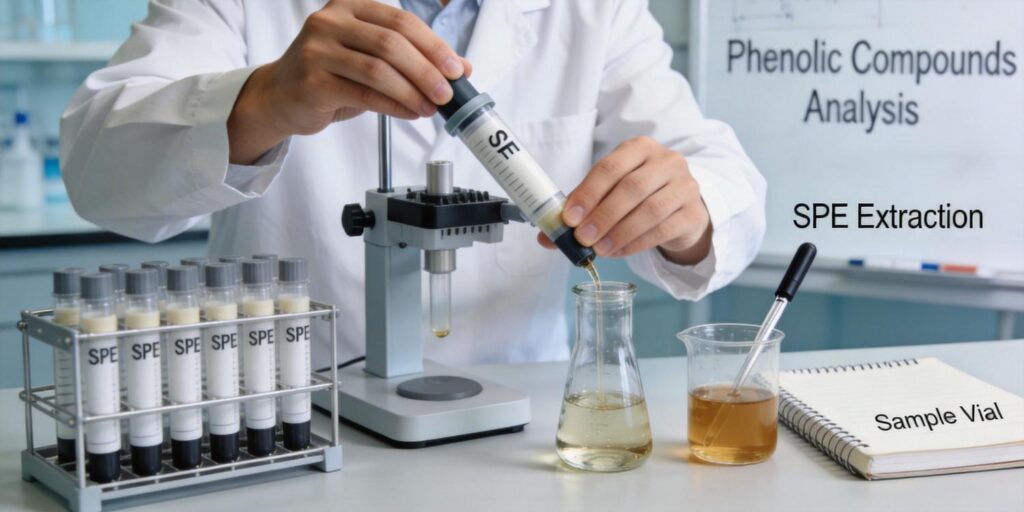
The program employs PS-DVB cartridges (1000 mg, 6 mL) preconditioned with dichloromethane, methanol, and 0.05N HCl. One-liter water samples are loaded at 20-25 mL/min, followed by washing with 0.05N HCl. Elution with 9.0 mL dichloromethane (dried with anhydrous sodium sulfate) provides concentrated extracts. After evaporation under nitrogen stream, extracts are reconstituted in 900 μL dichloromethane with 100 μL of internal standard solution containing 2,5-dibromotoluene and 2,2′,5,5′-tetrabromobiphenyl at 0.05 mg/mL.
Quality Control Measures
The program incorporates method blanks, laboratory control samples, matrix spikes, and duplicate analyses to assess method performance. Continuing calibration verification standards ensure instrumental response stability. Detection limits are established through analysis of low-level fortified samples, typically achieving 10-50 ng/L for most phenolic compounds.
Data Interpretation and Reporting
Results are reported with appropriate qualifiers indicating data quality. Concentrations are corrected based on internal standard response and recovery from laboratory control samples. Statistical analysis identifies trends and potential contamination sources, supporting regulatory decision-making and environmental management.
This comprehensive approach ensures reliable detection of phenolic compounds across the concentration range of regulatory concern, providing valuable data for environmental protection and public health assessment.
For laboratories seeking reliable SPE products for phenolic compound analysis, Poseidon Scientific offers a comprehensive range of HLB SPE cartridges, MAX SPE cartridges, and MCX SPE cartridges suitable for various phenolic compound applications. Our 96-well SPE plates provide high-throughput capabilities for monitoring programs requiring analysis of large sample numbers.