The Complexity of Natural Product Extracts
Natural product extracts represent one of the most challenging matrices in analytical chemistry, containing thousands of compounds spanning an enormous range of polarities, molecular weights, and chemical functionalities. These complex mixtures typically include pigments, lipids, carbohydrates, proteins, and diverse secondary metabolites that can interfere with downstream analysis. The high variability in plant composition based on species, growing conditions, and extraction methods further complicates purification strategies. Traditional liquid-liquid extraction methods often prove inadequate for these complex matrices, leading to poor recoveries and significant matrix effects in subsequent analytical techniques.
Removing Pigments and Lipids Using SPE
Solid-phase extraction provides an efficient solution for removing problematic pigments and lipids from natural product extracts. Pigments such as chlorophylls, carotenoids, and anthocyanins can cause significant interference in chromatographic analysis and mass spectrometry detection. Research demonstrates that SPE techniques can effectively eliminate these compounds while preserving target metabolites. For instance, Tsuji et al. (1995) utilized zinc acetate to coagulate fats in acetonitrile extracts of fruits and vegetables, allowing subsequent C18 SPE processing to remove both lipids and pigments effectively.
Lipid removal presents particular challenges due to their diverse chemical nature and tendency to foul analytical equipment. The high lipid content in many plant extracts can degrade HPLC column performance and suppress ionization in LC-MS analysis. SPE offers selective removal through careful sorbent selection and solvent optimization. Studies show that silica, C1, and C2 sorbents provide excellent de-fatting capabilities for plant extracts, while specialized approaches like the Kaluzny method using aminopropyl (NH2) sorbents can separate lipid classes with high efficiency and purity.
Sorbent Selection for Diverse Metabolites
Choosing the appropriate SPE sorbent is critical for successful natural product purification. The diversity of metabolites in plant extracts requires careful consideration of sorbent chemistry and retention mechanisms:
Reversed-Phase Sorbents
C18 and C8 bonded phases remain workhorse sorbents for natural product purification, particularly for medium to non-polar compounds. These sorbents effectively retain flavonoids, terpenoids, and alkaloids while allowing polar interferences to pass through. Research by Buszewski et al. (1992, 1993) demonstrated successful extraction of bioflavonoids like rutin using various reversed-phase sorbents.
Mixed-Mode and Polymeric Sorbents
Hydrophilic-lipophilic balanced (HLB) polymers and mixed-mode sorbents offer superior performance for complex natural product matrices. These sorbents provide both reversed-phase and ion-exchange capabilities, allowing retention of compounds across a wide polarity range. The development of universal sorbents like Oasis HLB has revolutionized natural product purification by offering high recovery for many analytes with simple methodology.
Ion-Exchange Sorbents
Strong cation exchange (SCX) and strong anion exchange (SAX) sorbents are essential for purifying charged metabolites. These sorbents enable selective retention of acidic compounds like phenolic acids or basic compounds like alkaloids. Glowniak et al. (1996) successfully extracted phenolic acids from Echinacea species using C18 followed by quaternary ammonium sorbents.
Specialized Sorbents
For specific applications, specialized sorbents provide unique advantages. Diol phases effectively retain neutral or acidic drugs of varying polarity, while phenylboronic acid (PBA) sorbents can capture compounds with diol moieties through boronate ester formation.
Example Workflow for Plant-Derived Compounds
A comprehensive SPE workflow for plant-derived compounds typically follows these optimized steps:
Sample Preparation
Begin with appropriate extraction of plant material using solvents compatible with subsequent SPE. Methanol or methanol-water mixtures often provide good extraction efficiency while maintaining analyte stability. Filter or centrifuge extracts to remove particulate matter before SPE processing.
SPE Cartridge Conditioning
Condition the selected sorbent with methanol or acetonitrile followed by water or appropriate buffer. This step activates the sorbent surface and ensures consistent retention characteristics.
Sample Loading
Load the prepared extract onto the conditioned cartridge at controlled flow rates (typically 1-3 drops per second). For complex matrices, consider pH adjustment to optimize retention of ionizable compounds.
Wash Steps
Remove interfering compounds using carefully optimized wash solvents. Water or low-percentage organic washes typically remove polar interferences, while intermediate-strength solvents can eliminate moderately retained matrix components without eluting target analytes.
Elution
Elute target compounds using the minimum volume of appropriate solvent. For reversed-phase sorbents, methanol or acetonitrile often provides efficient elution. For ion-exchange sorbents, pH adjustment or ionic strength modification facilitates elution.
Example: Flavonoid Purification
For flavonoid purification from plant extracts, a C18 sorbent conditioned with methanol followed by water provides excellent results. After loading the aqueous extract, wash with 20% methanol to remove sugars and polar acids, then elute flavonoids with 80% methanol. This simple protocol yields purified flavonoids suitable for LC-MS analysis.
LC-MS Profiling of Purified Extracts
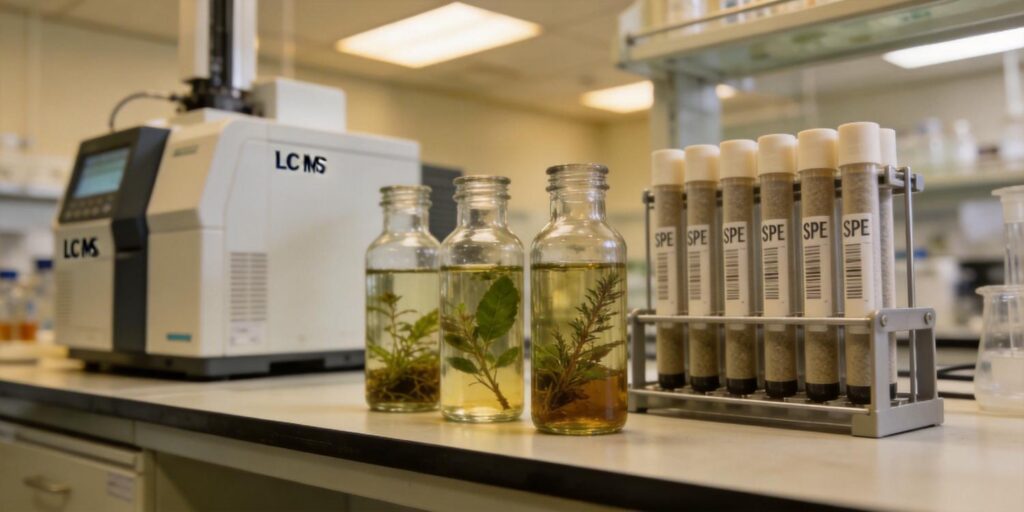
The combination of SPE purification with LC-MS analysis represents a powerful approach for natural product profiling. SPE clean-up significantly enhances LC-MS performance by removing matrix components that can suppress ionization or cause instrument fouling. Research demonstrates that SPE-LC-MS enables detection of ultra-trace level compounds in complex natural product matrices.
Key advantages of SPE-purified extracts for LC-MS include:
Reduced Ion Suppression
By removing co-extracted compounds that compete for ionization, SPE improves signal intensity and detection limits for target metabolites. This is particularly important for atmospheric pressure ionization techniques like electrospray ionization.
Extended Instrument Uptime
SPE removes compounds that can foul LC-MS interfaces and ion sources, reducing maintenance requirements and improving data quality consistency.
Enhanced Chromatographic Performance
Purified extracts yield cleaner chromatograms with better peak shape and resolution, facilitating metabolite identification and quantification.
Concentration Capability
SPE enables concentration of dilute extracts, improving detection of low-abundance metabolites that might otherwise go undetected.
Applications in Pharmaceutical Discovery
SPE purification plays a crucial role in pharmaceutical discovery from natural products, enabling efficient isolation of bioactive compounds for screening and development:
Bioassay-Guided Fractionation
SPE facilitates rapid fractionation of crude extracts for biological testing. The ability to generate multiple fractions with distinct chemical characteristics accelerates the identification of bioactive constituents.
Metabolite Profiling
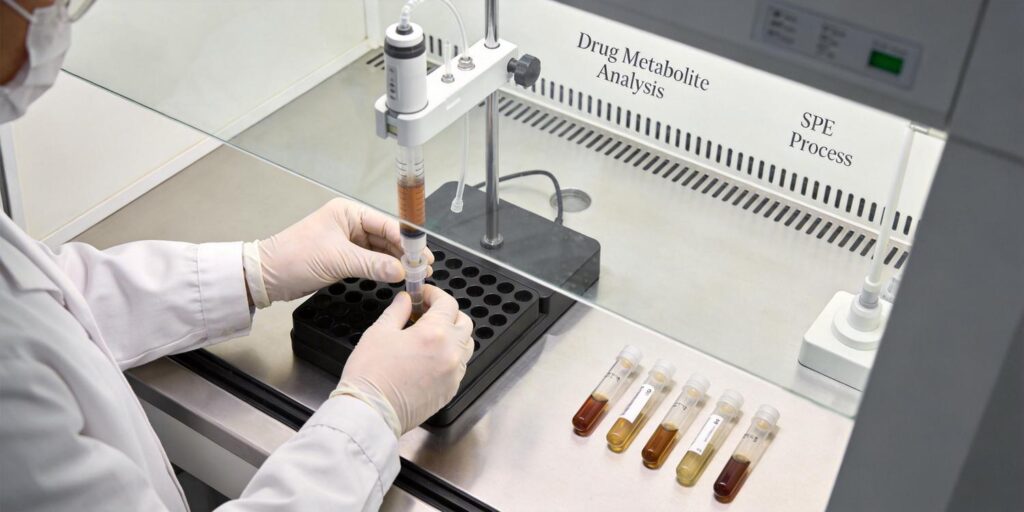
In drug metabolism studies, SPE enables isolation of drug metabolites from complex biological matrices, supporting pharmacokinetic and toxicological evaluations.
Natural Product Drug Development
From initial discovery through development, SPE supports purification of lead compounds for structural elucidation, bioactivity testing, and formulation development. The technique’s scalability makes it suitable for both analytical and preparative applications.
Quality Control of Herbal Preparations
SPE enables standardized purification of marker compounds from herbal preparations, supporting quality control and standardization efforts in traditional medicine and nutraceutical development.
The continued evolution of SPE technology, including 96-well plate formats and automated systems, further enhances its utility in high-throughput natural product screening and pharmaceutical development workflows. By providing efficient, reproducible purification of complex natural product extracts, SPE remains an indispensable tool in the search for new therapeutic agents from nature.