Importance of Biomarkers in Clinical Diagnostics
Clinical biomarkers have revolutionized modern medicine by providing objective, measurable indicators of biological processes, pathological states, or pharmacological responses to therapeutic interventions. These molecular signatures serve as critical tools for early disease detection, prognosis assessment, treatment monitoring, and therapeutic efficacy evaluation. The clinical utility of biomarkers spans across numerous medical specialties, including oncology, cardiology, neurology, and metabolic disorders.
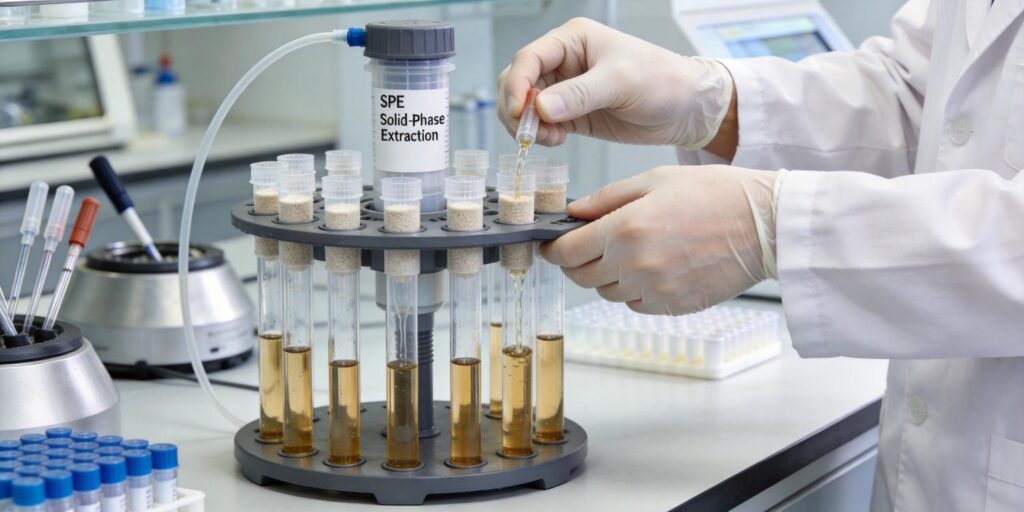
Solid-phase extraction (SPE) plays a pivotal role in biomarker analysis by enabling the selective isolation and concentration of target analytes from complex biological matrices. As noted in SPE literature, “Solid-phase extraction is widely used for the preparation of biological samples for further analysis in areas as diverse as clinical chemistry, forensic science, and biomedical and pharmaceutical research” (Ingwersen, 2000). The technique’s popularity stems from its ability to achieve high selectivities and recoveries while minimizing hazardous solvent consumption.
Biological Sample Matrices: Plasma and Urine
Plasma Sample Considerations
Plasma represents one of the most commonly analyzed biological matrices for biomarker discovery and validation. Its composition includes proteins, lipids, electrolytes, and various endogenous compounds that can interfere with analytical measurements. SPE extraction of plasma serves multiple objectives: concentration, clean-up, prevention of analytical column clogging, and elimination of protein binding (Ingwersen, 2000).
Modern drug candidates and biomarkers often exist at low concentrations in plasma, necessitating highly sensitive assays. As described in SPE methodology development, “assay sensitivity is a major goal of pharmacokinetic studies; sensitivity must be high enough to allow estimation of the terminal plasma half-life in vivo. In order to obtain such sensitivities, clean plasma extracts are essential” (Ingwersen, 2000).
Urine Sample Characteristics
Urine offers distinct advantages for biomarker analysis, including non-invasive collection and relatively lower protein content compared to plasma. However, urine contains high concentrations of salts, urea, and other endogenous compounds that require effective removal during sample preparation. SPE procedures for urine must address matrix background and endogenous compounds while maintaining high recovery of target biomarkers.
Research demonstrates successful SPE applications for urine analysis, including comprehensive screening procedures for stimulants, narcotics, adrenergic drugs and their metabolites (Solans et al., 1995), as well as methods for acidic, neutral, and basic drugs in urine using HPLC with photodiode array detection (Lai et al., 1997).
SPE Sorbent Options for Biomarker Extraction
Mixed-Mode Sorbents
Mixed-mode sorbents combining hydrophobic and ion-exchange interactions have proven particularly effective for biomarker extraction. These sorbents provide multiple retention mechanisms, allowing selective extraction of compounds with diverse physicochemical properties. As demonstrated in toxicological analysis, “the strategy of a mixed-mode cartridge providing hydrophobic and cation exchange interactions, combined with a pH-dependent sample application and extraction, can give high recoveries of analytes from plasma, urine, whole blood, and tissues” (de Zeeuw & Franke, 2000).
Specialized Sorbents for Specific Applications
Various SPE sorbents offer tailored selectivity for different biomarker classes:
- HLB (Hydrophilic-Lipophilic Balanced): Ideal for broad-spectrum extraction of compounds with diverse polarities
- MAX (Mixed-mode Anion Exchange): Excellent for acidic compounds and their metabolites
- MCX (Mixed-mode Cation Exchange): Optimal for basic compounds and their metabolites
- WAX (Weak Anion Exchange): Suitable for strong acids and highly polar compounds
- WCX (Weak Cation Exchange): Effective for strong bases and zwitterionic compounds
These sorbents are available in various formats, including traditional cartridges and 96-well plates for high-throughput applications.
Covalent Interaction Sorbents
Immobilized phenylboronic acid (PBA) represents a specialized sorbent class that forms covalent bonds with specific functional groups. This approach offers exceptional selectivity for compounds containing cis-diol groups, including catecholamines, glycosylated compounds, and certain metabolites. As Wilson and Martin (2000) describe, “covalent bond formation provides highly selective extraction mechanisms that complement traditional SPE approaches.”
Example Workflow for Metabolite Biomarkers
Sample Preparation Protocol
A comprehensive metabolite biomarker workflow typically involves the following steps:
- Sample Collection and Storage: Proper collection in appropriate containers with necessary preservatives
- Sample Pretreatment: Protein precipitation, centrifugation, and pH adjustment
- SPE Cartridge Conditioning: Sequential conditioning with appropriate solvents
- Sample Loading: Application of pretreated sample at controlled flow rates
- Washing Steps: Removal of interfering matrix components
- Elution: Selective recovery of target metabolites
- Concentration and Reconstitution: Preparation for analytical detection
Method Development Considerations
Effective SPE method development for metabolite biomarkers requires systematic optimization of several parameters:
- pH Optimization: Controlling ionization states for optimal retention and selectivity
- Solvent Selection: Choosing appropriate conditioning, washing, and elution solvents
- Flow Rate Control: Maintaining optimal contact time for efficient extraction
- Cartridge Capacity Matching: Selecting appropriate sorbent mass for expected analyte load
As described in SPE methodology, “a rational approach to the development of solid phase extraction methods for drugs in biological matrices” involves systematic screening of sorbents and pH values, followed by optimization of washing and elution procedures (Simmonds et al., 1994).
LC-MS Detection Strategies
Liquid Chromatography Separation
Following SPE extraction, liquid chromatography provides critical separation of metabolite biomarkers prior to mass spectrometric detection. Various chromatographic approaches offer complementary selectivity:
- Reversed-Phase Chromatography: Most common approach for metabolite separation
- Hydrophilic Interaction Chromatography (HILIC): Excellent for polar metabolites
- Ion-Pair Chromatography: Useful for ionic compounds requiring enhanced retention
- Chiral Chromatography: Essential for enantiomeric metabolite separation
Mass Spectrometric Detection
Modern LC-MS systems offer multiple detection strategies for metabolite biomarker analysis:
- Triple Quadrupole MS/MS: Gold standard for targeted quantification with multiple reaction monitoring (MRM)
- High-Resolution Mass Spectrometry: Orbitrap and Q-TOF instruments for untargeted metabolomics
- Ion Mobility Separation: Additional dimension of separation for complex samples
- Data-Dependent Acquisition: Automated MS/MS for metabolite identification
The combination of effective SPE sample preparation with advanced LC-MS detection enables sensitive and specific biomarker quantification across wide dynamic ranges.
Method Validation Considerations
Key Validation Parameters
Comprehensive method validation ensures reliable biomarker quantification and includes assessment of:
- Selectivity/Specificity: Demonstration of interference-free analysis
- Linearity: Assessment of calibration curve performance across relevant concentration ranges
- Accuracy and Precision: Evaluation of systematic and random errors
- Recovery: Determination of extraction efficiency
- Matrix Effects: Assessment of ionization suppression or enhancement
- Stability: Evaluation of analyte stability under various storage and processing conditions
Quality Control Implementation
Robust biomarker assays incorporate comprehensive quality control measures:
- Internal Standards: Stable isotope-labeled analogs for compensation of extraction and ionization variability
- Quality Control Samples: Low, medium, and high concentration QCs for ongoing method performance monitoring
- System Suitability Tests: Regular assessment of instrument performance
- Batch Acceptance Criteria: Defined limits for accuracy and precision
Regulatory Considerations
Biomarker assays intended for clinical applications must adhere to relevant regulatory guidelines, including:
- FDA Guidance Documents: Requirements for bioanalytical method validation
- CLIA Regulations: Clinical laboratory improvement amendments
- ISO Standards: Quality management system requirements
- CAP Accreditation: College of American Pathologists standards
Proper validation ensures that biomarker assays provide reliable data for clinical decision-making and regulatory submissions.
Future Directions
The field of biomarker analysis continues to evolve with emerging technologies and approaches. Future developments likely include:
- Miniaturized SPE Formats: Reduced sample and solvent consumption
- Automated SPE Platforms: Increased throughput and reproducibility
- Integrated Sample Preparation: Seamless connection to analytical systems
- Novel Sorbent Materials: Enhanced selectivity for challenging biomarkers
- Multi-omics Integration: Combined analysis of metabolites, proteins, and lipids
As SPE technology advances, it will continue to play a critical role in enabling sensitive, specific, and reliable biomarker analysis for clinical diagnostics and therapeutic monitoring.
For more information about SPE products and applications, visit our HLB SPE Cartridges, MAX SPE Cartridges, MCX SPE Cartridges, WAX SPE Cartridges, WCX SPE Cartridges, and 96-Well SPE Plate product pages.