In high- and ultrahigh-vacuum systems, reliable pressure measurement below 10-3 Torr often depends on cold cathode ionization gauges. Unlike hot-cathode designs that rely on thermionic emission, cold cathode gauges generate ions through a self-sustaining gas discharge initiated by high voltage. At Poseidon Scientific, our VG-SM225 Cold Cathode Vacuum Transmitter embodies this principle in a compact, cost-effective package optimized for mass spectrometers, scanning electron microscopes, and vacuum heat-treatment furnaces.
Understanding the ignition mechanism—the process by which the gauge transitions from an inactive state to a stable plasma discharge—is essential for engineers and procurement specialists. Proper awareness of ignition dynamics helps ensure consistent startup, prevents unnecessary downtime, and extends gauge lifetime. This article explains the physics step by step, grounded in the Penning discharge principle that powers the VG-SM225, while highlighting practical implications for system design and operation.
High Voltage Discharge Principle
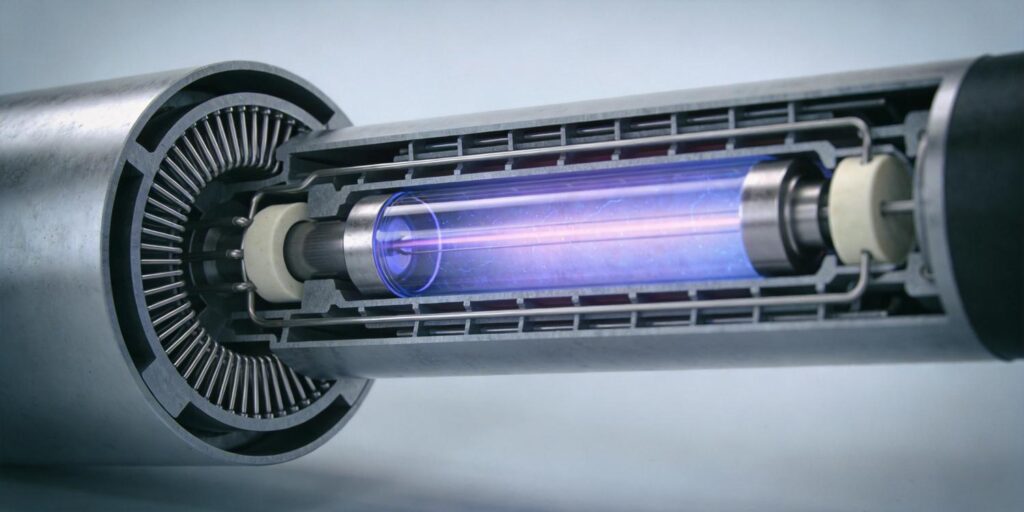
The VG-SM225 operates on the classic Penning discharge, a low-pressure gas discharge sustained by crossed electric and magnetic fields. A high negative voltage (startup at -2500 V, operating at -2000 V) is applied between the cylindrical anode and the central cathode assembly. This strong electric field extracts initial electrons from the cathode surface through field emission, especially at microscopic surface irregularities or sharp edges.
Once freed, these electrons accelerate toward the anode but are prevented from reaching it directly by the axial magnetic field (approximately 100 gauss from NdFeB permanent magnets). Instead, the Lorentz force causes the electrons to follow long, helical or cycloidal trajectories, dramatically increasing their path length within the discharge volume. This extended residence time dramatically raises the probability of ionizing collisions with residual gas molecules.
The result is a measurable ion current collected at the cathode. Because the discharge is self-sustaining, the gauge requires no hot filament—eliminating outgassing, filament burnout, and sensitivity to reactive gases such as hydrogen. This inherent robustness makes cold cathode gauges ideal for the 10-3 to 10-7 Torr range where our VG-SM225 is specified.
Electron Avalanche Formation
The transition from a few seed electrons to a stable discharge current occurs through a classic electron avalanche (Townsend avalanche). An initial electron, accelerated by the electric field, gains sufficient kinetic energy to ionize a gas molecule upon collision, releasing a secondary electron and a positive ion. Both the primary and secondary electrons are trapped by the magnetic field and continue to ionize additional molecules, creating an exponential multiplication of charge carriers.
This avalanche builds rapidly until space-charge effects limit further growth, establishing a steady-state plasma. The positive ions are accelerated toward the cathode, where they bombard the surface and liberate additional secondary electrons—further sustaining the discharge. In the VG-SM225, the “工”-shaped electrode geometry and star-shaped discharge plates optimize this avalanche process while maintaining a compact sensor volume.
The avalanche mechanism explains why cold cathode gauges exhibit high sensitivity (ion current proportional to pressure) yet require careful voltage management. At the design voltage of -2000 V, the avalanche is stable across the operating range; deviations can delay ignition or cause current discontinuities.
The Role of Magnetic Field
The magnetic field is the enabling element of the Penning discharge. Without it, electrons would travel straight to the anode in microseconds, producing negligible ionization. With the ~100 gauss axial field in the VG-SM225, electrons execute cycloidal motion with a radius determined by the E × B drift. This confines electrons to the annular region between cathode and anode (electrode spacing ~2 mm), extending their effective path length by orders of magnitude.
Stronger magnetic fields generally lower the ignition threshold and improve low-pressure performance, but they also increase sensor size and stray-field concerns. Our positive-magnetron (traditional Penning) design strikes an optimal balance: sufficiently strong confinement for reliable ignition down to 10-7 Torr while keeping the overall package smaller than most inverted-magnetron competitors. The permanent magnet assembly is fully integrated, eliminating the need for external magnets in most installations.
Pressure-Dependent Ignition Threshold
Ignition difficulty scales inversely with pressure. At higher pressures (poorer vacuum, above 10-3 Torr), abundant gas molecules enable rapid avalanche formation, but excessive collisions actually reduce net ion current and promote contamination through sputtering and carbon deposition. The VG-SM225 therefore incorporates automatic high-voltage shutdown above 10-3 Torr to protect the electrodes.
Conversely, at high vacuum (10-6 Torr and below), sparse molecules make it harder for electrons to find collision partners. Ignition may require several minutes—or even tens of minutes at 10-7 Torr—until a statistically lucky sequence of ionizing events triggers the avalanche. This is the fundamental physics behind the well-known “startup delay” of cold cathode gauges. Our firmware mitigates this by applying the full -2500 V startup voltage for a controlled period before stepping down to the -2000 V operating level, reliably reducing ignition time without overstressing components.
Plasma Stabilization
Once ignited, the discharge stabilizes when the ion production rate balances losses. Positive ions bombard the cathode, releasing secondary electrons that replenish the trapped electron population. The resulting space-charge cloud further shapes the electric field, creating a self-regulating equilibrium. In the VG-SM225, the perforated anode and optimized geometry ensure uniform plasma density, minimizing current fluctuations and improving measurement repeatability.
Long-term stability also depends on electrode cleanliness. Contamination from process gases can raise the ignition threshold or shift the current-pressure curve. The VG-SM225 features a fully removable sensor head, allowing simple field maintenance: light sanding of the electrodes with 200- or 500-grit paper restores metal luster and performance in minutes.
Safety Precautions
Operating a cold cathode gauge involves high voltage and a strong magnetic field, both of which demand respect. The VG-SM225 transmitter includes multiple layers of protection:
- Software interlock that disables high voltage above 10-3 Torr;
- Hardware current limiting and over-voltage shutdown;
- Visual status indicators (flashing light when high voltage is off due to over-pressure protection);
- Isolated RJ45 interface that keeps the user-side electronics at safe ground potential.
Installation guidelines emphasize keeping the gauge at least 10 cm from personnel and sensitive electronics to avoid magnetic interference. Operators should never attempt to open the housing while powered, and any maintenance must follow the detailed procedure in the user manual. These safeguards, combined with the gauge’s inherent fail-safe design, make the VG-SM225 suitable for both laboratory and industrial environments.
Startup Delay Considerations
Startup delay is the most frequently discussed operational characteristic of cold cathode gauges. In clean systems typical of mass spectrometry, the VG-SM225 typically ignites within 5 minutes at 10-6 Torr and 30 minutes at 10-7 Torr. These times are consistent with industry benchmarks for positive-magnetron designs and are significantly improved by the elevated startup voltage protocol.
Engineers designing automated vacuum systems should account for this delay in interlock logic. For applications requiring faster readiness, consider pairing the VG-SM225 with our VG-SP205 Pirani transmitter for seamless crossover at 10-3 Torr; the Pirani provides instant rough-vacuum data while the cold cathode stabilizes. Custom firmware options can also adjust startup voltage timing for specific chamber volumes or gas compositions.
Field data from early adopters confirm that proper system preconditioning (mild bake-out and clean electrodes) reduces average ignition time by 40–60 %. Contaminated gauges, by contrast, may exhibit intermittent ignition or permanent failure to start—underscoring the importance of scheduled maintenance.
Practical Benefits and System Integration
The ignition mechanism of the VG-SM225 directly translates into measurable user advantages: lower cost of ownership, smaller footprint than traditional cold cathode gauges, and full RS-232 protocol customization (minimum order 5–10 units). The gauge’s 0–10 V analog output (effective 2–8 V) integrates easily with PLCs and data-logging systems, while the digital interface allows real-time monitoring of both pressure and internal status flags.
Compared with hot-cathode alternatives, the cold cathode design eliminates filament-related failures and reactive-gas decomposition. Compared with competing cold cathode products, the VG-SM225 offers superior maintainability and a price point that fits tight OEM budgets without sacrificing reliability.
For engineers specifying vacuum instrumentation, the ignition physics described above are not abstract theory—they determine whether a gauge will start reliably every cycle, how much operator intervention is required, and ultimately how much system uptime you can expect.
Ready to discuss your specific application? Our engineering team welcomes technical discussions on ignition behavior, protocol customization, or system-level integration. Download the latest VG-SM225 Cold Cathode Vacuum Gauge datasheet or reach out directly to explore how Poseidon Scientific’s vacuum measurement solutions can optimize your next project. Whether you need standard units or a tailored configuration, we are here to help you achieve stable, repeatable high-vacuum performance.