
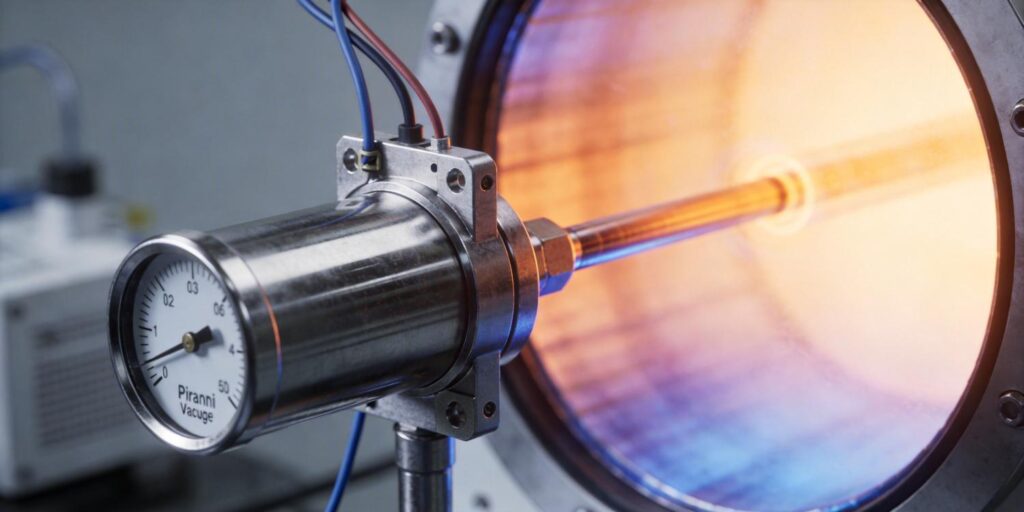
In vacuum systems ranging from scientific instruments to industrial processes, accurate pressure measurement is critical for process control, equipment protection, and product quality. The Pirani vacuum gauge remains one of the most widely used solutions for the rough-to-medium vacuum range (atmosphere down to approximately 10-3 Torr). At Poseidon Scientific, our VG-SP205 Pirani Vacuum Transmitter was engineered specifically to address the real-world demands of compactness, cost-effectiveness, and reliability in applications such as mass spectrometers and vacuum heat-treatment furnaces.
Yet even the most robust Pirani gauge is sensitive to environmental conditions—particularly temperature. This article examines how temperature influences Pirani gauge accuracy, drawing on fundamental thermal-conductivity principles, real-world performance data from our VG-SP205, and proven engineering practices. Whether you are an engineer optimizing a new system or a procurement specialist evaluating long-term reliability, understanding these effects will help you achieve stable, repeatable vacuum measurements.
Operating Principle of Pirani Gauges: Thermal Conductivity
The VG-SP205, like all Pirani gauges, relies on the principle of gas thermal conductivity. A thin platinum filament is resistively heated and maintained at a constant temperature (typically 100–150 °C above ambient) by a precision feedback circuit. Gas molecules colliding with the filament transfer heat away from it. The rate of heat loss is directly proportional to the number density of gas molecules—i.e., the pressure—in the operating range of roughly 10 Torr to 10-2 Torr.
At higher pressures (poorer vacuum), more frequent molecular collisions increase heat loss, requiring greater electrical power to keep the filament temperature stable. At lower pressures (higher vacuum), fewer collisions reduce heat loss, so less power is needed. The gauge measures this power (via voltage or current) and converts it to a pressure reading using a factory-calibrated curve. Outside the linear region—near atmosphere or below 10-2 Torr—the response becomes nonlinear, with errors that can reach ±50 % if unaddressed.
Our choice of platinum filament is deliberate: it offers a high temperature coefficient of resistance, excellent chemical stability against contamination, and consistent manufacturability. These material advantages, combined with the compact 316L stainless-steel body of the VG-SP205, deliver a robust sensor that fits tight instrument envelopes while maintaining a 3–5 year service life under typical conditions.
Influence of Ambient Temperature on Gauge Accuracy
Ambient temperature directly affects the baseline heat-transfer characteristics of the filament and the surrounding gas. A change in ambient temperature alters the temperature gradient between the filament and the gas, shifting the power required to maintain constant filament temperature. This manifests as “temperature drift” (温漂), one of the primary error sources in Pirani gauges.
The VG-SP205 is specified for reliable operation between 15 °C and 50 °C. Within this window, our dual compensation (hardware circuit + embedded algorithm) keeps drift below 5 % of reading. Outside this range, thermal effects become dominant: the gas thermal conductivity itself changes, the filament resistance-temperature relationship deviates from calibration, and mechanical expansion of the sensor body can introduce micro-shifts in geometry. Errors can quickly exceed 20–30 % and become unpredictable.
In practice, a 10 °C rise in ambient temperature without compensation can shift the indicated pressure by 8–12 % in the 1–10 Torr linear region. For mass-spectrometer users monitoring foreline pressure, such drift can trigger false alarms or compromise ion-source stability.
Gas Composition Impact on Measurement Accuracy
Pirani gauges are inherently gas-species dependent because different gases conduct heat at different rates. Nitrogen and air serve as the reference calibration gases for the VG-SP205. Helium, with roughly seven times the thermal conductivity of air, produces a higher indicated pressure for the same true pressure. Conversely, argon or heavier gases read lower.
In mixed-process environments—common in vacuum heat treatment or residual-gas analysis—unaccounted composition changes can introduce systematic offsets. Our current firmware assumes air/N₂; for applications with known process gases, Poseidon offers custom calibration curves at volumes as low as five units. This flexibility is a key differentiator from imported competitors whose protocols are often fixed.
Compensation Techniques Employed in the VG-SP205
Effective temperature compensation is not an afterthought—it is core to the VG-SP205 design. A dedicated NTC thermistor monitors housing temperature in real time. The embedded microcontroller applies a multi-point correction algorithm derived from extensive thermal-chamber testing. This algorithm adjusts both the filament drive power and the final pressure calculation, effectively flattening the temperature-response curve across the full 15–50 °C operating band.
Additional safeguards include:
- Digital filtering to suppress short-term thermal transients;
- Automatic zeroing at atmospheric pressure during power-up;
- RS-232 (customizable) output that transmits both compensated pressure and raw temperature data for system-level monitoring.
These techniques reduce temperature-induced error to less than ±3 % of reading under steady-state conditions—performance that rivals far more expensive instruments while keeping the unit price competitive.
Installation Best Practices: Keeping Away from Heat Sources
Even the best compensation has limits. The single most effective way to minimize temperature effects is to install the gauge where ambient conditions remain stable. Key recommendations:
Physical Placement
Mount the VG-SP205 at least 15 cm away from hot surfaces—turbomolecular pump housings, heater bands, or chamber walls that cycle above 60 °C. Use short, thermally insulated KF16/KF25 nipples when space is constrained.
Orientation and Shielding
The gauge can be mounted in any orientation, but avoid direct exposure to radiant heat or cooling air streams. A simple radiation shield or thermal baffle can reduce local gradients by 5–8 °C.
Electrical and Environmental Considerations
Route cables away from high-current heaters. Maintain the specified 15–50 °C envelope around the entire transmitter body. In OEM designs, we frequently integrate passive cooling fins or locate the gauge on a separate diagnostic port to isolate it from process heat.
Following these guidelines typically reduces observed drift by an additional 40–60 % beyond internal compensation alone.
Calibration Under Actual Operating Conditions
Factory calibration of the VG-SP205 is performed in a controlled air/N₂ atmosphere at 25 °C. For highest accuracy in the field, we recommend a single-point or multi-point verification under the user’s actual temperature and gas composition. Poseidon offers on-site or return-to-factory calibration services using NIST-traceable transfer standards.
Because the gauge is not user-adjustable, the most practical approach is to log the compensated output against a reference gauge (e.g., a capacitance manometer) at two or three known pressures within the linear region while the system is at operating temperature. This data can be used to apply a simple linear offset in the host controller if needed.
Real-World Example: Data Comparison With and Without Temperature Compensation
During internal validation of the VG-SP205, we subjected ten production units to a thermal cycle from 15 °C to 50 °C while maintaining a fixed true pressure of 1.0 Torr (air). Without compensation, the average indicated pressure varied from 0.82 Torr at 15 °C to 1.18 Torr at 50 °C—a ±18 % span. With the full compensation algorithm active, the same units stayed within 0.97–1.03 Torr (±3 %).
In a customer mass-spectrometer application, a similar test showed that proper installation (isolated from the 80 °C turbo pump) plus compensation reduced foreline pressure drift from 12 % to under 2 % over a 24-hour bake-out cycle. The result: fewer false trips of the interlock system and improved ion-source lifetime.
These data illustrate why temperature management is not optional—it directly translates into system uptime and measurement confidence.
Why Temperature Management Matters for Your Vacuum System
In today’s competitive landscape, engineers and procurement teams demand more than just a low purchase price. They need instruments that deliver repeatable performance with minimal maintenance and integration effort. The VG-SP205 Pirani Vacuum Transmitter meets these needs through thoughtful design: platinum filament, dual compensation, compact footprint, and fully customizable digital protocols (5–10 unit minimum).
By understanding and controlling temperature effects, users can extend the useful range of the gauge, reduce calibration frequency, and protect downstream components such as turbomolecular pumps or mass-spectrometer ion sources.
For complete specifications, dimensional drawings, and communication-protocol customization options, download the latest technical datasheet for the VG-SP205 Pirani Vacuum Transmitter. Our applications team is also available to review your system layout and recommend optimal installation practices.
At Poseidon Scientific, we continue to refine our vacuum-gauge portfolio—pairing the VG-SP205 with our VG-SM225 Cold Cathode Gauge—to deliver seamless coverage from atmosphere to 10-7 Torr at the lowest total cost of ownership.
Ready to optimize your vacuum measurement chain? Request your copy of the VG-SP205 datasheet today and discover how precise, temperature-stable Pirani gauging can improve your process reliability.


