Wastewater Epidemiology Overview
Wastewater epidemiology has emerged as a powerful public health tool that provides near real-time data on community-level drug consumption patterns. This innovative approach involves analyzing municipal wastewater for chemical biomarkers of illicit drug use, offering an objective, population-scale assessment that complements traditional survey methods. The technique traces its origins to environmental monitoring but has evolved into a sophisticated surveillance system used by public health agencies worldwide.
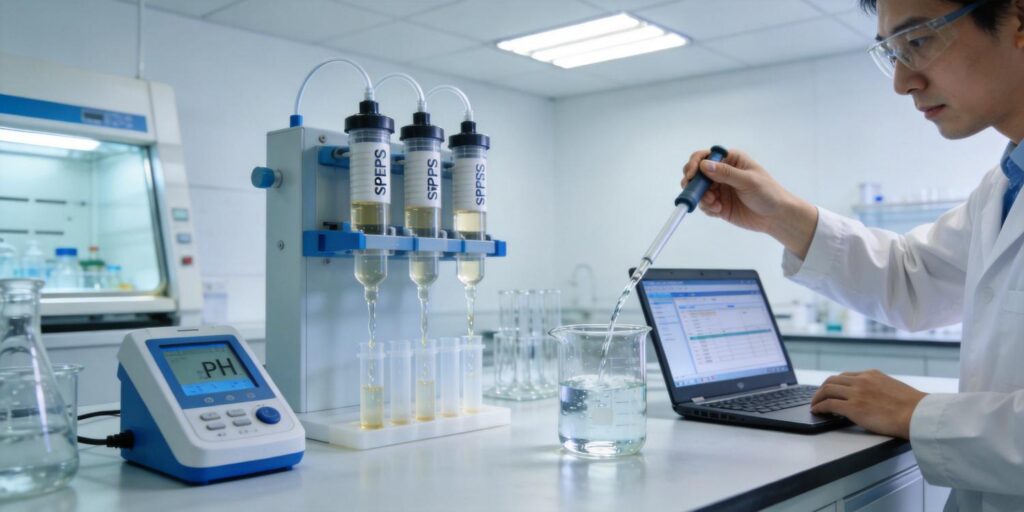
The fundamental principle involves collecting composite wastewater samples from treatment plants, which contain metabolic byproducts excreted by the population served. These samples represent a pooled biological matrix that reflects community-wide consumption patterns without identifying individual users. According to research from forensic and clinical applications, SPE has become indispensable in this field due to its ability to handle complex matrices while maintaining analytical integrity.
Trace Level Detection Challenges
Detecting illicit drugs and their metabolites in wastewater presents unique analytical challenges that push conventional methods to their limits. Target analytes typically exist at nanogram to picogram per liter concentrations, requiring exceptional sensitivity and selectivity. The wastewater matrix itself contains thousands of interfering compounds including pharmaceuticals, personal care products, industrial chemicals, and natural organic matter that can mask or interfere with target analytes.
Matrix effects represent perhaps the most significant challenge in wastewater analysis. As noted in SPE literature, “Biological samples are notoriously dirty; injecting them with minimum cleanup onto very sensitive and expensive instruments makes very little sense.” The complex mixture of organic and inorganic constituents can cause ion suppression in mass spectrometry, reduce chromatographic resolution, and lead to false positives or negatives. Furthermore, the variable nature of wastewater composition—affected by factors like industrial discharge, rainfall, and treatment processes—requires robust sample preparation methods that can handle this variability.
SPE Enrichment Methods for Drug Metabolites
Solid-phase extraction has become the gold standard for concentrating and purifying drug metabolites from wastewater samples. The technique’s versatility allows for selective isolation of target compounds based on their chemical properties. For wastewater epidemiology, mixed-mode SPE cartridges combining reversed-phase and ion-exchange mechanisms have proven particularly effective.
Selecting the Right SPE Phase
The choice of SPE sorbent depends on the target drug classes and their chemical characteristics. For comprehensive drug screening, mixed-mode phases like Poseidon Scientific’s MCX (Mixed-mode Cation Exchange) and WAX (Weak Anion Exchange) cartridges offer optimal performance. These phases combine hydrophobic interactions with ionic bonding capabilities, allowing for selective retention of both acidic and basic drug metabolites.
Optimized SPE Protocol
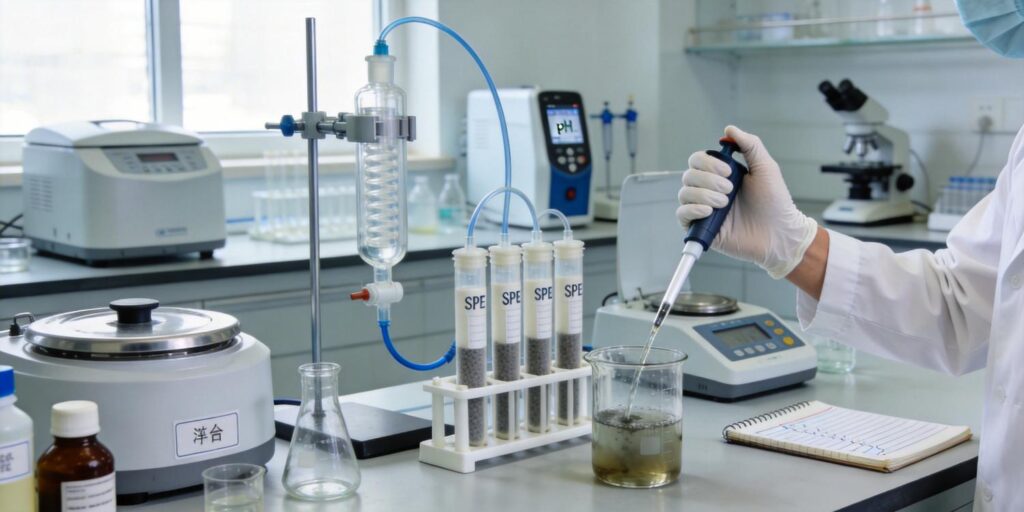
A typical SPE workflow for wastewater samples involves several critical steps:
- Conditioning: Activate the sorbent with methanol followed by water or buffer to ensure proper wetting and interaction sites
- Sample Loading: Apply the wastewater sample at controlled flow rates (typically 1-3 drops per second) to maximize analyte retention
- Washing: Remove interfering compounds with appropriate solvent mixtures that don’t elute target analytes
- Drying: Remove residual water to prevent dilution of elution solvent
- Elution: Recover analytes in minimal solvent volume for maximum concentration
Research demonstrates that “SPE recoveries should exceed 90% absolute recovery. If you don’t get that kind of recovery you are not adjusting other parameters (such as solubility, pH, and solvent strength) correctly.” This high recovery is essential for accurate quantification at trace levels.
Example Workflow for Large-Volume Wastewater Samples
Processing large-volume wastewater samples (typically 100-500 mL) requires specialized approaches to ensure adequate analyte enrichment while managing matrix complexity. Here’s a detailed workflow optimized for illicit drug detection:
Sample Collection and Preservation
Collect 24-hour composite samples using automated refrigerated samplers. Immediately adjust pH to 2-3 using hydrochloric acid to stabilize acidic metabolites and add sodium azide (0.1% w/v) to inhibit microbial degradation. Store samples at 4°C and process within 48 hours.
Pre-treatment Steps
Centrifuge samples at 4000 × g for 15 minutes to remove suspended solids. For particularly turbid samples, consider filtration through glass fiber filters (0.7 μm). Add internal standards (deuterated analogs of target analytes) at this stage to monitor extraction efficiency throughout the process.
SPE Procedure Using Mixed-mode Cartridges
For comprehensive analysis of multiple drug classes, use Poseidon Scientific’s HLB (Hydrophilic-Lipophilic Balance) cartridges followed by fractionation with ion-exchange phases. The HLB phase provides excellent retention of a wide polarity range, making it ideal for the initial extraction of wastewater samples containing diverse drug metabolites.
Load 100 mL of filtered wastewater onto a 200 mg HLB cartridge preconditioned with 6 mL methanol and 6 mL acidified water (pH 2). Wash with 5 mL 5% methanol in water, then dry under vacuum for 5 minutes. Elute with 6 mL methanol followed by 6 mL methanol with 2% ammonium hydroxide. For high-throughput applications, consider using 96-well SPE plates for parallel processing of multiple samples.
LC-MS/MS Detection Strategies
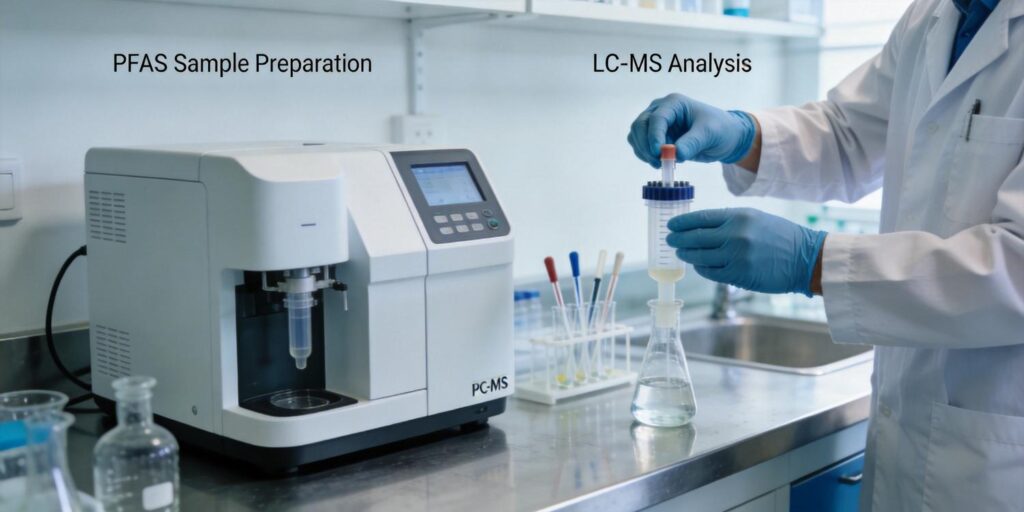
Liquid chromatography coupled with tandem mass spectrometry represents the analytical backbone of wastewater epidemiology. The combination provides the necessary sensitivity, selectivity, and throughput for routine monitoring programs.
Chromatographic Optimization
Use reversed-phase C18 columns (100 × 2.1 mm, 1.7-1.8 μm particle size) with gradient elution for optimal separation. Mobile phase typically consists of water with 0.1% formic acid (A) and acetonitrile with 0.1% formic acid (B). The gradient should start at 5% B, increase to 95% B over 10-15 minutes, then re-equilibrate. Column temperature of 40°C improves peak shape and reproducibility.
Mass Spectrometric Parameters
Electrospray ionization in positive mode covers most illicit drugs and metabolites, while negative mode may be required for certain acidic compounds. Use multiple reaction monitoring (MRM) with two transitions per analyte for confirmation. Optimize collision energies and cone voltages for each compound class. Include at least one deuterated internal standard per drug class to correct for matrix effects and instrument variability.
Quality Control Measures
Implement rigorous quality control including method blanks, matrix-matched calibration curves, and ongoing precision and recovery samples. The complexity of wastewater matrices necessitates standard addition approaches or isotope dilution for accurate quantification. As noted in SPE literature, “The chromatograms show almost no interference from endogenous matrix components, so that toxicologically relevant substances could be easily detected and quantitated” when proper SPE cleanup is employed.
Data Interpretation in Epidemiology Studies
Converting analytical results into meaningful public health data requires careful consideration of multiple factors beyond simple concentration measurements.
Back-calculation to Population Consumption
Use established excretion factors for parent drugs and metabolites to estimate mass loads. Consider population served by the wastewater treatment plant, flow rates, and sampling duration. Normalize results to population size (mg/1000 people/day) for comparability across different communities.
Temporal and Spatial Trends
Analyze data for patterns including weekday/weekend variations, seasonal trends, and geographic differences. Longitudinal monitoring provides insights into the effectiveness of drug policy interventions and emerging drug threats. The ability of SPE-LC-MS/MS to provide reproducible results at very low levels makes it ideal for tracking subtle changes in consumption patterns.
Uncertainty and Limitations
Acknowledge methodological uncertainties including stability of analytes in sewage, incomplete knowledge of excretion patterns, and population mobility. SPE methods, when properly optimized, minimize analytical variability, but other sources of uncertainty remain. As research indicates, “SPE can be automated quite easily with a variety of currently available equipment,” which improves reproducibility across laboratories and studies.
Integration with Other Data Sources
Correlate wastewater data with traditional indicators like drug seizure statistics, treatment admissions, and overdose deaths. This multi-method approach provides a more comprehensive understanding of drug use patterns and enhances the credibility of wastewater epidemiology as a public health tool.
The evolution of SPE technology continues to support advances in wastewater epidemiology. As noted in SPE literature, “There is every indication that it will continue to do so” in meeting the increasing demands of chemical analysis. With proper method development and quality assurance, SPE-based approaches provide reliable, sensitive detection of illicit drugs in wastewater, contributing valuable data to public health surveillance and drug policy evaluation.