The Critical Role of Vacuum in Heat Treatment Metallurgy
Vacuum heat treatment has become the preferred process for producing high-performance components in aerospace, automotive, tooling, and medical-device industries. By removing oxygen and other reactive gases, vacuum furnaces prevent oxidation, decarburization, and scaling while enabling precise control of microstructure, hardness, and fatigue life. Vacuum also reduces the risk of hydrogen embrittlement in sensitive alloys and allows brighter, cleaner surfaces that often eliminate the need for post-process finishing.
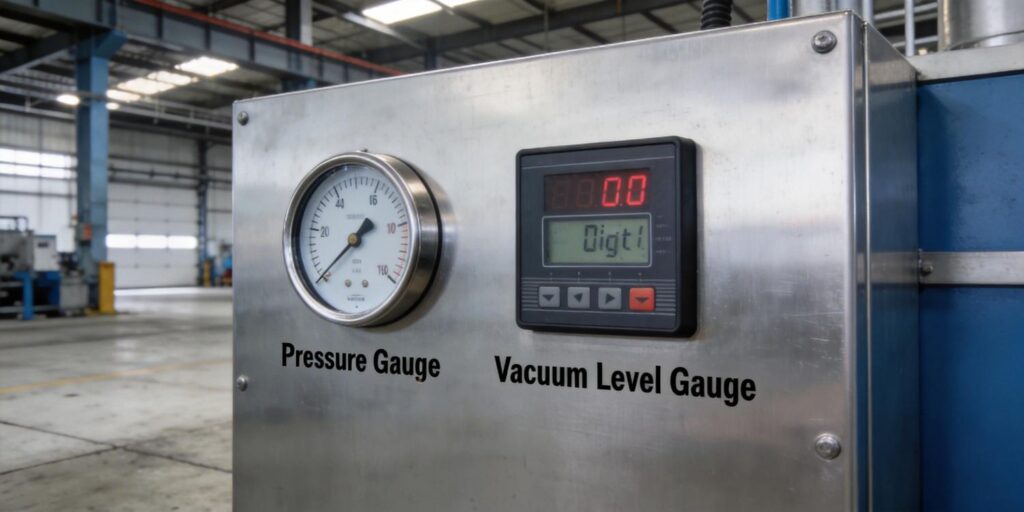
Successful vacuum heat treatment depends on maintaining the correct pressure profile throughout the entire cycle—ramp-up, soak, and controlled cooling. Even brief excursions outside the target vacuum range can cause surface discoloration, reduced mechanical properties, or outright part rejection. Accurate, continuous pressure monitoring is therefore not a luxury but a metallurgical necessity. Poseidon Scientific’s VG-SP205 Pirani Vacuum Transmitter and VG-SM225 Cold Cathode Vacuum Gauge were developed to deliver the full-range coverage and reliability that furnace builders and heat-treat shops require at an economical price point.
Required Pressure Levels During Heating and Soaking Phases
Typical vacuum heat treatment specifications call for a working vacuum of 10⁻³ Torr (approximately 0.133 Pa) or better during the critical heating and soaking stages. For more demanding materials—such as titanium alloys, nickel-base superalloys, or tool steels processed under bright-annealing or solution-annealing conditions—pressures of 10⁻⁴ to 10⁻⁵ Torr are often mandated to minimize oxide formation and ensure proper diffusion.
During initial ramp-up, the furnace may start at atmosphere and must reach the target vacuum before the load exceeds 300–400 °C. Soak times can range from 30 minutes to several hours at temperatures up to 1200 °C, during which pressure must remain stable. Any rise above the specified limit risks contamination and triggers quality-hold procedures. The transition region around 10⁻³ Torr is particularly important: this is where roughing pumps hand off to high-vacuum pumps and where the risk of virtual leaks or outgassing peaks. A single gauge cannot cover both the rough vacuum and high-vacuum regimes with adequate accuracy, making a complementary Pirani-plus-cold-cathode solution the industry standard.
Managing Outgassing During High-Temperature Cycles
High-temperature vacuum cycles release adsorbed and dissolved gases from chamber walls, fixturing, and the workload itself. This outgassing—primarily water vapor, hydrogen, and hydrocarbons—creates transient pressure spikes that must be monitored and pumped away before they affect part metallurgy. The phenomenon is most pronounced between 400 °C and 800 °C, when surface desorption rates increase exponentially.
Effective vacuum monitoring during these excursions requires gauges with fast response and minimal thermal drift. The VG-SP205 Pirani excels here because its platinum filament and dual compensation (circuit plus algorithm) maintain stable readings across the 15–50 °C operating envelope, even when the gauge body is exposed to conducted heat from the hot zone. For the high-vacuum phase, the VG-SM225 Cold Cathode provides the sensitivity needed to detect subtle pressure rises caused by outgassing without the X-ray limitations or filament burnout risks associated with hot-cathode designs. Its positive-magnetron geometry and removable electrodes also allow quick cleaning if contamination accumulates during extended high-temperature runs.
Why Pirani Gauges Are Preferred for the Roughing Stage
The roughing stage—from atmosphere down to approximately 10⁻³ Torr—is where the majority of the gas load is removed and where rapid, repeatable pressure feedback is essential for safe valve sequencing and pump protection. Standard Pirani technology, as implemented in the VG-SP205, is the optimal choice for this phase for several reasons:
- Fast response time—sub-second in the linear 10–10⁻² Torr region—allows closed-loop control of roughing valves and foreline pressure limits.
- Robustness at higher pressures: the gauge operates reliably near atmosphere without the startup delays or contamination risks of ionization gauges.
- Maintenance-free design: the platinum filament offers excellent chemical stability and a typical service life of 3–5 years in clean heat-treat environments.
- Cost effectiveness: at a self-manufactured price of 3000–3500 RMB, the VG-SP205 delivers performance equivalent to imported units costing nearly twice as much.
During roughing, the Pirani’s 0–10 V analog output (effective linear range 2–8 V) feeds directly into the furnace PLC for automatic pump sequencing and alarm generation. Its customizable RS232 digital protocol further simplifies integration without custom driver development.
Cold Cathode Gauges for High-Vacuum Verification and Process Assurance
Once the system crosses into the high-vacuum regime (below 10⁻³ Torr), a cold-cathode ionization gauge becomes the preferred sensor for final verification and long-term stability monitoring. The VG-SM225 uses the proven Penning discharge principle with positive-magnetron geometry, delivering accurate readings from 10⁻³ to 10⁻⁷ Torr. Its automatic high-voltage shutdown above 10⁻³ Torr prevents electrode damage during transitional phases, while the removable sensor head allows in-situ cleaning with 500-mesh sandpaper—restoring performance in minutes without breaking the chamber seal.
In heat-treatment furnaces, the cold cathode serves two critical functions: confirming that outgassing has been adequately pumped away before soak begins and providing continuous verification that vacuum remains within specification throughout the hold period. The gauge’s ion-current response is fast once the discharge is established, and its digital output enables precise trending for statistical process control. Because the VG-SM225 is fully compatible with the VG-SP205, the two transmitters share a common interface, simplifying PLC programming and reducing spare-parts inventory.
Thermal Shielding Considerations for Accurate Gauge Readings
Furnace chamber temperatures can exceed 1000 °C, while vacuum gauges are rated for 15–50 °C operation. Without proper thermal management, conducted or radiated heat causes calibration drift, filament resistance changes, or even permanent sensor damage. Best practice is to mount both the VG-SP205 and VG-SM225 on KF16 or KF25 flanges with 150–300 mm of extension tubing or a water-cooled elbow. This isolates the gauge body from the hot zone while maintaining adequate conductance for representative pressure readings.
Additional radiation shields or reflective baffles between the gauge port and the workload further reduce heat load. Because both Poseidon transmitters incorporate dual temperature-compensation circuits, they tolerate brief excursions beyond the nominal range better than many competing designs. Operators should still verify gauge body temperature periodically—especially during the first few qualification runs of a new furnace configuration—to ensure long-term stability.
Signal Integration into Furnace PLC Systems
Modern vacuum heat-treatment furnaces rely on PLC-based control for recipe management, data logging, and safety interlocks. The VG-SP205 and VG-SM225 are designed for direct integration:
- Analog output: 0–10 V (effective 2–8 V linear range) connects to standard PLC analog input cards for real-time pressure display and PID control.
- Digital output: fully customizable RS232 protocol matches existing PLC serial ports or can be converted to RS485/Modbus with a simple gateway.
- Status signals: the VG-SM225 provides high-voltage enable/disable and fault indicators that can be wired directly into safety interlocks, preventing high-voltage application during roughing or venting.
Because both gauges support the same protocol family, a single serial port can poll both devices, simplifying ladder logic and reducing I/O count. Factory calibration certificates traceable to national standards satisfy NADCAP and AMS 2750 documentation requirements, while digital logging of pressure versus time provides the audit trail needed for customer approvals.
Conclusion: A Complete, Cost-Effective Vacuum Monitoring Solution for Heat-Treatment Furnaces
From initial roughing through high-vacuum soak and controlled cooling, vacuum heat treatment demands precise, reliable pressure monitoring across the full operating range. The complementary pairing of the VG-SP205 Pirani Vacuum Transmitter for the roughing stage and the VG-SM225 Cold Cathode Vacuum Gauge for high-vacuum verification delivers continuous coverage, fast response, field maintainability, and seamless PLC integration—at a fraction of the cost of traditional imported systems.
Engineers and furnace builders who specify Poseidon Scientific gauges benefit from lower capital expenditure, reduced spare-parts inventory, and extended maintenance intervals, all while meeting the stringent vacuum requirements of modern metallurgy.
Learn more about the VG-SP205 Pirani Vacuum Transmitter or explore the VG-SM225 Cold Cathode Vacuum Gauge.
Ready to optimize vacuum monitoring on your heat-treatment furnace? Contact our applications engineering team today for a no-obligation furnace application consultation. We will review your chamber size, temperature profile, PLC platform, and process requirements, then recommend the ideal gauge configuration, mounting arrangement, and protocol settings—complete with a detailed cost and performance comparison.