
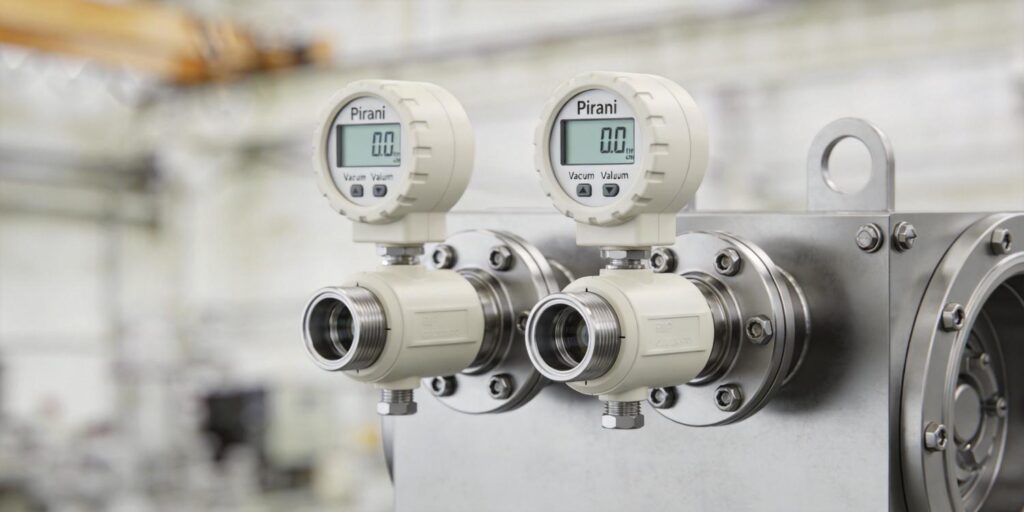
Measurement Principle Difference Between Standard Pirani and Convection-Enhanced Pirani Gauges
Both standard Pirani and convection-enhanced Pirani vacuum gauges operate on the fundamental principle of thermal conductivity: a heated filament (typically platinum in modern designs) loses heat to the surrounding gas molecules, and the power required to maintain constant filament temperature correlates directly with gas pressure. In a standard Pirani gauge such as Poseidon Scientific’s VG-SP205 Pirani Vacuum Transmitter, heat loss occurs primarily through molecular conduction. At pressures below approximately 1 Torr, gas molecules travel independently and transfer heat via individual collisions with the filament surface. The relationship follows a clear power-versus-pressure curve that is highly repeatable once calibrated for a specific gas (normally air or nitrogen).
Convection-enhanced Pirani gauges introduce an intentional geometric asymmetry or additional convection pathways—often through specially shaped sensor tubes or baffles—that amplify natural convection currents at higher pressures. Above roughly 1 Torr, bulk gas movement (convection) begins to dominate heat transfer alongside conduction. By optimizing the sensor to harness this effect rather than suppress it, convection-enhanced designs produce a more pronounced and linear heat-loss signal near atmosphere. The result is a hybrid measurement mechanism that still relies on thermal conductivity but leverages convection for improved high-pressure performance.
This principle difference is subtle yet critical. Standard Pirani gauges prioritize precision in the medium-vacuum linear region (10 Torr to 10⁻² Torr), while convection-enhanced versions trade some mid-range linearity for extended usability at atmospheric pressures. Engineers evaluating replacement sensors should confirm the exact sensor geometry and compensation algorithms before specifying, as the underlying physics directly affects calibration curves and gas-species sensitivity.
Extended Range Explanation and Practical Implications
A standard Pirani gauge, such as the VG-SP205, is rated from atmosphere down to 10⁻³ Torr. Its most accurate region lies between 10 Torr and 10⁻² Torr, where the power-pressure relationship is nearly linear. Outside this window—particularly near atmosphere and below 10⁻² Torr—non-linearity increases, with typical error margins reaching ±50 %. The gauge remains functional at atmosphere, but resolution and repeatability degrade because convection currents become unpredictable without intentional enhancement.
Convection-enhanced Pirani gauges extend usable range and accuracy closer to true atmospheric pressure (760 Torr) by making convection a controlled, repeatable contributor to heat loss. Many commercial models claim reliable readings from atmosphere to 10⁻⁴ Torr or lower, with significantly flatter error bands above 10 Torr. This extension is valuable in applications requiring precise monitoring during initial pump-down or in load-lock chambers where pressure must be verified near 760 Torr before valve actuation.
For most research and industrial vacuum systems, however, the additional high-pressure resolution of a convection-enhanced gauge provides marginal benefit once the system drops below 10 Torr. The VG-SP205’s calibrated range aligns perfectly with the roughing stage of typical vacuum trains, and its performance is complemented by a cold cathode gauge for the high-vacuum regime. The extended range of convection-enhanced models comes at the expense of added sensor complexity, which can reduce long-term reliability in contaminated environments.
Accuracy Comparison Across Operating Ranges
Accuracy is context-dependent and should be evaluated against the specific pressure window of the application. In the high-precision linear zone (10 Torr to 10⁻² Torr), both standard and convection-enhanced Pirani gauges achieve comparable performance—typically ±5–10 % of reading when properly temperature-compensated. Below 10⁻² Torr, standard designs like the VG-SP205 maintain usable output down to 10⁻³ Torr, although error grows to ±50 % at the extreme low end. Convection-enhanced gauges often exhibit slightly better low-end behavior because residual convection effects help stabilize the signal, but the difference is rarely decisive once a cold cathode gauge takes over.
At the high-pressure end (above 10 Torr to atmosphere), convection-enhanced designs demonstrate clear superiority. Their error remains under ±20 % across the entire atmospheric transition, while standard Pirani gauges can show deviations up to ±50 % due to uncontrolled convection. Temperature compensation circuits and firmware algorithms in modern standard Pirani transmitters—such as those in the VG-SP205—mitigate much of this effect, delivering sufficient accuracy for process control and interlocks without the added cost of convection optimization.
Gas-species dependence affects both types equally: thermal conductivity varies with molecular weight and specific heat. Both require calibration for non-air gases, though digital outputs on the VG-SP205 allow simple correction factors to be applied in the host controller.
Temperature Influence and Compensation Strategies
Ambient temperature is the dominant external variable for any thermal conductivity gauge. Changes as small as 5 °C can shift the baseline filament resistance and alter the power-pressure curve. Standard Pirani gauges are particularly sensitive because their measurement relies exclusively on conduction; convection-enhanced models experience additional variability from temperature-driven gas density changes that affect convection currents.
Both technologies employ dual compensation—hardware circuitry plus embedded firmware algorithms—to maintain accuracy across the 15–50 °C operating window. The VG-SP205 implements this compensation natively, ensuring drift remains below 1 % per 10 °C in the linear region. Outside the rated range, readings become unreliable regardless of design. For laboratories or production floors with wide temperature swings, engineers should consider active thermal shielding or locate the gauge away from heat sources such as pumps or furnaces.
In practice, the temperature influence of a standard Pirani is easier to model and correct in software because the heat-loss mechanism is simpler. Convection-enhanced gauges require more complex multi-variable compensation tables, increasing both development cost and potential points of failure.
Application Suitability: When to Choose Each Type
Standard Pirani gauges excel in cost-sensitive, reliability-focused applications where the critical pressure window lies between 10 Torr and 10⁻³ Torr. Typical use cases include:
- Foreline monitoring on turbomolecular pump stations
- Vacuum heat-treatment furnaces during roughing and transition phases
- Mass spectrometer and SEM load locks
- General laboratory vacuum manifolds
Convection-enhanced Pirani gauges are preferred when precise atmospheric-pressure verification is mandatory—such as in automated load-lock sequences, leak-test setups, or systems that must confirm chamber venting before opening. Their advantage diminishes rapidly once the system enters high vacuum, at which point a cold cathode gauge provides superior sensitivity and response.
For the majority of industrial and research users, the VG-SP205 standard Pirani paired with the VG-SM225 Cold Cathode Vacuum Gauge delivers full-range coverage (atmosphere to 10⁻⁷ Torr) at lower total cost and with simpler maintenance. The combination avoids the overlap uncertainty and higher price of a single convection-enhanced sensor while providing digital RS232 outputs for seamless PLC or data-acquisition integration.
Cost Comparison: Initial Price Versus Lifetime Ownership
Initial purchase price favors the standard Pirani. Poseidon Scientific’s VG-SP205 is manufactured at 3000–3500 RMB, delivering performance comparable to imported units costing 5000–6000 RMB. Convection-enhanced Pirani transmitters from major brands typically carry 20–40 % higher list prices due to more complex sensor machining and additional compensation electronics.
Lifetime cost further widens the gap. The VG-SP205 requires essentially zero maintenance for 3–5 years in clean service, while its platinum filament offers excellent contamination resistance. Convection-enhanced designs, with their more intricate internal geometry, can accumulate deposits faster in process environments and often require full unit replacement rather than simple electrode cleaning. When paired with the field-serviceable VG-SM225 Cold Cathode (electrodes cleaned in minutes with 500-mesh sandpaper), the Poseidon standard Pirani solution yields the lowest total cost of ownership for most vacuum systems.
Recommendation Matrix
| Application Requirement | Standard Pirani (VG-SP205) | Convection-Enhanced Pirani | Recommended Poseidon Solution |
|---|---|---|---|
| Primary range 10 Torr to 10⁻³ Torr | Excellent linearity and speed | Acceptable but over-specified | VG-SP205 + VG-SM225 pair |
| Precise atmospheric verification needed | Adequate for most interlocks | Superior resolution | VG-SP205 (if budget-constrained) or evaluate convection alternative |
| Cost-sensitive OEM or retrofit | Lowest initial and lifetime cost | Higher upfront expense | VG-SP205 standard configuration |
| Contaminated or reactive gas environments | Platinum filament offers superior resistance | More susceptible to convection-path fouling | VG-SP205 + VG-SM225 (cleanable electrodes) |
| Full-range monitoring (atm to 10⁻⁷ Torr) | Requires cold cathode complement | Still requires cold cathode for high vacuum | VG-SP205 + VG-SM225 (optimal cost/performance) |
Conclusion: Making the Right Choice for Your Vacuum System
Selecting between a standard Pirani and a convection-enhanced Pirani ultimately depends on where your process spends the majority of its time and how critical atmospheric-pressure accuracy truly is. For the vast majority of vacuum applications—roughing lines, foreline protection, load-lock control, and general laboratory work—the standard Pirani delivers the performance engineers need at a significantly lower total cost of ownership.
Poseidon Scientific’s VG-SP205 Pirani Vacuum Transmitter embodies the strengths of the classic thermal-conductivity design: fast response, robust platinum filament, full temperature compensation, and customizable RS232 protocol for effortless integration. When combined with the VG-SM225 Cold Cathode Vacuum Gauge, the pair provides continuous, accurate monitoring from atmosphere to 10⁻⁷ Torr without the premium price or added complexity of convection enhancement.
Learn more about the VG-SP205 Pirani Vacuum Transmitter or explore the VG-SM225 Cold Cathode Vacuum Gauge for complete system coverage.
Still unsure which Pirani technology best fits your specific pressure profile, gas mixture, or budget? Contact our applications engineering team today for no-obligation product selection support. We will review your chamber design, typical pump-down curves, and integration requirements, then deliver a tailored recommendation with cost analysis, mounting guidance, and protocol settings—ensuring you choose the vacuum gauge solution that delivers long-term reliability without over-engineering.


