Challenges Analyzing Polyphenols in Complex Beverage Matrices
Polyphenol analysis in beverages presents unique analytical challenges due to the complex nature of beverage matrices. Beverages like wine, tea, fruit juices, and soft drinks contain high concentrations of sugars, organic acids, pigments, and other interfering compounds that can mask or interfere with polyphenol detection. The alcohol content in wines and spirits further complicates extraction procedures, while variable sugar content across different beverage types affects method consistency.
According to Simpson and Wynne (2000), beverages with high alcohol or sugar/syrup content present particular challenges for SPE processing. Wine analysis requires consideration of volatile components responsible for bouquet and sugar acids contributing to flavor. The presence of anthocyanins (pigments) in red wines and various phenolic acids across different beverage types necessitates selective extraction strategies that can separate these compounds from matrix interferences.
Removal of Sugars and Pigments Using SPE
Solid-phase extraction offers an effective solution for removing sugars and pigments from beverage samples before polyphenol analysis. Traditional methods often struggle with these matrix components, but SPE provides selective retention mechanisms that can separate polyphenols from interfering compounds.
Research demonstrates that SPE can effectively fractionate wine into volatile components using solid-supported liquid-liquid extraction while simultaneously extracting pigments (anthocyanins) on C18 bonded phases, leaving sugars in the effluent. This crude class fractionation can be further refined by passing the wine through anion exchangers to trap wine acids. A two-cartridge extraction system using C8 and SCX phases has been successfully employed to remove caffeine, aspartame, sodium benzoate, and caramel color acids from soft drinks during analysis of aspartame degradation products.
The key advantage of SPE for sugar and pigment removal lies in its ability to operate under mild pH conditions, thereby limiting decomposition or rearrangement of labile polyphenolic compounds. This is particularly important for preserving the integrity of sensitive phenolic structures during analysis.
Sorbent Selection for Phenolic Compounds
Choosing the appropriate SPE sorbent is critical for successful polyphenol extraction from beverages. Different sorbents offer varying selectivity based on the chemical properties of target polyphenols and matrix components.
C18 and C8 Reversed-Phase Sorbents
C18 sorbents are widely used for polyphenol extraction due to their strong hydrophobic interactions with phenolic compounds. These sorbents effectively retain polyphenols while allowing polar sugars and some organic acids to pass through. C8 phases offer slightly less retention and can be advantageous for eluting more polar polyphenols with lower solvent volumes.
Mixed-Mode and Ion-Exchange Sorbents
For beverages containing both acidic and basic polyphenols, mixed-mode sorbents combining reversed-phase and ion-exchange mechanisms provide superior selectivity. Weak anion exchange (WAX) and weak cation exchange (WCX) sorbents from Poseidon Scientific’s product line offer targeted extraction capabilities for specific polyphenol classes based on their ionization states.
Polymeric Sorbents
Polymeric sorbents like HLB (Hydrophilic-Lipophilic Balance) provide excellent retention for a broad range of polyphenols with varying polarities. These sorbents maintain good wettability even with 100% aqueous samples, making them ideal for beverage applications where sample dilution might be limited.
Research by Buszewski et al. (1992, 1993) investigated the extraction of bioflavonoids like rutin from plants using various sorbents, demonstrating that C18 sorbents effectively isolate flavans in phenolic fractions for chemotaxonomic purposes.
Example Extraction and Cleanup Workflow
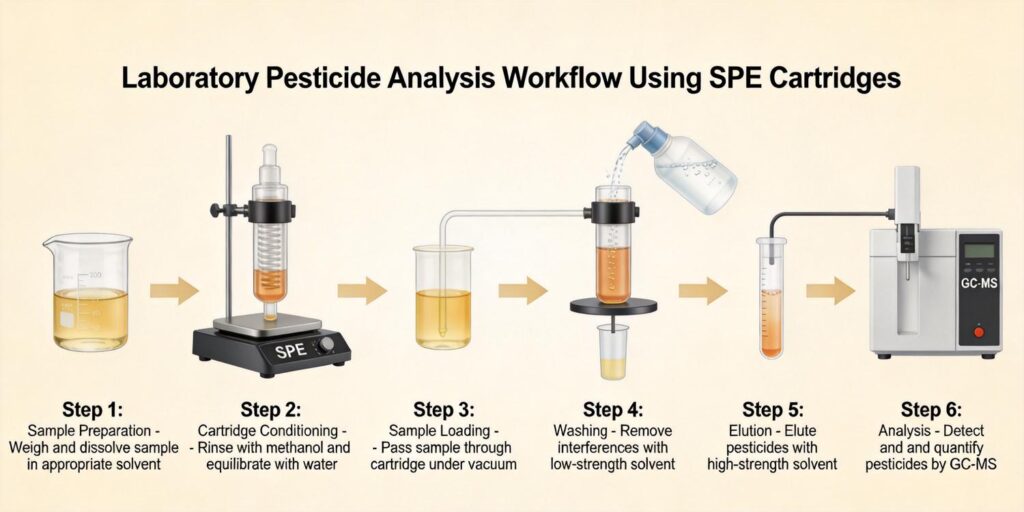
A comprehensive SPE workflow for polyphenol analysis in beverages typically follows these steps:
1. Sample Preparation
Beverage samples are typically diluted with acidified water (pH 2-3) to protonate phenolic acids and improve retention on reversed-phase sorbents. For alcoholic beverages, dilution with water reduces alcohol content to prevent breakthrough during loading.
2. SPE Cartridge Conditioning
Cartridges are conditioned with methanol followed by acidified water matching the sample pH. This step ensures proper sorbent activation and eliminates potential interferences from manufacturing residues.
3. Sample Loading
Samples are loaded at controlled flow rates (typically 1-3 mL/min) to ensure optimal analyte retention. For high-sugar beverages, slower flow rates may be necessary to prevent column clogging.
4. Washing Steps
Wash solvents are carefully selected to remove sugars, organic acids, and other matrix components while retaining polyphenols. Common wash solutions include 5-10% methanol in acidified water or water-acetonitrile mixtures.
5. Elution
Polyphenols are eluted with appropriate organic solvents, typically methanol or acetonitrile, often acidified with formic or acetic acid to improve recovery of acidic polyphenols. Elution volumes are minimized to concentrate analytes.
The SPE strategy generally comprises isolation and concentration of analytes from complex matrices by adsorption onto appropriate sorbents, removal of interfering impurities by washing with suitable solvent systems, and selective recovery of retained analytes with modified solvent systems of suitable elution strength.
HPLC and LC-MS Detection Methods
Following SPE cleanup, polyphenols are typically analyzed using HPLC with various detection methods or LC-MS for more comprehensive characterization.
HPLC with UV/Vis Detection
Reverse-phase HPLC with UV/Vis detection remains the workhorse for polyphenol analysis. Different polyphenol classes exhibit characteristic absorption maxima: flavonoids at 280 nm, hydroxycinnamic acids at 320 nm, and anthocyanins at 520 nm. Diode array detection (DAD) allows simultaneous monitoring at multiple wavelengths.
LC-MS and LC-MS/MS
Liquid chromatography-mass spectrometry provides superior identification and quantification capabilities, especially for complex polyphenol mixtures. Electrospray ionization (ESI) in negative mode is commonly used for most polyphenols, while anthocyanins are better analyzed in positive mode. Tandem mass spectrometry (MS/MS) enables structural elucidation and confirmation of polyphenol identities.
Method Integration
On-line SPE-HPLC systems offer automated analysis with improved reproducibility and reduced sample handling. These systems integrate SPE cleanup directly with chromatographic separation, minimizing analyte loss and contamination risks. Research demonstrates that on-line SPE provides quantitative recovery and excellent precision over large linear ranges for lipophilic species in complex matrices.
Improving Reproducibility in Beverage Analysis
Reproducible polyphenol analysis in beverages requires careful attention to several key factors:
Standardized SPE Procedures
Consistent conditioning, loading, washing, and elution protocols are essential. Flow rates should be controlled using vacuum manifolds or positive pressure systems. Cartridge-to-cartridge variability can be minimized by using high-quality SPE products from reputable manufacturers like Poseidon Scientific.
pH Control
Maintaining consistent pH throughout the extraction process is critical for reproducible polyphenol recovery. Buffered solutions should be used for sample dilution and wash steps to ensure consistent ionization states of target analytes.
Internal Standards
Appropriate internal standards should be added to samples before extraction to monitor and correct for recovery variations. Stable isotope-labeled polyphenols are ideal for LC-MS methods, while structurally similar compounds can be used for HPLC-UV methods.
Quality Control Samples
Including quality control samples with known polyphenol concentrations in each batch monitors method performance over time. These samples help identify potential issues with SPE cartridges, solvents, or instrumentation.
Automation
Automated SPE systems significantly improve reproducibility by eliminating manual handling variations. 96-well SPE plates from Poseidon Scientific enable high-throughput analysis with consistent processing across multiple samples.
SPE offers significant advantages over traditional liquid-liquid extraction for beverage analysis, including higher selectivity, cleaner extracts, better reproducibility, avoidance of emulsion formation, and easier automation. By implementing optimized SPE methods with appropriate sorbent selection and careful procedural controls, laboratories can achieve reliable, reproducible polyphenol analysis across diverse beverage matrices.
For specific applications, Poseidon Scientific offers a range of SPE products including HLB SPE cartridges, MAX SPE cartridges, MCX SPE cartridges, WAX SPE cartridges, WCX SPE cartridges, and 96-well SPE plates to meet various analytical needs in beverage polyphenol analysis.