Common Laboratory Vacuum Setups and Their Monitoring Needs
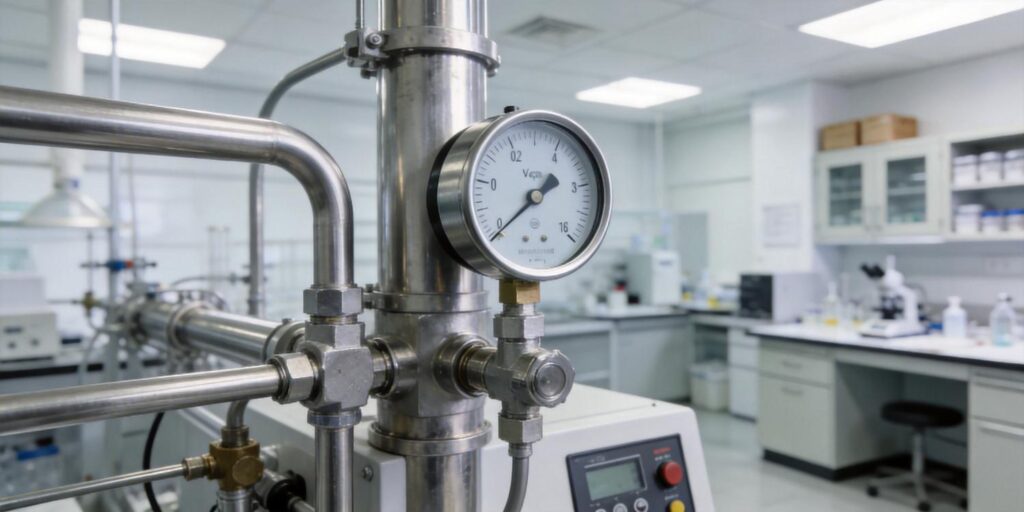
Research laboratories rely on vacuum technology for a wide range of experiments, from basic material characterization to advanced surface science and analytical instrumentation. Typical setups include small bell-jar chambers for thin-film deposition, custom vacuum manifolds for gas-handling experiments, and integrated systems within commercial instruments such as mass spectrometers, scanning electron microscopes (SEM), and atomic force microscopes (AFM). Many labs also operate vacuum ovens, glovebox-integrated chambers, or tabletop turbopump stations for sample preparation and plasma cleaning.
These systems often combine a rotary vane roughing pump with a turbomolecular or diffusion pump to achieve and maintain the required vacuum. Because space is limited and experiments frequently change, the vacuum monitoring solution must be compact, easy to integrate, and capable of spanning multiple pressure decades without requiring frequent recalibration or bulky controllers. Poseidon Scientific’s vacuum transmitters address these constraints directly, delivering reliable performance in the compact footprints that modern research environments demand.
Vacuum Range Requirements Across Research Applications
Most laboratory vacuum processes span from atmosphere down to the high-vacuum regime. Rough vacuum (atmosphere to 10⁻³ Torr) is sufficient for initial pump-down, degassing, and many sample-transfer operations. High vacuum (10⁻³ to 10⁻⁷ Torr) is essential for mass spectrometry, electron microscopy, and surface-analysis techniques where residual gas molecules must be minimized to prevent scattering or contamination.
Applications such as residual gas analysis or ultra-clean thin-film growth may push toward 10⁻⁷ Torr, while simpler vacuum drying or freeze-drying experiments operate comfortably above 10⁻³ Torr. A single gauge cannot cover this full spectrum with adequate accuracy; the transition region around 10⁻³ Torr is particularly challenging because thermal conductivity and ionization-based principles overlap with reduced sensitivity. Using complementary technologies—Pirani for the higher-pressure range and cold cathode for the lower-pressure range—eliminates blind spots and ensures continuous, accurate monitoring throughout the pump-down curve.
Benefits of Compact Vacuum Transmitters in Space-Constrained Labs
Research laboratories prioritize bench space, portability, and minimal infrastructure. Traditional vacuum gauges often require large controllers or rack-mounted electronics that compete with other instruments for real estate. Poseidon Scientific’s VG-SP205 Pirani Vacuum Transmitter and VG-SM225 Cold Cathode Vacuum Gauge feature highly compact designs that mount directly via standard KF16 or KF25 flanges, eliminating the need for separate controller boxes in many setups.
The small footprint reduces conductance losses and allows installation in tight locations—directly on the chamber, foreline, or load-lock—without obstructing optical paths or manipulator arms. Low power consumption and 15–50 °C operating range make them suitable for both air-conditioned cleanrooms and less-controlled university labs. Their rugged construction and arbitrary mounting orientation further simplify retrofits on existing equipment, helping principal investigators and lab managers deploy reliable vacuum monitoring without major system redesigns.
Data Logging Integration for Modern Research Workflows
Accurate, time-stamped pressure data is now a core requirement for reproducible research, grant reporting, and publication-quality results. Both the VG-SP205 and VG-SM225 provide industry-standard 0–10 V analog outputs (effective linear range 2–8 V) alongside fully customizable RS232 digital protocols. This dual-output capability allows seamless connection to existing lab data acquisition systems, LabVIEW environments, Arduino-based loggers, or PLCs without additional signal converters.
Engineers can log pressure at 1 Hz or higher, correlate it with temperature, sample position, or spectrometer readings, and export CSV files for statistical analysis or electronic lab notebooks. The customizable protocol layer means labs can match the exact data frame and baud rate of legacy equipment, avoiding costly software rewrites. For multi-user facilities, digital logging also supports remote monitoring via Ethernet gateways, enabling principal investigators to track experiments from their offices or while traveling.
Safety Interlocks and Fail-Safe Operation in Shared Lab Environments
Shared research facilities expose vacuum gauges to users with varying levels of experience. The VG-SM225 incorporates built-in high-voltage management and automatic shutdown above 10⁻³ Torr, preventing electrode contamination or arcing during improper operation. Visual status indicators (including flashing alerts when high voltage is disabled) provide immediate feedback to lab personnel.
Analog and digital outputs can be wired directly into interlock circuits—triggering pump shutdown, valve closure, or alarm systems if pressure exceeds preset thresholds. This capability is especially valuable in teaching labs or core facilities where accidental venting or power interruptions are common. By integrating gauge feedback into the safety architecture, laboratories reduce the risk of equipment damage, sample loss, and unplanned downtime.
Budget Considerations for Academic and Research Procurement
Grant funding and departmental budgets place tight constraints on capital equipment. Imported vacuum gauges from established brands often carry price tags of 8000–10000 RMB per unit, consuming a disproportionate share of instrument budgets. Poseidon Scientific’s self-developed transmitters achieve equivalent performance at 3000–3500 RMB through efficient domestic manufacturing and a focus on essential functionality—durability and accuracy over marginal precision gains.
The maintainable design of the VG-SM225 further lowers lifetime cost: its removable electrodes can be cleaned with 500-mesh sandpaper in minutes, restoring full performance without full replacement. The VG-SP205 requires essentially no maintenance for 3–5 years in typical lab conditions. When combined with customizable communication protocols that eliminate custom driver development, the total cost of ownership drops 40–60 % compared with legacy solutions. This price-performance advantage allows research groups to equip multiple stations or upgrade aging systems within the same fiscal year.
Recommended Gauge Configuration for Typical Research Laboratories
For most university and government research labs, Poseidon Scientific recommends a dual-gauge architecture that pairs the VG-SP205 Pirani Vacuum Transmitter with the VG-SM225 Cold Cathode Vacuum Gauge. The Pirani covers atmosphere to 10⁻³ Torr with fast response and high linearity in the 10–10⁻² Torr region, while the cold cathode seamlessly takes over from 10⁻³ to 10⁻⁷ Torr using its proven Penning discharge principle.
Install both units directly on the chamber or via short KF tubing to ensure representative readings. Use the RS232 outputs on a single serial port (or USB adapter) for unified data logging, and wire the 0–10 V analog signals to the existing DAQ or interlock system. This configuration has been validated in mass-spectrometry forelines, SEM sample chambers, and vacuum coating setups, delivering stable readings with minimal hysteresis and easy electrode maintenance on the cold cathode unit.
Labs needing only rough vacuum can start with the VG-SP205 alone; those pushing toward UHV can add the cold cathode later. The modular approach future-proofs the investment while keeping initial costs low.
Conclusion: Reliable Vacuum Monitoring That Fits Every Lab Budget
Research laboratories require vacuum monitoring that is accurate, compact, integrable, and affordable—without sacrificing safety or data quality. Poseidon Scientific’s VG-SP205 Pirani and VG-SM225 Cold Cathode transmitters meet these demands with proven performance, field-serviceable design, and seamless digital/analog connectivity tailored to the realities of academic and institutional environments.
Whether outfitting a new core facility, upgrading legacy analytical instruments, or supporting student-led experiments, these gauges deliver the full-range coverage and long-term reliability that principal investigators and lab managers value most.
Discover the VG-SP205 Pirani Vacuum Transmitter or explore the VG-SM225 Cold Cathode Vacuum Gauge.
Ready to equip your laboratory with cost-effective, high-performance vacuum monitoring? Contact our applications team today for a no-obligation lab quotation. We will review your chamber sizes, typical pressure ranges, and data-interface requirements, then propose the optimal gauge configuration with pricing, delivery, and integration guidance tailored to your research needs.