Overview of Therapeutic Drug Monitoring Workflows
Therapeutic drug monitoring (TDM) represents a critical component of modern clinical pharmacology, bridging the gap between drug administration and optimal therapeutic outcomes. At its core, TDM involves measuring drug concentrations in biological fluids to ensure they remain within the therapeutic window—high enough to be effective but low enough to avoid toxicity. This precision medicine approach is particularly vital for drugs with narrow therapeutic indices, significant inter-patient variability, or complex pharmacokinetics.
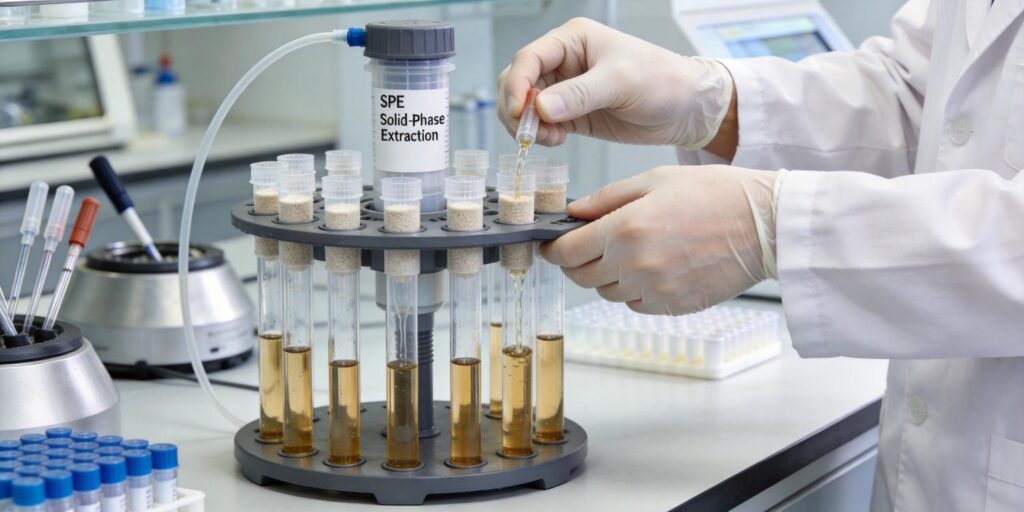
Solid-phase extraction (SPE) has emerged as the cornerstone of TDM sample preparation due to its ability to achieve high selectivities and recoveries while minimizing hazardous solvent consumption. As noted in pharmaceutical literature, “SPE is widely used for the preparation of biological samples for further analysis in areas as diverse as clinical chemistry, forensic science, and biomedical and pharmaceutical research.” The popularity of SPE stems from its utility in achieving clean extracts essential for sensitive pharmacokinetic studies, where modern drug candidates are often very potent substances administered at relatively low doses.
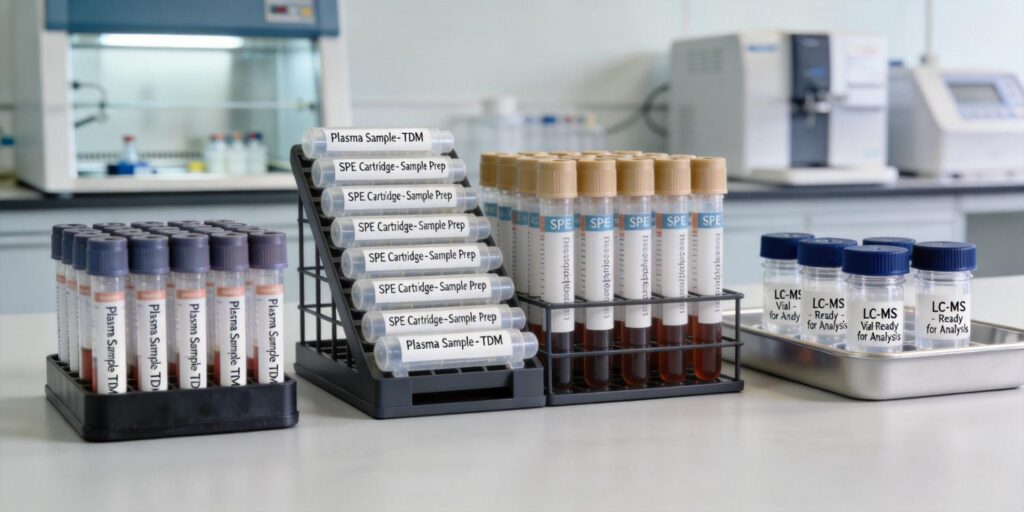
The typical TDM workflow begins with sample collection, followed by appropriate storage and transport to the laboratory. Once received, samples undergo SPE-based cleanup to isolate target analytes from complex biological matrices before quantification using techniques like LC-MS/MS. This systematic approach ensures reliable results that clinicians can use to make informed dosing decisions, ultimately improving patient safety and treatment efficacy.
Biological Matrix Complexity: Plasma vs. Serum
Understanding the composition and characteristics of biological matrices is fundamental to developing effective SPE methods for TDM. The two most common matrices in clinical monitoring are plasma and serum, each presenting unique challenges and considerations for sample preparation.
Plasma Composition and Challenges
Plasma, the liquid component of blood containing anticoagulants, comprises approximately 55% of total blood volume. Its complex composition includes:
- Proteins (albumin, globulins, fibrinogen)
- Electrolytes (sodium, potassium, calcium)
- Lipids (cholesterol, triglycerides)
- Hormones and metabolites
- Drugs and their metabolites
The high protein content in plasma (60-80 g/L) presents significant challenges for SPE method development. Proteins can bind to drugs, reducing their availability for extraction, and can clog SPE cartridges or analytical columns if not properly removed. As noted in SPE literature, “Prevention of clogging of analytical columns and elimination of protein binding” are key objectives when extracting biological samples.
Serum Characteristics
Serum differs from plasma primarily in the absence of fibrinogen and clotting factors, as it’s obtained after blood coagulation. While serum contains similar components to plasma, its preparation eliminates some proteins but introduces potential variability from the clotting process. Research indicates that “serum, plasma, whole blood” samples require specific SPE approaches depending on the target analytes, with different extraction columns and conditions recommended for various drug classes.
Matrix Effects on SPE Performance
Both matrices contain endogenous compounds that can interfere with drug analysis through:
- Ion suppression/enhancement in mass spectrometry
- Chromatographic interferences
- Non-specific binding to SPE sorbents
- Competition for binding sites on mixed-mode sorbents
Successful SPE method development requires thorough knowledge of matrix composition to identify and eliminate interferences while troubleshooting low recoveries. As emphasized in analytical literature, “The more that is known about the composition of the sample matrix, the greater the opportunity to develop SPE methods that yield cleaner extracts.”
Selecting SPE Sorbents for Different Drug Classes
The choice of SPE sorbent is perhaps the most critical decision in TDM method development, directly impacting recovery, selectivity, and final extract cleanliness. Modern SPE sorbents can be broadly categorized based on their retention mechanisms and chemical properties.
Reversed-Phase Sorbents (C18, C8, HLB)
Reversed-phase sorbents are ideal for hydrophobic drugs and their metabolites. The hydrophobic divinylbenzene methacrylate copolymers, such as HLB (Hydrophilic-Lipophilic Balance) sorbents, offer superior performance for a wide range of compounds. These sorbents “use divinylbenzene combined with styrene, n-vinylpyrrolidone or methacrylates” and provide high recovery for many analytes with simple methods. They’re particularly valuable when the analytical technique is LC-MS/MS, where cycle times may be between one and two minutes per analysis.
For basic, hydrophobic drugs like promethazine, C18 sorbents effectively isolate analytes from aqueous samples. After washing with appropriate solvent systems to remove excipients, drugs can be recovered with methanol. Similar procedures apply to various hydrophobic therapeutic agents.
Ion-Exchange Sorbents (MCX, MAX, WCX, WAX)
Ion-exchange sorbents provide selective retention based on analyte charge state, making them indispensable for polar or ionizable drugs:
- Mixed-mode Cation Exchange (MCX): Combines reversed-phase and strong cation exchange properties for basic drugs
- Mixed-mode Anion Exchange (MAX): Ideal for acidic drugs and their metabolites
- Weak Cation Exchange (WCX): Suitable for strong bases
- Weak Anion Exchange (WAX): Effective for strong acids
For basic, comparatively hydrophilic drugs such as chlorhexidine and benzydamine, SCX (strong cation exchange) packing materials are preferred. At pH 4.5, protonated chlorhexidine is retained by a PRS (propylsulfonic acid) sorbent while uncharged excipients pass through. Subsequent elution with appropriate solvent provides quantitative drug recovery.
Mixed-Mode Sorbents for Comprehensive Extraction
The strategy of “a mixed-mode cartridge providing hydrophobic and cation exchange interactions, combined with a pH-dependent sample application and extraction, can give high recoveries of analytes from plasma, urine, whole blood, and tissues.” This approach is particularly valuable in TDM where multiple analytes or drug classes might need simultaneous extraction.
Specialized Sorbents for Specific Applications
Diol sorbents have proven suitable for analyzing formulations containing neutral or acidic drugs of different polarity, such as hydrocortisone acetate and piroxicam. In these applications, cream samples are dissolved in appropriate dichloromethane-n-hexane mixtures, where the ratio is adjusted to give weak matrix-analyte interactions while favoring sorbent-analyte interactions.
Example SPE Protocol for Plasma Samples
Developing a robust SPE protocol for plasma samples requires systematic optimization of each step. Below is a comprehensive protocol framework that can be adapted for various therapeutic drugs.
Sample Pretreatment
Before SPE extraction, plasma samples typically require:
- Protein Precipitation: Using organic solvents (acetonitrile, methanol) or acids (trichloroacetic acid) to denature and remove proteins
- Dilution: With appropriate buffer to adjust pH and ionic strength
- Internal Standard Addition: Stable isotope-labeled analogs of target analytes for quantification
As demonstrated in research, “By homogenizing the meconium in methanol, centrifuging the homogenate, drying down the supernate to a volume of less than 1 mL and then diluting this in the same phosphate buffer that would have been used for diluting a urine sample, the sample could be extracted successfully.” This approach has been shown to be effective for plasma and whole blood as well.
SPE Cartridge Conditioning
Proper conditioning ensures optimal sorbent activation and reproducible results:
1. Methanol: 3 mL (or 6 mL for some sorbents)
2. Water: 3 mL
3. Buffer: 1-3 mL matching sample pH
For specific sorbents, conditioning protocols vary:
– C18 sorbent: Rinse with 6 mL of methanol
– SAX sorbent: Rinse with 6 mL of methanol followed by 3 mL of methanol-buffer solution (pH 8) (1:1, v/v)
– SCX sorbents: Rinse with 6 mL of methanol followed by 3 mL of buffer solution (pH 4.5)
– Diol sorbent: Rinse with 6 mL of dichloromethane followed by 1 mL of n-hexane
Sample Loading
Load pretreated samples at controlled flow rates (typically 1-2 mL/min) to ensure adequate interaction time with the sorbent. As noted in method development guidelines, “Load at 1-3 drops/sec (recovery ∝ 1/flow)” to maximize analyte retention.
Washing Steps
Remove interferences with sequential washing:
- Water wash: 2 mL to remove salts and polar impurities
- Acid/base wash: 2 mL of 0.1 N HCl or appropriate buffer
- Organic wash: 3 mL of methanol or acetonitrile
- Drying: Maximum vacuum for 5 minutes
- Hexane wash: 2 mL for lipophilic interferences (when applicable)
Analyte Elution
Selective elution using appropriate solvent systems:
- Basic drugs from MCX: 3 mL of methylene chloride-isopropanol-ammonium hydroxide (78:20:2)
- Acidic drugs from MAX: 3 mL of 2% ammonium hydroxide in ethyl acetate
- Neutral drugs from reversed-phase: Methanol or acetonitrile
Eluates are typically evaporated to dryness under nitrogen or vacuum and reconstituted in mobile phase compatible solvent for analysis.
LC-MS/MS Quantification Improvements Through SPE
The integration of SPE with LC-MS/MS has revolutionized TDM by providing unprecedented sensitivity, specificity, and throughput. SPE directly addresses several critical challenges in LC-MS/MS analysis of biological samples.
Reduction of Matrix Effects
Matrix effects—ion suppression or enhancement caused by co-eluting compounds—represent a major challenge in LC-MS/MS quantification. SPE significantly reduces these effects by:
- Removing phospholipids: Major contributors to ion suppression in ESI
- Eliminating proteins and salts: That can interfere with ionization
- Reducing endogenous compounds: That compete for ionization
As noted in analytical literature, “LC-MS demanded that the proteins and ionic species be removed—within limits the presence of other small organic molecules was not a problem because the MS detector could ‘select them out’ of the effluent from the chromatographic column.”
Improved Sensitivity and Lower Limits of Quantification
SPE enables concentration of analytes from large sample volumes into small elution volumes, significantly improving method sensitivity. This is particularly important for TDM of drugs administered at low doses or those with low circulating concentrations. The clean extracts obtained through SPE also reduce background noise, further enhancing signal-to-noise ratios.
Extended Column and Instrument Life
By removing proteins, lipids, and other matrix components that can accumulate on LC columns and MS ion sources, SPE helps maintain optimal instrument performance and reduces maintenance requirements. This is especially valuable in high-throughput clinical laboratories where instrument uptime is critical.
Compatibility with High-Throughput Analysis
Modern SPE formats, particularly 96-well plates, enable parallel processing of multiple samples, dramatically increasing throughput. Automated SPE systems can process hundreds of samples per day with minimal manual intervention, making them ideal for busy clinical laboratories. As highlighted in technical literature, “SPE usage is accelerating due to combinatorial synthesis and high-throughput LC-MS analysis, overall LC-MS usage increases and greater instrument uptime, smaller samples requiring smaller bed masses, minimization of organic solvents and waste, and ease of automation.”
Validation for Clinical Laboratories
Comprehensive validation is essential to ensure SPE-based TDM methods meet regulatory requirements and provide clinically reliable results. The validation process should address several key parameters.
Recovery and Efficiency
Absolute recovery calculations are crucial for method validation:
% Recovery = (ratio of extracted sample / ratio of unextracted calibrator) × 100
Where ratio = (area of drug / area of internal standard)
Recoveries should be consistent and preferably >70% for quantitative methods. Method development should include optimization of recovery through screening of different sorbents, pH values, washing procedures, and elution conditions.
Selectivity and Specificity
Methods must demonstrate selectivity against endogenous matrix components and commonly co-administered drugs. This involves testing blank matrices from multiple sources and spiking with potential interferents. As demonstrated in forensic applications, “The chromatograms show almost no interference from endogenous matrix components, so that toxicologically relevant substances could be easily detected and quantitated.”
Linearity and Range
Calibration curves should cover the clinically relevant concentration range with appropriate weighting. Typical TDM methods require linearity from sub-therapeutic to toxic concentrations. Research shows that “The assay is linear from 1 to 100 mg/L with the upper range limited by the saturation of the detector. The method could be run with a split injection if higher concentrations need to be quantified.”
Precision and Accuracy
Both within-run and between-run precision should be evaluated at multiple concentration levels (low, medium, high). Accuracy is typically assessed through recovery of quality control samples. The general STA (systematic toxicological analysis) method, while comprehensive, “is relatively long (approximately 40 min) and it must be carried out with care. However, the method lends itself to automation, which can increase the throughput and substantially reduce the amount of manual labor.”
Stability
Stability studies should include:
- Short-term stability at room temperature
- Long-term stability at storage temperatures
- Freeze-thaw stability
- Processed sample stability
For example, in GHB analysis, “The diTMS derivatives are stable for more than 7 d at room temperature,” demonstrating adequate stability for clinical applications.
Carryover and Cross-Contamination
SPE methods must minimize carryover between samples, particularly when processing high-concentration samples followed by low-concentration ones. Proper washing protocols and, when necessary, use of separate cartridges for high-concentration samples can address this concern.
Clinical Implementation Considerations
When implementing SPE-based TDM methods in clinical laboratories, several practical factors must be considered:
- Throughput requirements: Match SPE format (cartridges vs. 96-well plates) to sample volume
- Automation compatibility: Ensure methods work with available liquid handling systems
- Cost-effectiveness: Balance sorbent cost against labor savings and result quality
- Regulatory compliance: Adhere to CLIA, CAP, or other relevant guidelines
- Staff training: Ensure proper technique for consistent results
As emphasized throughout analytical literature, successful SPE method development requires “good knowledge of the matrix composition” and systematic optimization of each step. By following these principles and validation guidelines, clinical laboratories can implement robust, reliable SPE-based TDM methods that provide the accurate, timely results essential for optimal patient care.
The continued evolution of SPE sorbents and formats, combined with advances in LC-MS/MS technology, promises even greater capabilities for therapeutic drug monitoring. As new drug candidates enter clinical use and personalized medicine approaches become more widespread, SPE will remain an indispensable tool for ensuring safe and effective pharmacotherapy.