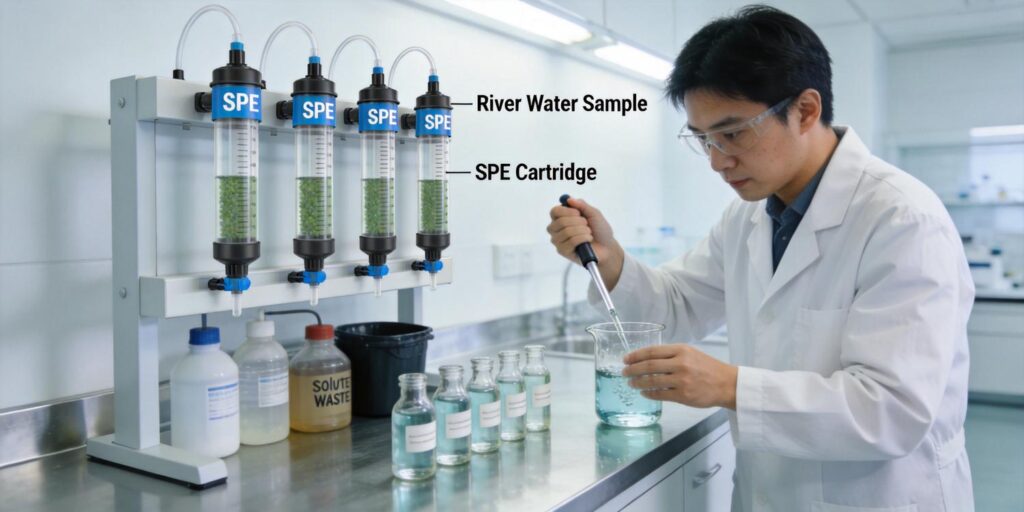
Importance of Herbicide Monitoring in Surface Water
Herbicide contamination in surface water represents a significant environmental and public health concern that demands rigorous monitoring programs. Agricultural runoff, industrial discharges, and improper disposal practices can introduce these persistent organic compounds into aquatic ecosystems at concentrations that threaten both ecological balance and human water supplies. The trace-level detection required for regulatory compliance—often in the parts-per-trillion (ppt) range—makes solid-phase extraction (SPE) an indispensable tool for environmental analysts.
Research demonstrates that SPE provides the necessary sensitivity for detecting herbicides like atrazine, metolachlor, and sulfonylurea compounds at sub-ppt levels in complex aqueous matrices. The technique’s ability to concentrate analytes while removing interfering substances like humic acids and fulvic acids makes it particularly valuable for surface water analysis where natural organic matter is abundant. As noted in environmental chemistry literature, SPE has become the method of choice for herbicide monitoring due to its superior recovery rates (typically exceeding 90%) compared to traditional liquid-liquid extraction methods.
Sample Volume Requirements and Enrichment
The selection of appropriate sample volumes represents a critical consideration in herbicide monitoring protocols. Surface water samples typically range from 100 mL to 1 L, depending on the required detection limits and the expected herbicide concentrations. Larger volumes provide greater enrichment factors but require careful consideration of SPE cartridge capacity and potential breakthrough volumes.
Enrichment factors of 100-1000x are commonly achieved through SPE, enabling detection of herbicides at concentrations as low as 0.01-0.1 μg/L. The breakthrough volume—the maximum sample volume that can be processed without analyte loss—depends on multiple factors including sorbent chemistry, flow rate, and herbicide physicochemical properties. Studies have shown that polymeric sorbents generally offer higher breakthrough volumes for polar herbicides compared to traditional C18 silica-based materials, making them particularly suitable for large-volume environmental samples.
SPE Sorbent Selection for Herbicide Classes
The diverse chemical properties of herbicide classes necessitate careful sorbent selection to achieve optimal recovery and selectivity. Modern SPE technology offers several specialized sorbent options tailored to different herbicide chemistries:
Reversed-Phase Sorbents (C18, C8, HLB)
For non-polar to moderately polar herbicides including triazines (atrazine, simazine), phenylureas, and chloroacetamides (metolachlor), reversed-phase sorbents provide excellent retention. Hydrophilic-lipophilic balance (HLB) polymers have gained popularity for their ability to retain a wide range of herbicides with varying polarities while maintaining high recovery rates even for challenging analytes.
Mixed-Mode Sorbents (MCX, MAX, WAX, WCX)
Ionizable herbicides such as phenoxy acids (2,4-D, MCPA), sulfonylureas, and glyphosate require mixed-mode sorbents that combine reversed-phase and ion-exchange mechanisms. Cation-exchange sorbents (MCX, WCX) effectively retain basic herbicides, while anion-exchange materials (MAX, WAX) target acidic compounds. These sorbents allow selective elution through pH adjustment, providing cleaner extracts for subsequent analysis.
Specialized Environmental Sorbents
Environmental-specific sorbents designed to handle complex matrices with high dissolved organic carbon content offer advantages for surface water analysis. These materials minimize interference from humic substances while maintaining high herbicide recoveries, as documented in studies comparing different sorbent types for pesticide analysis in environmental waters.
Field Sampling and Preservation Steps
Proper field sampling and preservation protocols are essential for maintaining herbicide integrity between collection and analysis. Key considerations include:
- Sample Collection: Use amber glass containers to prevent photodegradation of light-sensitive herbicides. Collect samples from representative locations, avoiding surface scum and bottom sediments.
- Preservation: Immediate acidification to pH ~2-3 with hydrochloric or sulfuric acid prevents microbial degradation and hydrolysis of labile herbicides. Refrigeration at 4°C during transport and storage is mandatory.
- Holding Times: Most regulatory methods specify maximum holding times (typically 7-14 days for acidified samples) to ensure analyte stability. Some herbicides, particularly organophosphates and carbamates, require more stringent timelines.
- Field Blanks and Spikes: Include field blanks (analyte-free water processed through sampling equipment) and field spikes (known herbicide additions) to monitor contamination and analyte losses during sampling and transport.
LC-MS Detection and Quantification
Liquid chromatography-mass spectrometry (LC-MS) has become the gold standard for herbicide quantification in environmental samples due to its sensitivity, selectivity, and ability to handle polar, thermally labile compounds. The integration of SPE with LC-MS provides a powerful analytical workflow:
Chromatographic Separation
Reversed-phase C18 columns with gradient elution using water-methanol or water-acetonitrile mobile phases effectively separate most herbicide classes. The addition of volatile buffers like ammonium formate or acetate enhances ionization efficiency in MS detection while maintaining chromatographic performance.
Mass Spectrometric Detection
Triple quadrupole instruments operating in multiple reaction monitoring (MRM) mode offer the sensitivity and selectivity required for trace-level herbicide analysis. Electrospray ionization (ESI) in both positive and negative modes covers the broad range of herbicide polarities. Recent advances in high-resolution mass spectrometry (HRMS) provide additional confirmation through accurate mass measurements.
Quantification Approaches
Matrix-matched calibration standards prepared in blank surface water extracts compensate for matrix effects that can suppress or enhance ionization. Internal standards, preferably isotopically labeled analogs of target herbicides, correct for variations in extraction efficiency and instrument response.
Data Quality Control Procedures
Rigorous quality control measures ensure the reliability and defensibility of herbicide monitoring data. A comprehensive QC program should include:
Method Blanks and Controls
Process blanks (analyte-free water through entire SPE procedure) monitor laboratory contamination. Continuing calibration verification standards assess instrument performance throughout analytical batches.
Matrix Spike/Matrix Spike Duplicates
Matrix spikes evaluate method accuracy in the specific sample matrix, while duplicates assess precision. Recovery criteria (typically 70-130% for most herbicides) must be established and monitored.
Surrogate Standards
Non-native compounds added to all samples before extraction monitor extraction efficiency and correct for analyte losses. Deuterated or 13C-labeled herbicides make ideal surrogates when available.
Quality Control Charts
Statistical control charts tracking recovery rates, retention times, and response factors over time identify trends and ensure method stability. Action limits trigger investigation and corrective actions when exceeded.
Method Detection Limits (MDLs)
MDLs determined through replicate analyses of low-concentration spikes establish the lowest concentration reliably distinguishable from zero. Practical quantification limits (PQLs) provide more realistic working detection limits.
The integration of automated SPE systems, particularly in 96-well plate formats, has significantly improved the precision and throughput of herbicide monitoring programs while reducing analyst exposure to solvents. As environmental regulations continue to evolve toward lower detection limits for an expanding list of herbicide compounds, SPE remains at the forefront of sample preparation technology, providing the sensitivity, selectivity, and reliability required for effective environmental monitoring.
For laboratories seeking to optimize their herbicide monitoring capabilities, HLB SPE cartridges offer excellent performance for a wide range of herbicide classes, while MAX and MCX mixed-mode sorbents provide targeted solutions for ionizable compounds. High-throughput laboratories may benefit from 96-well SPE plates for increased productivity in environmental monitoring programs.