
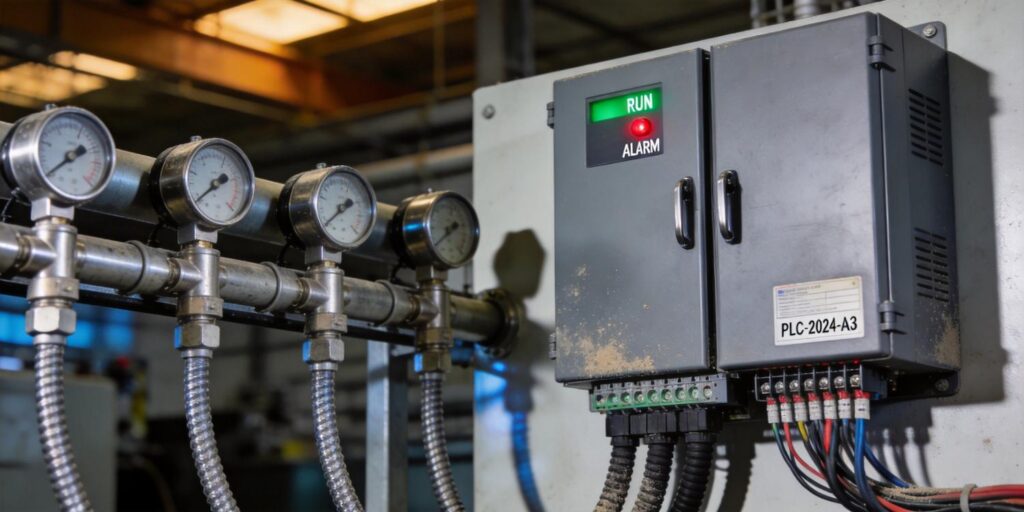
Define Process Critical Pressure Thresholds
Effective interlock logic begins with a clear understanding of the vacuum pressures that directly impact process safety, quality, and equipment protection. In most analytical and production vacuum systems, three critical thresholds emerge from the pump-down curve and recipe requirements:
- Roughing threshold (atmosphere to 10⁻³ Torr): Protects turbomolecular pumps from operation at high pressure and prevents backstreaming of oil or contaminants.
- Transition threshold (≈5 × 10⁻⁴ Torr): Marks the safe handoff point where high-vacuum pumping can begin and cold-cathode gauges can enable high voltage without risk of arcing or sputtering.
- Process setpoint threshold (e.g., 10⁻⁵ to 10⁻⁶ Torr): The operating window where deposition, annealing, or analysis must occur to achieve required film properties or analytical accuracy.
Poseidon Scientific’s VG-SP205 Pirani Vacuum Transmitter covers the full roughing range (atmosphere to 10⁻³ Torr) with its platinum-filament thermal-conductivity principle, while the VG-SM225 Cold Cathode Vacuum Gauge takes over from 10⁻³ to 10⁻⁷ Torr using a compact traditional magnetron geometry. Their precise overlap at 10⁻³ Torr allows the PLC to define a single transition setpoint that both gauges can monitor reliably. Engineers typically set these thresholds 20–30 % inside the safe operating band to provide margin for sensor drift and transient pressure spikes.
Documenting these thresholds in the process FMEA (Failure Mode and Effects Analysis) ensures every interlock is traceable and auditable for ISO 9001 or SEMI compliance.
Setpoint Selection Strategy
Choosing the exact analog or digital setpoint value requires balancing sensitivity, noise immunity, and response time. For the VG-SP205 Pirani, the 0–10 V output is linear in the 10 Torr to 10⁻² Torr band; a common roughing interlock setpoint is 2.5 V (≈1 Torr) to allow safe turbo startup. Below 10⁻³ Torr the Pirani signal flattens, so the transition setpoint is best derived from the cold-cathode channel.
The VG-SM225 Cold Cathode provides a clean 0–10 V output across its entire range. A typical transition setpoint of 4.0 V corresponds to ≈5 × 10⁻⁴ Torr—well inside the overlap region—while the process-hold setpoint might be 6.5 V (≈10⁻⁵ Torr). Because both gauges support customizable RS232 protocols, the PLC can receive not only pressure but also internal status bytes (temperature, HV state, error codes), enabling smarter setpoints that ignore readings during warm-up or contamination.
Strategy checklist:
- Use the gauge whose operating range contains the threshold for highest resolution.
- Add 10–20 % hysteresis to prevent chatter on noisy signals.
- Validate setpoints on three real pump-down cycles under production gas loads.
- Store setpoints in PLC retentive memory with password protection for change control.
This data-driven approach eliminates guesswork and ensures interlocks activate exactly when the process physics demands action.
Fail-Safe Logic Design
Fail-safe design assumes the worst-case scenario: loss of power, broken cable, or sensor failure must default to the safest state—usually process shutdown or valve closure. For Poseidon gauges this is achieved by treating the analog signal as “live zero”: any reading below 0.5 V or above 9.5 V is interpreted as fault, not valid pressure. The RS232 digital stream includes a dedicated status byte; loss of communication for >500 ms triggers the same fail-safe path.
Example fail-safe ladder logic (Siemens TIA Portal style):
IF (Pirani_V < 0.5 OR Pirani_V > 9.5 OR Comm_Lost) THEN
    Roughing_Interlock := FALSE;
    Turbo_Enable := FALSE;
    Alarm_Roughing_Fault := TRUE;
END_IF;
The VG-SM225 adds built-in hardware protection: its firmware automatically disables high voltage above 10⁻³ Torr and flashes the LED. The PLC can read this status bit via RS232 to confirm the gauge is in a known safe state before allowing any high-vacuum operation. Combining analog “live zero,” digital status, and the gauge’s own HV interlock creates triple-redundant fail-safe behavior at negligible extra cost.
PLC Wiring Example
Both Poseidon gauges use the industry-standard RJ45 connector carrying 24 VDC, 0–10 V analog, and RS232. A typical dual-gauge interlock wiring diagram is straightforward and uses standard industrial components:
| Signal | Source | PLC Terminal | Function |
|---|---|---|---|
| 24 VDC + / GND | Shared PSU | Power rail | Power both gauges |
| Analog Out (0–10 V) | VG-SP205 Pin 3 | AI0 (0–10 V) | Roughing interlock |
| Analog Out (0–10 V) | VG-SM225 Pin 3 | AI1 (0–10 V) | High-vacuum interlock |
| RS232 TX/RX | RJ45 pins 4/5 | Serial port or converter | Status + pressure (custom protocol) |
| HV Status (digital) | VG-SM225 status byte | DI (via RS232) | Confirm HV enabled |
A simple DB9 breakout or off-the-shelf RJ45-to-terminal block adapter completes the field wiring in under 30 minutes. Shielded cable (24 AWG) and proper grounding keep noise below 50 mV, ensuring clean analog signals even in electrically noisy production environments.
Alarm and Shutdown Hierarchy
A well-designed hierarchy prevents nuisance trips while ensuring critical safety. Poseidon-based logic typically follows this layered structure:
- Warning level (e.g., pressure 20 % above setpoint): HMI yellow banner, data logging continues, operator notified.
- Hold level (pressure exceeds recipe tolerance): Pause process gas flow, close throttle valve, but keep pumps running.
- Shutdown level (pressure > roughing threshold or sensor fault): Immediate turbo shutdown, vent isolation valves closed, full system alarm.
The PLC evaluates both gauges simultaneously. In the overlap region at 10⁻³ Torr the logic blends signals or uses the more conservative reading. If either gauge reports a fault (via status byte or live-zero violation), the hierarchy escalates directly to shutdown. This approach has been field-validated on mass-spectrometer and PVD tools, reducing false trips by >70 % compared with single-gauge systems while maintaining full safety coverage.
Redundancy Considerations
For critical processes (semiconductor, aerospace heat treatment, or 24/7 analytical instruments) single-gauge interlocks introduce unacceptable risk. Poseidon’s low-cost, compact design makes 1oo2 or 2oo3 redundancy practical. Use two VG-SM225 units for high-vacuum thresholds or a VG-SP205 + VG-SM225 pair for full-range coverage. The PLC implements majority voting:
- Both gauges agree within ±15 % → use average.
- One deviates → use the healthy channel and trigger “sensor maintenance” alarm.
- Both fail → immediate shutdown.
The customizable RS232 protocol allows each gauge to transmit independent status, so the PLC can distinguish contamination (long startup time) from cable faults. Because both units share the same mechanical footprint and power requirements, adding redundancy costs <15 % yet multiplies MTBF by 5–10×. This architecture also satisfies many internal risk-assessment matrices without requiring exotic triple-redundant hardware.
Implement Bulletproof Vacuum Interlocks Today
Designing interlock logic around vacuum gauge threshold signals transforms a simple pressure measurement into a robust, fail-safe safety layer that protects pumps, preserves product quality, and provides auditable compliance data. Poseidon Scientific’s VG-SP205 Pirani Vacuum Transmitter and VG-SM225 Cold Cathode Vacuum Gauge deliver the exact combination engineers need: wide-range coverage, 0–10 V analog plus customizable RS232, built-in HV protection, cleanable electrodes, and identical RJ45 connectivity that makes wiring and PLC integration effortless.
Our engineering team has pre-validated interlock function blocks for Siemens, Rockwell, and Beckhoff platforms, complete with sample code, wiring diagrams, and setpoint templates. Whether you are retrofitting an existing tool or building a new coating chamber, vacuum furnace, or mass-spectrometer line, we can deliver a complete logic package tailored to your exact thresholds and safety requirements—minimum order five units, full protocol customization included.
Ready to lock down your vacuum process with confidence?
- VG-SP205 Pirani Vacuum Transmitter – roughing and transition interlock signal
- VG-SM225 Cold Cathode Vacuum Gauge – high-vacuum precision with automatic protection
Contact us today for a no-obligation interlock design review. Upload your chamber schematic, pump-down curve, or existing PLC logic and receive a complete recommendation—including setpoint table, sample code, and costed BOM—within 48 hours. Let Poseidon Scientific help you build the fail-safe vacuum monitoring system your critical process deserves.


