
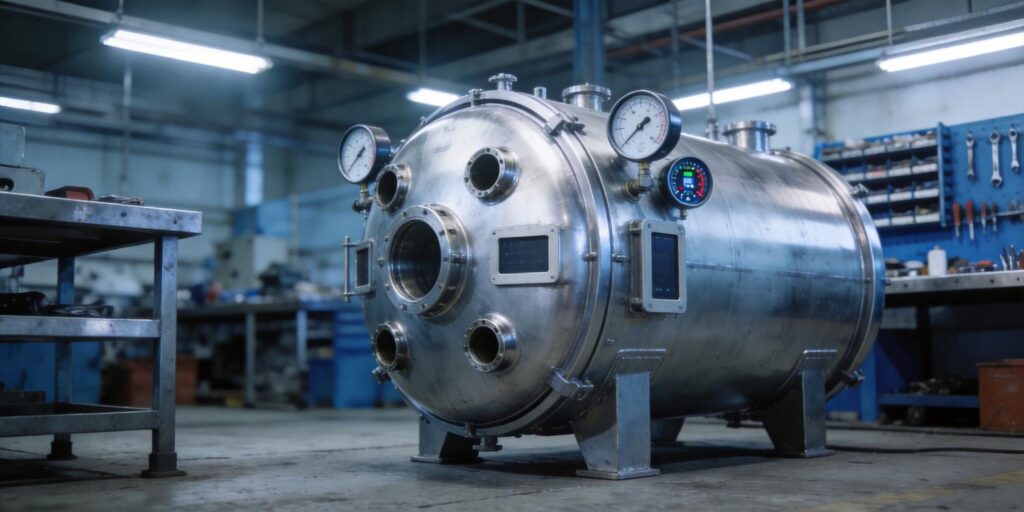
Large-scale industrial vacuum chambers—whether 10 m³ vacuum heat-treatment furnaces, multi-meter PVD coating systems, or aerospace simulation chambers—present unique monitoring challenges that small analytical instruments simply do not face. With volumes measured in cubic meters rather than liters, pump-down times stretch from minutes to hours, outgassing becomes significant, and pressure gradients across the chamber can reach 20–50 %. A single gauge mounted anywhere gives only a local snapshot; a well-engineered strategy using Poseidon Scientific’s VG-SP205 Pirani Vacuum Transmitter and VG-SM225 Cold Cathode Vacuum Gauge delivers the full-picture visibility required for safe, repeatable, and cost-effective operation.
This article outlines a practical vacuum monitoring strategy built around chamber volume effects, pump-down dynamics, optimal sensor placement, signal integration, and automated alarms. The approach has been field-validated in production-scale heat-treatment and coating lines, reducing scrap rates and energy consumption while cutting gauge-related hardware costs by 60–65 % versus imported equivalents.
Chamber Volume Considerations
Chamber volume directly scales pump-down time and outgassing load. The classic relationship is:
\( t \approx \frac{V}{S} \ln\left(\frac{P_0}{P_f}\right) + \frac{Q}{S} \cdot t \),
where \( V \) is volume, \( S \) is effective pumping speed, \( P_0 \) initial pressure, \( P_f \) final pressure, and \( Q \) is the outgassing rate. In a 5 m³ furnace, reaching 10⁻³ Torr can take 30–90 minutes even with a 5000 L/s turbomolecular pump; larger 20 m³ chambers may require hours.
Larger volumes amplify two effects that single-point monitoring cannot capture:
- Conductance limitations: Gas flow from remote corners to the pump port creates pressure gradients. A gauge at the pump throat may read 2–5× lower than one at the far wall.
- Outgassing dominance: At pressures below 10⁻³ Torr, wall desorption and virtual leaks dominate over residual gas. Multiple sensors reveal whether the chamber has reached equilibrium or is still “breathing.”
The solution is zonal monitoring. For chambers up to 10 m³, deploy one VG-SP205 Pirani on the roughing line and two VG-SM225 cold-cathode gauges (load side and pump side). For 10–50 m³ systems, scale to two Pirani units (top and bottom) plus three cold-cathode units. Both Poseidon models share identical KF16/KF25 flanges and footprints, so adding sensors never requires mechanical redesign.
Pump-Down Behavior and Crossover Management
Industrial pump-down follows a characteristic curve: rapid drop from atmosphere to 10 Torr (mechanical pump), slower descent through the molecular-flow transition (10⁻¹ to 10⁻³ Torr), then high-vacuum pumping to base pressure. The critical 10⁻³ Torr crossover is where most single-gauge systems fail—Pirani loses resolution while cold-cathode start-up can lag 5–30 minutes in ultra-clean chambers.
The Poseidon dual-technology pair eliminates this gap:
- VG-SP205 Pirani provides continuous, fast-response data (≤100 ms) from atmosphere to 10⁻³ Torr with linear performance in the 10–10⁻² Torr band where roughing valves and foreline pressure must be tightly controlled.
- VG-SM225 Cold Cathode remains in protected standby (high voltage disabled by firmware interlock) until the Pirani confirms pressure < 10⁻³ Torr, then automatically enables and stabilizes within seconds.
In practice, operators configure the PLC to use Pirani data for the first 80 % of pump-down and cold-cathode data for the final 20 %. The intentional overlap at 10⁻³ Torr gives two independent readings during the transition, allowing immediate detection of anomalies such as valve leakage or sudden outgassing bursts. Because both transmitters output the same 0–10 V analog scale and identical RS232 frames, the control system switches channels automatically with zero custom code in most installations.
Sensor Placement Strategy
Correct placement turns a set of gauges into a true monitoring network. Poseidon’s installation guidelines, validated across dozens of large-chamber projects, recommend:
| Chamber Zone | Recommended Gauge | Placement Rationale | Typical Quantity |
|---|---|---|---|
| Roughing / foreline | VG-SP205 Pirani | Fast response; monitors pump performance and oil backstreaming | 1–2 |
| Load / door area | VG-SP205 or VG-SM225 | Captures venting and initial outgassing; survives repeated atmosphere exposure | 1 |
| Process / center volume | VG-SM225 Cold Cathode | Represents true workpiece pressure; minimal magnetic interference at 100 gauss | 1–2 |
| Pump throat / exhaust | VG-SM225 Cold Cathode | Verifies ultimate base pressure; detects conductance bottlenecks | 1 |
All gauges mount in any orientation—no flow-direction sensitivity. Use short KF16/KF25 stub tubes (≤300 mm) to minimize conductance errors; avoid mounting directly opposite high-velocity pump inlets where local pressure dips occur. For chambers with internal fixtures or multiple shelves, add one extra cold-cathode unit per zone to confirm uniformity before starting the thermal cycle.
The VG-SM225’s removable sensor head is especially valuable in large systems: contamination from lubricants or process residues can be cleaned in place in under 15 minutes without breaking main chamber vacuum or requiring recalibration.
Signal Integration for Plant-Wide Visibility
Large chambers are almost always controlled by PLCs or SCADA systems that demand both local and remote data. Poseidon transmitters support hybrid integration:
- Analog (0–10 V): Direct wiring to legacy PLC analog input cards; effective 2–8 V span gives 0.1 % resolution with standard 16-bit cards.
- Digital RS232: 9600 baud, 9-byte frame every 100 ms including status, error codes, and checksum. Up to 32 gauges can share a single multi-drop bus via optional RS485 board spin.
For systems with 6–12 gauges, the digital route reduces wiring by 70 % and adds diagnostic value: the control system can log filament-open or discharge-failure codes directly into the historian for predictive maintenance. Free protocol customization (orders of 5+ units) allows direct mapping to Modbus RTU, EtherNet/IP, or Profibus—eliminating gateway hardware and driver development costs that imported gauges often require.
Temperature compensation (hardware + algorithm) keeps drift below 1 % across 15–50 °C, ensuring stable readings even when chamber walls cycle from 20 °C to 800 °C externally.
Automation Alarms and Interlocks
Automated alarms transform raw pressure data into process protection. Poseidon’s built-in status and error bytes make implementation straightforward. Typical alarm set points for a vacuum heat-treatment furnace include:
- Roughing complete: Pirani < 5 Torr → open high-vacuum valve (prevent backstreaming).
- Crossover ready: Pirani < 10⁻³ Torr and Cold Cathode enabled → start heaters.
- Base pressure achieved: Cold Cathode < 5×10⁻⁶ Torr → load thermal cycle recipe.
- Leak or outgassing alert: Any gauge rises >20 % in 60 s → trigger audible alarm and pause process.
- Sensor health: Error code 128 (discharge failure) or 129 (filament open) → automatic standby mode and maintenance notification.
Because the two technologies use different physics, simultaneous false alarms are statistically improbable. The control logic can require “both gauges agree” for critical interlocks, reducing nuisance trips while maintaining safety. All alarms are logged with timestamp and gauge ID, satisfying ISO 9001 and NADCAP traceability requirements.
Case Example: 12 m³ Multi-Zone Vacuum Heat-Treatment Line
A major Chinese automotive tooling supplier upgraded a legacy 12 m³ triple-chamber heat-treatment line in 2025. The original imported single-gauge setup (one MKS cold cathode per chamber) suffered frequent start-up delays, contamination shutdowns, and inconsistent base-pressure readings across zones.
The new strategy deployed:
- Two VG-SP205 Pirani units per chamber (roughing line + load door)
- Three VG-SM225 Cold Cathode units per chamber (load, center, pump throat)
- Full RS232 integration to a Siemens S7-1500 PLC with free custom protocol mapping
Results after six months of 24/7 operation:
- Pump-down time reduced 28 % through precise crossover timing
- Zone-to-zone uniformity improved from ±25 % to ±8 %
- Zero gauge-related downtime (cold-cathode heads cleaned in-house every 4 months)
- Total gauge hardware cost dropped from 120 000 RMB to 42 000 RMB
- Energy savings of 15 % from optimized pump sequencing
The customer has since standardized the same strategy across three additional lines, proving scalability from pilot to full production.
Build a Reliable Large-Chamber Monitoring Strategy
Effective vacuum monitoring in large-scale industrial chambers is not about buying the most expensive gauge—it is about deploying the right technology in the right places with intelligent integration. The VG-SP205 Pirani Vacuum Transmitter and VG-SM225 Cold Cathode Vacuum Gauge deliver exactly that combination: full-range coverage, automatic crossover, zonal visibility, field serviceability, and open digital integration at a self-developed cost that protects project margins.
Whether you are specifying instrumentation for a new 20 m³ coating chamber, retrofitting legacy heat-treatment furnaces, or scaling an existing vacuum process line, this strategy eliminates blind spots, accelerates pump-down, and provides the audit-ready data your quality system demands.
Explore the VG-SP205 Pirani Vacuum Transmitter and VG-SM225 Cold Cathode Vacuum Gauge today. Need a multi-gauge layout diagram for your chamber dimensions, PLC ladder-logic examples, custom alarm setpoint worksheet, or a no-obligation sample set for on-site testing? Contact our applications team directly—we respond within 24 hours and have helped industrial OEMs worldwide implement this exact large-chamber strategy with zero commissioning surprises.


