
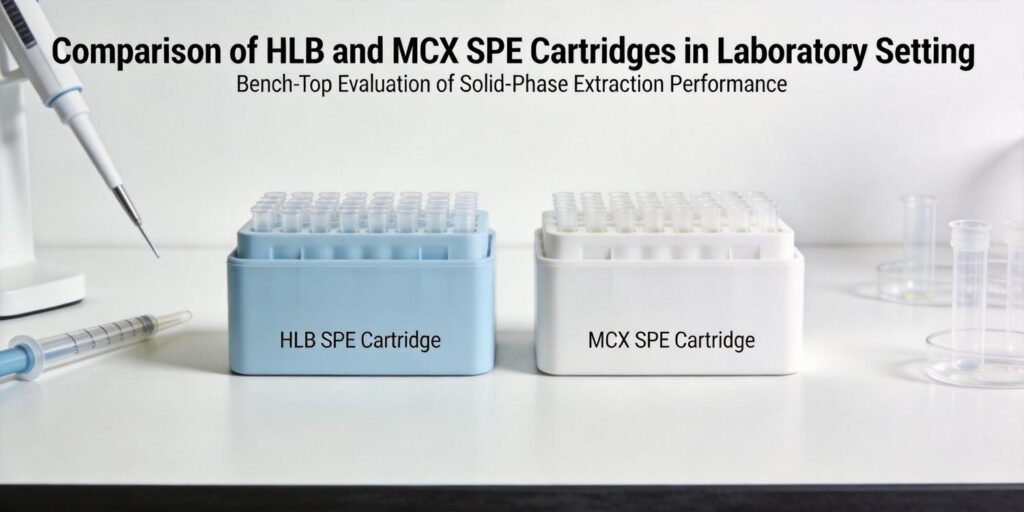
Comparison of Sorbent Chemistry
When selecting between HLB (Hydrophilic-Lipophilic Balanced) and MCX (Mixed-mode Cation eXchange) SPE cartridges, understanding their fundamental sorbent chemistry is crucial for making informed decisions. These two sorbent types represent different approaches to solid-phase extraction, each with distinct retention mechanisms and applications.
HLB Sorbent Chemistry
Oasis HLB, introduced in 1996, revolutionized SPE with its water-wettable copolymer technology. The HLB sorbent is constructed from a hydrophilic-lipophilic balanced copolymer that provides both hydrophilic and lipophilic retention properties. This unique chemistry offers several key advantages:
- Water-wettable nature: Unlike traditional silica-based sorbents, HLB doesn’t require conditioning and equilibration steps before sample loading. This allows direct loading of aqueous samples without sacrificing recovery.
- pH stability: The sorbent remains stable across the entire pH range (0-14), making method development simpler and more robust.
- No silanol interactions: The absence of silanol groups eliminates secondary interactions that can complicate retention and method development.
- High capacity: HLB provides superior capacity for a wide range of compounds, particularly polar analytes that might be challenging for traditional reversed-phase sorbents.
The HLB sorbent functions primarily through reversed-phase retention mechanisms, utilizing hydrophobic interactions for non-polar compounds while maintaining retention capabilities for polar analytes through its hydrophilic components.
MCX Sorbent Chemistry
Oasis MCX represents a more specialized approach, combining reversed-phase retention with cation-exchange functionality. This mixed-mode sorbent offers orthogonal selectivity for basic compounds:
- Dual retention mechanism: MCX provides both reversed-phase (hydrophobic) and cation-exchange retention, offering enhanced selectivity for basic analytes.
- Controlled ion-exchange capacity: With a tightly controlled ion-exchange capacity of 1 meq/g, MCX ensures reproducible SPE protocols.
- pH stability: Like HLB, MCX maintains stability across pH 0-14, simplifying method development.
- No silanol complications: The absence of silanol groups prevents unwanted secondary interactions.
The cation-exchange functionality in MCX comes from sulfonic acid groups on the sorbent surface, which interact with protonated basic compounds through ionic interactions. This dual mechanism allows for more selective retention and cleaner extracts when dealing with basic analytes in complex matrices.
Analyte Polarity Considerations
The polarity of your target analytes plays a critical role in determining whether HLB or MCX is the appropriate choice for your application. Understanding how these sorbents interact with different types of compounds will guide your selection process.
HLB for Broad Polarity Range
HLB excels at handling a wide spectrum of analyte polarities:
- Acids, bases, and neutrals: HLB effectively retains compounds across all three categories, making it ideal for multi-class analyses.
- Polar compounds: The hydrophilic component of HLB provides excellent retention for polar analytes that might be lost on traditional reversed-phase sorbents.
- Non-polar compounds: The lipophilic component ensures strong retention for hydrophobic analytes.
- Compounds with varying pKa: HLB works well for analytes with pKa values across the entire range, though it doesn’t provide the selective retention of mixed-mode sorbents.
According to Waters documentation, HLB is particularly effective for extremely polar compounds, offering high capacity that exceeds traditional silica-based sorbents. When converting from C18 silica-based sorbents to Oasis SPE sorbents, you can use approximately 2/3 less Oasis sorbent (100 mg C18 sorbent = 30 mg Oasis sorbent) due to the increased capacity.
MCX for Basic Compounds
MCX is specifically designed for basic analytes and offers enhanced selectivity:
- Basic compounds (pKa > 2): MCX provides optimal retention for weak bases and other basic analytes.
- Protonated bases: The cation-exchange functionality interacts strongly with protonated basic compounds at appropriate pH conditions.
- Compounds requiring selective retention: MCX offers orthogonal selectivity through its mixed-mode mechanism, allowing for cleaner extracts when dealing with basic analytes in complex matrices.
- Analytes with specific pKa requirements: For optimal retention on MCX, the sample pH should be at least 2 units below the analyte’s pKa to ensure protonation and effective cation-exchange interaction.
The dual retention mechanism of MCX means that basic analytes are retained through both hydrophobic interactions and ionic bonding, providing stronger overall retention and better selectivity compared to single-mode sorbents.
Typical Use Cases
Understanding the typical applications for each sorbent type will help you match your specific needs with the appropriate technology.
HLB Applications
HLB serves as a versatile workhorse for numerous applications:
- Multi-class drug analysis: When analyzing diverse drug classes in biological fluids, HLB provides broad-spectrum retention.
- Environmental water analysis: For trace organic contaminants in water samples, HLB offers excellent recovery across various compound classes.
- Food and beverage analysis: HLB effectively handles complex matrices while maintaining good recovery for target analytes.
- Pharmaceutical analysis: For drug discovery and development applications requiring analysis of diverse compound libraries.
- General screening applications: When the analyte profile is unknown or includes compounds with varying chemical properties.
HLB’s simplicity makes it particularly valuable for routine applications. The PRiME HLB variant takes this further by eliminating conditioning and equilibration steps while removing more than 95% of common matrix interferences such as phospholipids, fats, salts, and proteins.
MCX Applications
MCX finds its strength in more specialized applications:
- Basic drug analysis in biological matrices: Particularly effective for analyzing basic drugs and their metabolites in plasma, serum, or urine.
- Forensic toxicology: For selective extraction of basic drugs of abuse from complex biological samples.
- Pharmaceutical impurity profiling: When selective retention of basic impurities or degradation products is required.
- Environmental analysis of basic compounds: For selective extraction of basic contaminants from environmental samples.
- Applications requiring ultra-clean extracts: The mixed-mode mechanism provides superior cleanup compared to single-mode sorbents.
MCX is particularly valuable when matrix effects pose significant challenges or when high sensitivity is required. The orthogonal selectivity helps reduce matrix interferences that might co-elute with target analytes on single-mode sorbents.
Practical Selection Guide
Making the right choice between HLB and MCX requires considering several practical factors. Here’s a systematic approach to guide your selection:
Decision Flowchart
Start with these questions:
- What is the chemical nature of your analytes?
- If analyzing acids, bases, and neutrals together → Choose HLB
- If specifically targeting basic compounds → Consider MCX
- If dealing with acidic compounds → Consider MAX (Mixed-mode Anion eXchange)
- What is your primary objective?
- Maximum simplicity and broad coverage → Choose HLB
- Maximum selectivity and cleanliness → Consider MCX for basic analytes
- Routine analysis with minimal steps → Consider PRiME HLB
- What is your sample matrix complexity?
- Simple matrices with minimal interferences → HLB may suffice
- Complex biological matrices with many interferences → MCX may provide cleaner extracts
- High lipid content samples → PRiME HLB offers excellent phospholipid removal
Technical Considerations
Method Development Factors:
- pH optimization: For MCX, ensure sample pH is at least 2 units below analyte pKa for effective protonation and cation-exchange retention.
- Elution solvent selection: HLB typically uses methanol or methanol-containing mixtures, while MCX may require specific elution protocols involving pH adjustment.
- Wash optimization: MCX allows for more aggressive washing conditions while maintaining analyte retention due to the dual retention mechanism.
- Capacity considerations: Both sorbents offer high capacity, but MCX’s mixed-mode mechanism may provide higher effective capacity for basic analytes in certain conditions.
Format Selection:
Both HLB and MCX are available in various formats to suit different laboratory needs:
- Cartridges: Available in sizes from 1 cc/10 mg to 35 cc/6 g
- 96-well plates: For high-throughput applications, available with 2 mg to 60 mg sorbent per well
- μElution plates: For low elution volume applications requiring no evaporation step
- Particle sizes: Available in 30 μm (for most plasma, serum, and human urine) or 60 μm (for more viscous samples like animal urine)
Cost-Benefit Analysis
Consider these factors when evaluating the economic aspects:
- Method development time: HLB typically requires less method development time due to its simplicity
- Consumable costs: While MCX cartridges may have slightly higher unit costs, the improved selectivity may reduce downstream costs associated with instrument maintenance and data analysis
- Throughput considerations: The simplified protocols of PRiME HLB can significantly increase throughput in routine applications
- Data quality impact: Cleaner extracts from MCX may improve data quality, potentially reducing reanalysis costs
Hybrid Approaches
In some cases, a hybrid approach may be optimal:
- Initial screening with HLB: Use HLB for initial method development and screening, then switch to MCX if selectivity issues arise
- Sequential SPE: In particularly challenging applications, consider using HLB followed by MCX for maximum cleanup
- Method transfer: When transferring methods from other laboratories, carefully evaluate whether the original sorbent choice remains optimal for your specific conditions
Validation Considerations
When validating methods using either sorbent, pay particular attention to:
- Recovery consistency: Both sorbents offer excellent batch-to-batch consistency, but verify recovery across your expected concentration range
- Matrix effects: Evaluate matrix effects carefully, as MCX may provide better reduction of ion suppression/enhancement for basic analytes
- Robustness: Test method robustness against variations in sample pH, loading volume, and wash conditions
- Carryover: Verify that carryover meets your method requirements, particularly when dealing with high concentration samples
By carefully considering these factors and following this practical guide, you can make an informed decision between HLB and MCX SPE cartridges that optimizes both analytical performance and operational efficiency for your specific application.
For more detailed information about our SPE products, visit our HLB SPE Cartridges, MCX SPE Cartridges, and 96-well SPE Plate product pages.


