Definition of Base Pressure
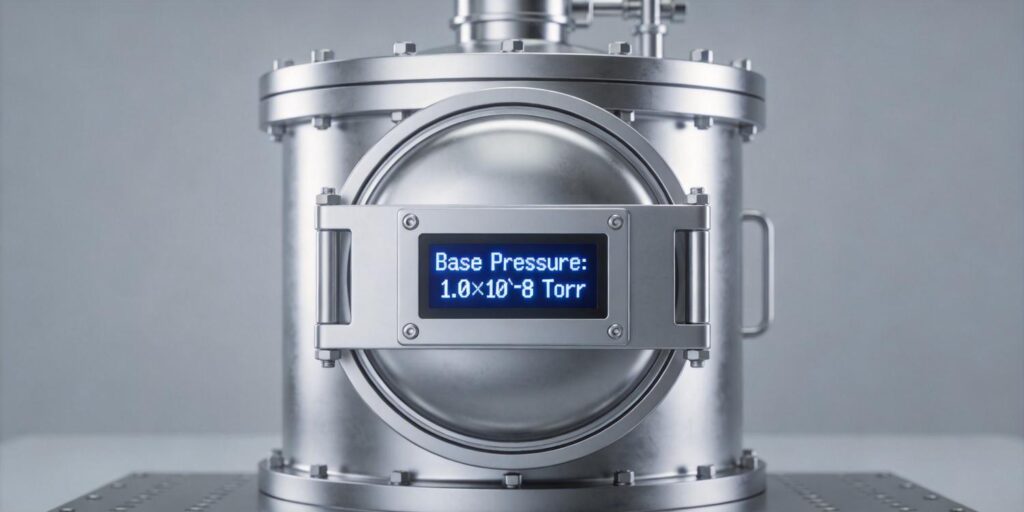
Base pressure, also called ultimate vacuum or blank-off pressure, is the lowest stable pressure a vacuum system can achieve when all pumps are operating at full capacity, the chamber is isolated from any external gas load, and sufficient time has been allowed for outgassing to stabilize. In practical terms, it represents the system’s inherent vacuum capability once transient effects from initial pump-down have subsided.
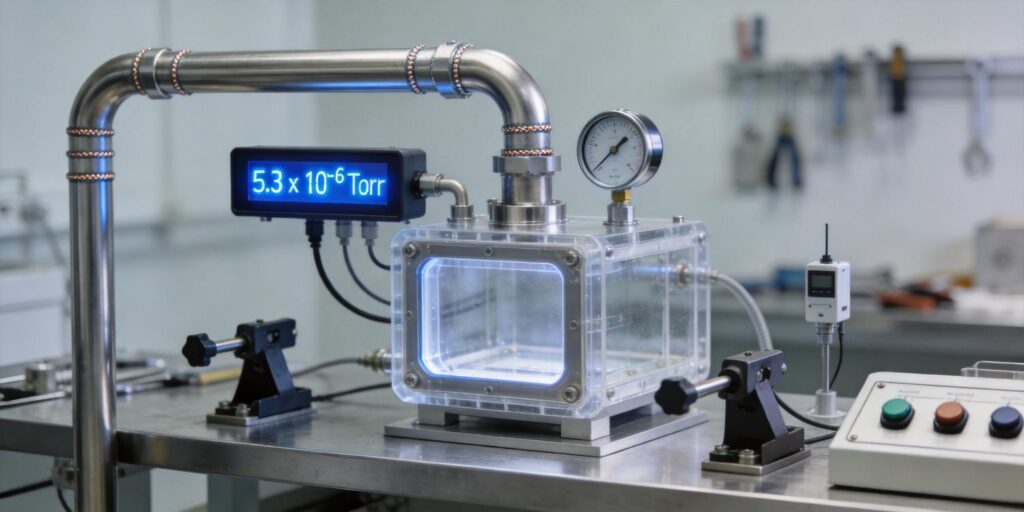
For most industrial and laboratory high-vacuum applications, base pressure is measured in the 10⁻⁵ to 10⁻⁷ Torr range. It is not a fixed property of the pump alone but emerges from the interaction of the entire vacuum envelope—chamber walls, seals, fixtures, and instrumentation. Engineers rely on accurate base-pressure verification to confirm that a system is ready for process gas introduction, plasma ignition, or sensitive material processing. Poseidon Scientific’s VG-SM225 Cold Cathode Vacuum Gauge is specifically engineered to deliver reliable readings in exactly this regime, providing the confidence needed before proceeding to the next process step.
Factors Affecting Ultimate Vacuum
Several interrelated factors determine how low a system can ultimately go. The two dominant contributors are the effective pumping speed at the chamber and the rate of gas evolution (outgassing) from all internal surfaces. Minor leaks, virtual leaks from trapped volumes, and backstreaming from pump oil (in older rotary vane systems) can also limit performance.
Temperature plays a critical role: raising chamber temperature during bake-out dramatically accelerates outgassing, allowing the system to reach a lower base pressure once cooled. Surface finish, material selection (stainless steel vs. aluminum), and the use of low-outgassing elastomers further influence results. In real-world systems, these variables rarely align perfectly, which is why base pressure is always verified empirically rather than calculated from pump specifications alone.
Pump Performance Influence on Base Pressure
The pump’s ultimate pressure specification is a necessary but insufficient predictor of system base pressure. A turbomolecular pump rated for 10⁻⁹ Torr may only achieve 10⁻⁶ Torr in a chamber with high surface area or recent exposure to atmosphere. Effective pumping speed at the chamber throat—not the pump inlet—dictates the result, and conductance losses through valves and manifolds must be accounted for.
Oil-sealed rotary vane or dry scroll pumps handle the roughing stage down to ~10⁻³ Torr, after which high-vacuum pumps take over. Any degradation in pump performance (worn vanes, contaminated oil, or reduced compression ratio) directly raises the observable base pressure. Regular pump maintenance and periodic speed testing are therefore essential. Poseidon gauges help operators monitor this degradation: a slow rise in stabilized pressure over successive cycles is often the first indicator that pump service is required.
Outgassing Contribution to Base Pressure Limits
Outgassing—the slow release of adsorbed water vapor, hydrocarbons, and dissolved gases from chamber walls, seals, and internal fixtures—is frequently the dominant limiter of base pressure in unbaked systems. Even electropolished stainless steel releases monolayers of water vapor for hours after initial pump-down. Virtual leaks (trapped volumes behind screws or in weld porosity) produce similar effects that appear as pressure plateaus on the pump-down curve.
In practice, outgassing rate decreases exponentially with time under vacuum and can be accelerated by mild heating or UV exposure. For most production vacuum drying ovens, coating chambers, and heat-treatment furnaces, the base pressure achieved after 30–60 minutes of pumping is dominated by outgassing rather than pump ultimate pressure. The VG-SM225 Cold Cathode Vacuum Gauge excels at quantifying this contribution because its Penning discharge principle is insensitive to the low gas loads typical of stabilized high vacuum, delivering repeatable readings once the system has settled.
Cold Cathode Role in Base Pressure Verification
Once the system crosses below 10⁻³ Torr, a cold cathode gauge becomes the preferred instrument for confirming true base pressure. The VG-SM225 uses a positive-magnetron (Penning) discharge sustained by crossed electric and magnetic fields (~100 gauss). Electrons follow extended spiral paths, producing ion current directly proportional to gas density in the 10⁻³ to 10⁻⁷ Torr operating band.
Unlike hot-cathode ionization gauges, the VG-SM225 has no heated filament to contribute its own outgassing or burn out under sudden pressure spikes. Its modular sensor head can be cleaned on-site with abrasive paper if minor contamination occurs, and built-in software protection automatically disables high voltage above 10⁻³ Torr. These features make it the practical choice for routine verification: operators simply wait for the reading to stabilize and confirm that the system has reached the target base pressure before introducing process gas or applying heat.
Measurement Stability Considerations
Stable base-pressure measurement requires attention to both gauge and system factors. Temperature drift in the gauge electronics, residual magnetic field leakage, and electrode contamination can all introduce small offsets. Poseidon’s VG-SM225 incorporates temperature compensation and individual factory calibration curves stored by serial number, keeping repeatability within ±10 % across the operating band.
System-level stability is equally important. Short, high-conductance connections between the gauge and chamber minimize pressure gradients. The gauge should be mounted away from direct line-of-sight to high-outgassing components (such as freshly installed targets or seals) yet still representative of the process zone. Periodic cross-checking against a second gauge or a known reference point confirms that the reported base pressure is not artificially elevated by gauge-specific drift.
Practical Example Curve: Typical Pump-Down to Base Pressure
Consider a 200-liter stainless-steel vacuum chamber equipped with a 300 L/s turbomolecular pump and roughing pump. The table below shows a representative pump-down sequence measured with a Poseidon VG-SP205 Pirani (roughing) and VG-SM225 Cold Cathode (high vacuum):
| Time (min) | Pressure (Torr) | Gauge | Comment |
|---|---|---|---|
| 0 | 760 | VG-SP205 Pirani | Atmosphere, vented chamber |
| 2 | 10 | VG-SP205 Pirani | Roughing complete, solvent/water vapor peak |
| 8 | 0.001 | VG-SP205 Pirani | Transition to high vacuum |
| 15 | 5.2 × 10⁻⁵ | VG-SM225 Cold Cathode | Initial stabilization |
| 45 | 8.7 × 10⁻⁶ | VG-SM225 Cold Cathode | Base pressure reached (outgassing dominant) |
| 120 | 7.9 × 10⁻⁶ | VG-SM225 Cold Cathode | Stable base pressure confirmed |
This curve illustrates the classic exponential decay followed by a long plateau once outgassing becomes the rate-limiting step. The cold-cathode gauge verifies that the system has truly reached equilibrium before process initiation.
Conclusion: Reliable Base Pressure Verification Drives Process Success
Understanding and measuring base pressure is fundamental to repeatable high-vacuum performance. By isolating the contributions of pump speed and outgassing, engineers can diagnose system health, optimize pump-down recipes, and ensure consistent results across batches. Poseidon Scientific’s VG-SM225 Cold Cathode Vacuum Gauge, with its field-serviceable design, stable Penning discharge, and direct compatibility with existing controllers, provides the accurate, low-maintenance verification tool required for today’s demanding applications.
When paired with the VG-SP205 Pirani Vacuum Transmitter for roughing-stage monitoring, the combination delivers complete visibility from atmosphere to true high vacuum—all at a cost structure and serviceability level that supports both laboratory and production environments.
Ready to optimize base pressure measurement in your high-vacuum system? Contact Poseidon Scientific today for a no-obligation consultation. Our team—led by the engineers who designed the VG-SM225 and VG-SP205—will review your chamber layout, pump configuration, and process requirements and recommend the exact monitoring solution that delivers stable, verifiable base pressure with minimal maintenance.
Explore the full specifications of the VG-SM225 Cold Cathode Vacuum Gauge for high-vacuum verification or the complementary VG-SP205 Pirani Vacuum Transmitter and take the next step toward more reliable, repeatable vacuum performance.