Increasing Concern Over Trace Antibiotics in Drinking Water Supplies
The detection of trace-level antibiotics in drinking water has emerged as a critical environmental and public health concern. As pharmaceutical consumption increases globally, residues from antibiotics like sulfonamides, macrolides, and fluoroquinolones are finding their way into water systems through various pathways including wastewater treatment plant effluents, agricultural runoff, and improper disposal. These compounds, often present at ng/L to μg/L concentrations, pose potential risks including antibiotic resistance development, ecological disruption, and chronic human health effects.
Regulatory agencies worldwide are increasingly focusing on monitoring these emerging contaminants. The analytical challenge lies in detecting these compounds at ultra-trace levels in complex aqueous matrices while maintaining method robustness and reliability. Solid-phase extraction (SPE) has proven indispensable for addressing these challenges, offering both sample cleanup and analyte concentration capabilities that are essential for reliable detection.
Target Analytes: Sulfonamides, Macrolides, and Fluoroquinolones
Three major antibiotic classes dominate drinking water monitoring programs due to their widespread use and environmental persistence:
Sulfonamides
These bacteriostatic antibiotics contain an aromatic amine group and sulfonamide moiety, making them amphoteric compounds with pKa values typically between 2-3 (sulfonamide group) and 5-7 (amino group). Their moderate hydrophobicity (log P values 0.5-1.5) and zwitterionic nature at neutral pH require careful pH optimization during extraction.
Macrolides
Large, hydrophobic compounds (log P values 2-4) with multiple basic functional groups. Erythromycin, clarithromycin, and azithromycin are commonly monitored. Their high molecular weight and complex structure necessitate efficient extraction methods to achieve adequate recovery.
Fluoroquinolones
These broad-spectrum antibiotics contain both carboxylic acid and basic amine groups, resulting in zwitterionic behavior. Ciprofloxacin, norfloxacin, and ofloxacin are frequently detected in water samples. Their amphoteric nature requires pH optimization to ensure proper retention on SPE sorbents.
Water Sample Pre-treatment: Filtration and pH Adjustment Strategies
Proper sample pre-treatment is crucial for successful SPE of antibiotics from drinking water. The process typically involves two key steps:
Filtration
Drinking water samples (typically 0.5-1 L volumes) should be filtered through 0.45 μm glass fiber or cellulose membrane filters to remove particulate matter that could clog SPE cartridges. For some applications, 0.7 μm filters may be acceptable, but 0.45 μm provides better protection for SPE media. It’s essential to avoid filters that might adsorb target analytes—glass fiber filters generally show minimal adsorption for most antibiotics.
pH Adjustment
pH optimization is critical for efficient extraction of antibiotics with multiple ionizable groups:
- For sulfonamides: Adjust to pH 5-6 to maximize retention on mixed-mode sorbents
- For macrolides: pH 8-9 enhances retention on hydrophobic phases
- For fluoroquinolones: pH 7-8 optimizes zwitterionic retention
- For multi-class extraction: pH 7 provides reasonable compromise for all three classes
Buffer systems like phosphate or acetate buffers (10-50 mM) help maintain stable pH during sample loading. The buffer concentration should be sufficient to overcome matrix effects but not so high as to cause salting-out effects that might reduce recovery.
SPE Sorbent Selection for Broad-Spectrum Antibiotic Extraction
Selecting the appropriate SPE sorbent is paramount for successful multi-class antibiotic analysis. Based on extensive research and practical experience, several sorbent options have proven effective:
Mixed-Mode Cation Exchange (MCX) Sorbents
These sorbents combine hydrophobic (C8 or C18) and strong cation exchange (sulfonic acid) functionalities. They are particularly effective for basic and zwitterionic antibiotics. At acidic pH, protonated amine groups interact with the cation exchange sites, while hydrophobic moieties interact with the C8/C18 chains. This dual retention mechanism provides excellent recovery for macrolides and fluoroquinolones.
Mixed-Mode Anion Exchange (MAX) Sorbents
Combining hydrophobic and strong anion exchange (quaternary amine) functionalities, MAX sorbents work well for acidic compounds. While less commonly used for these antibiotic classes, they can be valuable for specific applications or as part of sequential extraction schemes.
Hydrophilic-Lipophilic Balanced (HLB) Sorbents
These polymeric sorbents containing both hydrophilic (N-vinylpyrrolidone) and lipophilic (divinylbenzene) monomers provide excellent retention for a wide range of compounds regardless of pH. HLB sorbents are particularly useful for multi-class antibiotic analysis as they retain compounds across a broad pH range without requiring pH optimization for each class.
Weak Cation Exchange (WCX) Sorbents
These sorbents contain carboxylic acid groups that provide pH-dependent cation exchange capacity. They offer selective retention of basic compounds while allowing neutral and acidic compounds to pass through, potentially simplifying cleanup for specific applications.
Weak Anion Exchange (WAX) Sorbents
Containing secondary amine groups, WAX sorbents provide pH-dependent anion exchange capacity. They can be useful for specific antibiotic classes or as part of more complex extraction strategies.
For most multi-class antibiotic applications, HLB or MCX sorbents provide the best balance of recovery, selectivity, and ease of use. Cartridge sizes typically range from 60 mg to 500 mg bed mass, with 200-500 mg being common for 1 L water samples.
Example Workflow for 1 L Drinking Water Enrichment
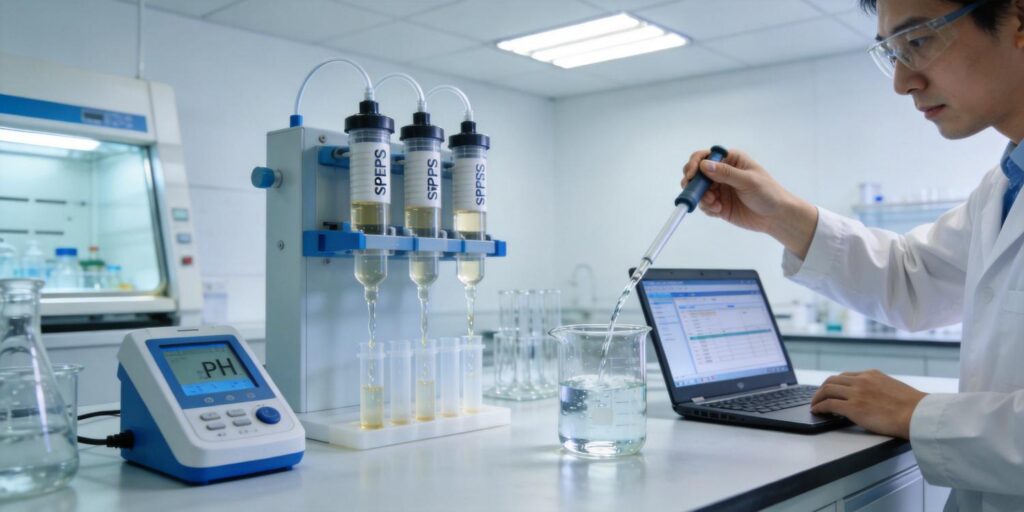
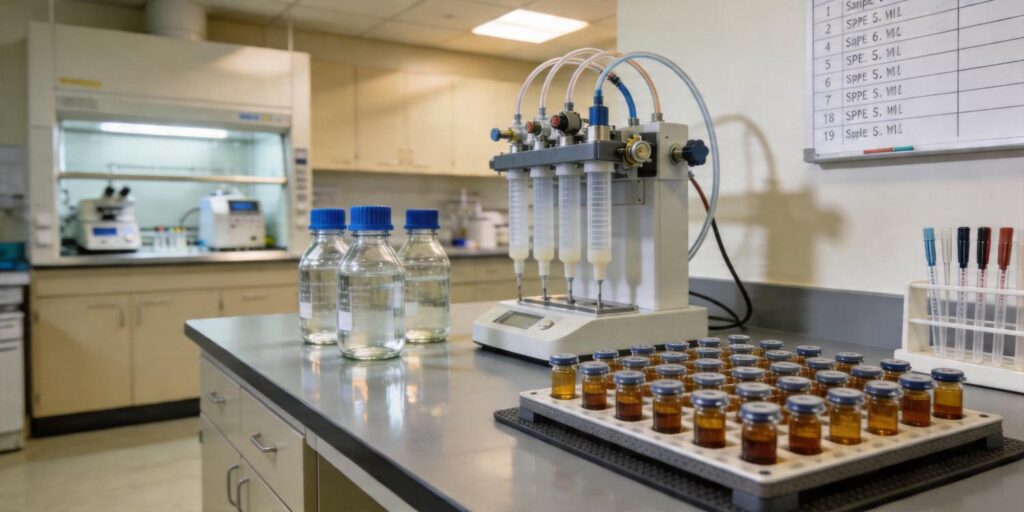
Here’s a detailed workflow for extracting trace antibiotics from 1 L drinking water samples using HLB sorbents:
Materials and Equipment
- HLB SPE cartridges (200-500 mg, 6 mL)
- Vacuum manifold or positive pressure processor
- pH meter and buffer solutions
- Collection tubes (15-50 mL)
- Evaporation system (nitrogen evaporator or centrifugal concentrator)
- Solvents: methanol, acetonitrile, water (LC-MS grade)
Step-by-Step Procedure
- Sample Preparation: Filter 1 L drinking water through 0.45 μm glass fiber filter. Adjust pH to 7.0 ± 0.2 using dilute HCl or NaOH.
- SPE Cartridge Conditioning:
- Condition with 5 mL methanol at 1-2 mL/min
- Equilibrate with 5 mL deionized water at 1-2 mL/min
- Do not allow sorbent to dry before sample loading
- Sample Loading:
- Load 1 L sample at 5-10 mL/min (gravity flow or gentle vacuum)
- Maintain consistent flow rate to ensure optimal recovery
- Cartridge Washing:
- Wash with 5 mL 5% methanol in water to remove weakly retained interferences
- Apply vacuum for 5 minutes to dry cartridge completely
- Analyte Elution:
- Elute with 2 × 5 mL methanol (or methanol with 2% formic acid for improved recovery of basic compounds)
- Collect eluate in clean glass tubes
- Sample Concentration:
- Evaporate eluate to near dryness under gentle nitrogen stream at 30-40°C
- Reconstitute in 1 mL initial mobile phase composition (typically 5-10% organic in water)
- Filter through 0.2 μm syringe filter if necessary
This workflow typically achieves 70-120% recovery for most antibiotics with RSD values <15%. For improved selectivity, consider adding a wash step with 5 mL hexane to remove non-polar interferences before elution.
LC-MS/MS Detection and Method Sensitivity Optimization
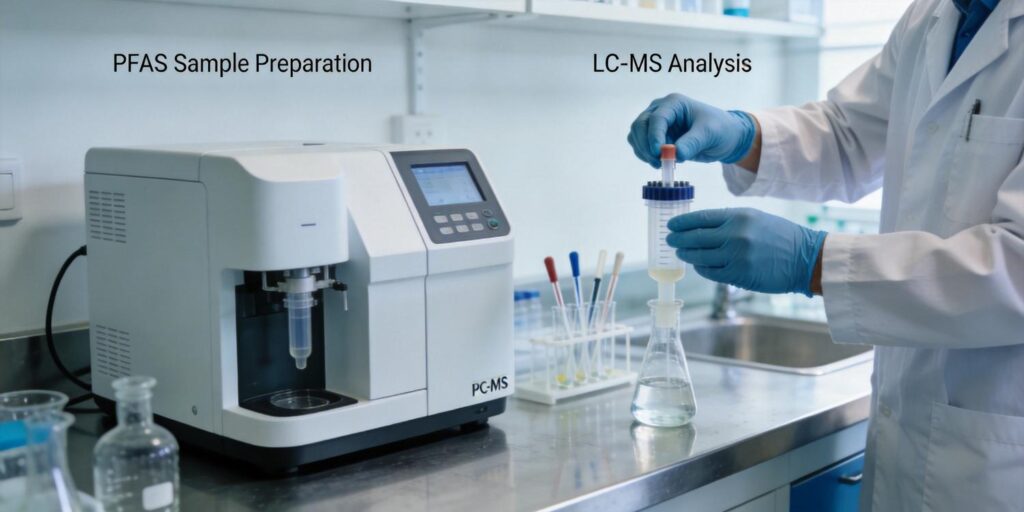
Liquid chromatography coupled with tandem mass spectrometry (LC-MS/MS) represents the gold standard for trace antibiotic analysis in water samples. The combination of SPE enrichment with LC-MS/MS detection enables detection limits in the low ng/L range.
Chromatographic Conditions
Optimal separation of antibiotic classes requires careful column and mobile phase selection:
- Column: C18 or C8 columns (100-150 mm × 2.1 mm, 3-5 μm particle size) provide adequate separation
- Mobile Phase: Water and methanol or acetonitrile, both containing 0.1% formic acid
- Gradient: Typically 5-95% organic over 15-20 minutes
- Flow Rate: 0.2-0.4 mL/min for optimal MS sensitivity
- Column Temperature: 30-40°C for improved peak shape
Mass Spectrometry Parameters
Electrospray ionization (ESI) in positive mode is most commonly used for these antibiotic classes:
- Ion Source Parameters: Capillary voltage 3-4 kV, source temperature 300-400°C, desolvation gas flow 600-800 L/h
- Collision Energies: Optimize for each compound (typically 10-40 eV)
- Monitoring: Use multiple reaction monitoring (MRM) with 2-3 transitions per compound for confirmation
- Dwell Times: 20-50 ms per transition to ensure adequate data points across peaks
Sensitivity Optimization Strategies
- Matrix Effects Assessment: Evaluate signal suppression/enhancement using post-extraction spiked samples. If matrix effects exceed 20%, consider additional cleanup steps or use of isotope-labeled internal standards.
- Internal Standard Selection: Use isotope-labeled analogs of target antibiotics when available. For multi-class analysis, select at least one internal standard per antibiotic class.
- Injection Volume Optimization: Balance between sensitivity and potential matrix effects. Typically 5-20 μL provides optimal results.
- Source Maintenance: Regular cleaning of ion source components minimizes sensitivity drift and maintains detection limits.
Method Validation Parameters
A comprehensive validation should include:
- Linearity: 1-500 ng/L with R² > 0.99
- Limit of Detection (LOD): 0.1-5 ng/L depending on compound
- Limit of Quantification (LOQ): 0.5-10 ng/L
- Recovery: 70-120% with RSD < 20% at LOQ and < 15% at higher concentrations
- Precision: Intra-day and inter-day RSD < 15%
- Matrix Effects: Evaluate at low, medium, and high concentrations
Quality Control Measures
Implement robust QC protocols including:
- Method blanks (extracted deionized water) with each batch
- Continuing calibration verification standards
- Matrix-spiked samples at low, medium, and high concentrations
- Duplicate samples for precision assessment
- Surrogate recovery standards for process control
Conclusion
The detection of trace antibiotics in drinking water requires a carefully optimized SPE-LC-MS/MS workflow that addresses the unique challenges posed by these diverse compounds. By selecting appropriate SPE sorbents (particularly HLB or mixed-mode materials), optimizing sample pre-treatment conditions, and implementing rigorous LC-MS/MS parameters, laboratories can achieve reliable detection at environmentally relevant concentrations.
As regulatory requirements continue to evolve and public concern grows, robust analytical methods for antibiotic monitoring will remain essential for protecting water quality and public health. The SPE-based approaches described here provide a solid foundation for laboratories developing or improving their antibiotic monitoring capabilities in drinking water matrices.
For laboratories seeking to implement these methods, Poseidon Scientific offers a comprehensive range of SPE products including HLB SPE cartridges, MAX SPE cartridges, MCX SPE cartridges, and 96-well SPE plates that are ideally suited for antibiotic analysis in water samples.