Emerging Contaminants in Drinking Water Systems
The detection of trace pharmaceuticals in drinking water has become a critical environmental concern over the past two decades. As research from Simpson and Wells (2000) demonstrates, SPE applications for environmental monitoring have grown substantially, with pharmaceuticals representing an emerging class of contaminants that challenge traditional analytical methods. These compounds enter water systems through various pathways including wastewater treatment plant effluents, agricultural runoff, and improper disposal of medications.
Pharmaceuticals in drinking water typically exist at ng/L (parts per trillion) levels, presenting significant analytical challenges. The diversity of pharmaceutical compounds—ranging from non-steroidal anti-inflammatory drugs (NSAIDs) to antibiotics, beta-blockers, and antidepressants—requires selective extraction approaches that can handle compounds with varying physicochemical properties including different pKa values, polarities, and functional groups.
Preconcentration Challenges at ng/L Levels
At trace concentrations (ng/L), effective preconcentration is essential for achieving detectable analyte levels. As Poole and Poole (2000) discuss in their theoretical treatment of SPE, the breakthrough volume (Vb) becomes the critical parameter determining how much sample can be processed without analyte loss. For pharmaceuticals with log Pow values above approximately 3.5, researchers have found no breakthrough from alkyl-bonded silica sorbents up to sample volumes of one liter, though the sorbent mass used in these experiments was unspecified.
The fundamental challenge lies in the fact that many pharmaceuticals are polar compounds with moderate hydrophobicity. As Nakamura et al. (1996) concluded, attention to sample volume is crucial for successful SPE, and the appropriate sample volume can be approximated in relation to the log Pow values of the analytes. For more hydrophilic pharmaceuticals, breakthrough occurs at smaller volumes, necessitating careful method optimization.
Cartridge Capacity and Breakthrough Considerations
Understanding breakthrough behavior is essential for designing effective SPE workflows. As defined by Larrivee and Poole (1994), breakthrough volume is “the volume of sample, assumed to have a constant concentration, that can be passed through the SPE device before the concentration of the analyte at the outlet of the device reaches a certain fraction of the concentration of the analyte at the inlet.”
Bidlingmeyer (1984) first described theoretical breakthrough volume profiles in SPE, demonstrating that recovery is theoretically 100% up to and including a loading volume determined by the capacity factor plus the volume of solvent in the column when the sample was introduced. Beyond this point, recovery efficiency drops nonlinearly.
Several practical approaches can help manage breakthrough concerns:
1. Sorbent Mass Optimization
Pfaab and Jork (1994) determined that the ratio of sorbent to sample volume necessary to avoid breakthrough of phenylurea herbicides during SPE from drinking water should be 1 g of reversed-phase octadecyl bonded sorbent per liter of water for typical concentration ranges. In our work, a 1 g mass of sorbent has become a standard starting point for SPE method development using reversed-phase sorbents.
2. Breakthrough Monitoring
Using a second cartridge in series with the primary extraction cartridge provides a simple indicator of breakthrough. If any analyte appears in the eluent of the second cartridge after sample loading and separate elution of each cartridge, then the sorbent capacity of the first cartridge has clearly been exceeded.
3. Flow Rate Control
Bidlingmeyer (1984) reported that recovery is dependent on flow rate through the SPE device because breakthrough volume is decreased due to band-broadening at higher flow rates. Mayer and Poole (1994) found that the recovery of analytes by SPE shows significant flow-rate dependence when the sample volume exceeds the breakthrough volume of the analyte.
Example SPE Workflow for Large-Volume Water Samples
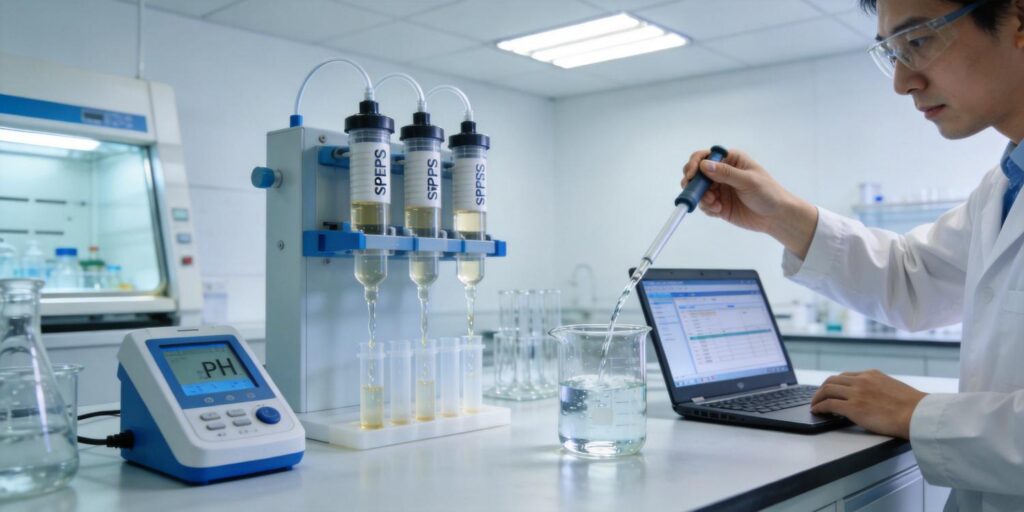
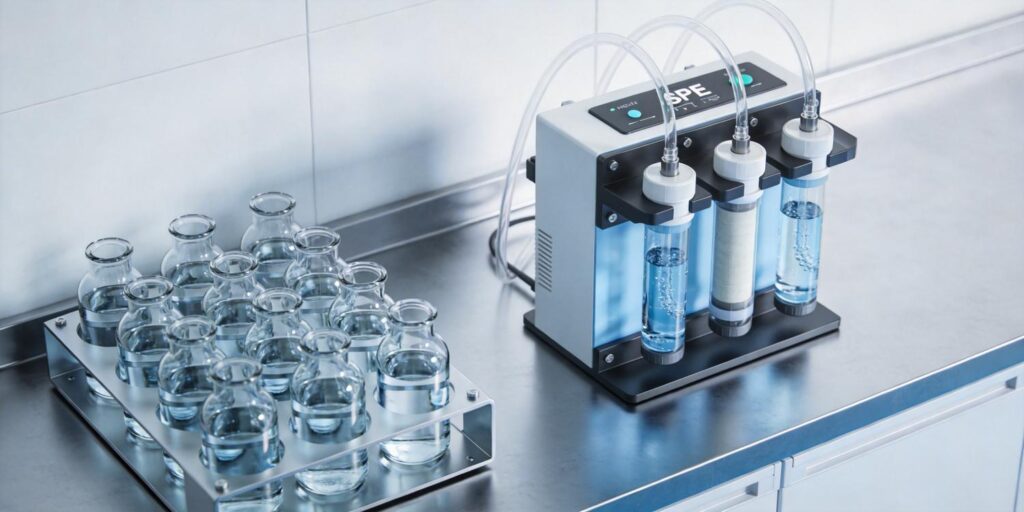
A robust SPE workflow for pharmaceutical analysis in drinking water typically follows these fundamental steps:
Step 1: Cartridge Conditioning
Before use, SPE columns must be properly conditioned. For C18 sorbents, this typically involves rinsing with 6 mL of methanol followed by 3 mL of water or buffer solution. The conditioning step prepares the cartridge to accept the aqueous sample by activating the sorbent surface and removing any contaminants that could interfere with analysis.
Step 2: Sample Loading
Large-volume water samples (typically 0.5-2 L) are passed through the conditioned cartridge at controlled flow rates (1-10 mL/min). The sample volume is selected based on breakthrough volume considerations and desired concentration factors. For weakly retained pharmaceuticals, sample pH adjustment may be necessary to ensure proper retention.
Step 3: Washing
After sample loading, the cartridge is washed with an appropriate solvent that removes matrix interferences without eluting the target analytes. For reversed-phase extractions, this typically involves 3-5 mL of water or a water-methanol mixture (95:5 v/v).
Step 4: Drying
The cartridge is dried under vacuum or with nitrogen gas to remove residual water, which is particularly important when the elution solvent is incompatible with water or when subsequent derivatization steps are required.
Step 5: Elution
Target pharmaceuticals are eluted using a small volume (2-5 mL) of appropriate organic solvent. Common elution solvents include methanol, acetonitrile, or mixtures with modifiers. The elution volume should be minimized to maximize concentration factors while ensuring complete analyte recovery.
Step 6: Concentration and Reconstitution
The eluate is typically concentrated under gentle nitrogen stream or vacuum evaporation and reconstituted in a smaller volume of solvent compatible with the subsequent analytical technique.
LC-MS Detection of Pharmaceuticals After SPE Enrichment
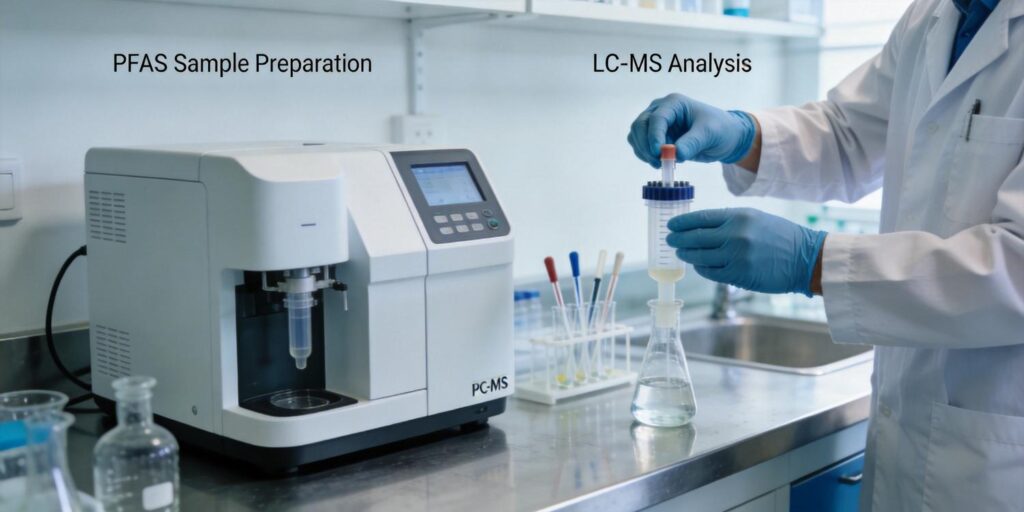
Liquid chromatography-mass spectrometry (LC-MS) has become the technique of choice for pharmaceutical analysis in water due to its sensitivity, selectivity, and ability to handle polar compounds. The combination of SPE with LC-MS offers several advantages:
1. Enhanced Sensitivity
Bowers et al. (1997) demonstrated that using an ion-spray MS/MS system linked to an auto-sampler and on-line SPE robot yielded sensitivities of 50 pg/mL for sample sizes of only 200 μL. Such sensitivities are crucial for detecting pharmaceuticals at ng/L levels in environmental samples.
2. Matrix Removal
SPE effectively removes humic substances, inorganic salts, and other matrix components that can suppress ionization in LC-MS systems. As noted in the literature, “the removal of humics and other species present” is one benefit of employing SPE for these analyses.
3. Method Flexibility
Different SPE sorbents can be selected based on the pharmaceutical classes being analyzed. For example:
- HLB (Hydrophilic-Lipophilic Balanced): Suitable for a wide range of pharmaceuticals with varying polarities
- MCX (Mixed-mode Cation Exchange): Ideal for basic pharmaceuticals that can be protonated
- MAX (Mixed-mode Anion Exchange): Effective for acidic pharmaceuticals
- WCX (Weak Cation Exchange): Useful for compounds with specific functional groups
4. On-line vs. Off-line Approaches
Both on-line and off-line SPE-LC-MS approaches have been successfully applied. On-line systems offer automation advantages and can achieve sample throughputs of 320-960 samples per day for broad-range pharmaceutical screening, as demonstrated by Beaudry et al. (1998). Off-line approaches provide greater flexibility in method development and can handle larger sample volumes.
Quality Control and Method Validation
Rigorous quality control measures are essential for reliable pharmaceutical analysis at trace levels. Key considerations include:
1. Method Validation Parameters
Complete method validation should assess:
- Recovery efficiency: Typically 70-120% for most pharmaceuticals
- Precision: Both intra-day and inter-day variability
- Linearity: Over the expected concentration range
- Limit of detection (LOD) and limit of quantification (LOQ)
- Matrix effects: Particularly important for LC-MS analysis
2. Quality Control Samples
Each batch should include:
- Method blanks: To monitor for contamination
- Laboratory control samples: Fortified with known concentrations of target analytes
- Matrix spikes: To assess matrix effects
- Duplicate samples: To evaluate precision
3. Breakthrough Testing
Regular testing of breakthrough volumes under actual sample conditions is crucial, as breakthrough behavior can be affected by matrix components. The presence of natural organic matter (NOM) can complicate environmental analyses because analytes can exist in free form or complexed with particulate or dissolved organic matter, changing their retention properties compared to the free analyte.
4. Sorbent Performance Monitoring
Lot-to-lot reproducibility of SPE cartridges should be verified, and performance should be monitored over time. Some manufacturers provide cartridges specifically tested for the presence of bisphenol A and other phenols and phthalates, assuring that endocrine disruptors in water samples can be analyzed to parts per trillion levels.
5. Data Quality Objectives
Establishing clear data quality objectives (DQOs) before method implementation ensures that the analytical results will be fit for their intended purpose. This includes defining acceptable ranges for recovery, precision, and detection limits based on regulatory requirements or research objectives.
The successful application of SPE for trace pharmaceutical analysis in drinking water requires careful consideration of all these factors—from understanding breakthrough behavior to selecting appropriate sorbents and implementing rigorous quality control measures. As environmental monitoring requirements continue to evolve, SPE methodologies will remain essential tools for protecting water quality and public health.
For laboratories seeking to implement or optimize SPE workflows for pharmaceutical analysis, Poseidon Scientific offers a comprehensive range of SPE products including HLB SPE cartridges, MAX SPE cartridges, MCX SPE cartridges, WAX SPE cartridges, WCX SPE cartridges, and 96-well SPE plates designed to meet the demanding requirements of trace environmental analysis.