Analytical Challenges in Chocolate Matrices
Chocolate represents one of the most challenging food matrices for contaminant analysis due to its complex composition. The primary components—cocoa solids, cocoa butter, sugar, and milk solids—create a heterogeneous mixture that interferes with analytical detection methods. The high lipid content (typically 25-35% in dark chocolate) presents significant challenges for sample preparation, as lipids can co-extract with target contaminants and cause matrix effects in chromatographic systems.
According to established SPE literature, complex matrices like chocolate require careful consideration of extraction conditions. As noted in SPE applications for food analysis, “The high or variable water and fat contents of citrus fruit, berries and nuts can present capacity problems” (Simpson & Wynne, 2000). This observation applies equally to chocolate, where the lipid load can overwhelm standard extraction cartridges if not properly managed.
Lipids and Cocoa Pigments Interference
The two primary interference sources in chocolate analysis are lipids from cocoa butter and colored compounds from cocoa solids. Cocoa butter contains triglycerides, fatty acids, and other lipids that can:
- Co-extract with target contaminants
- Cause matrix effects in LC-MS systems
- Lead to ion suppression or enhancement
- Clog analytical columns and reduce instrument performance
Cocoa pigments, including anthocyanins and polyphenols, present additional challenges. These compounds can absorb at wavelengths used for UV detection and may interfere with contaminant identification. Research on plant extracts has shown that “the matrix, though still likely to contain plant sugars, acids and colorants, does not contain the co-formulated excipients and therefore does not present many of the problems associated with them” (Simpson & Wynne, 2000). However, in chocolate, these natural pigments are present in high concentrations and must be addressed during cleanup.
SPE Sorbent Selection for Contaminant Analysis
Primary Sorbent Considerations
Selecting the appropriate SPE sorbent for chocolate analysis depends on the target contaminants and their chemical properties. For most pesticide residues and environmental contaminants, reversed-phase sorbents are typically employed:
- C18 sorbents: Ideal for non-polar to moderately polar contaminants. As noted in SPE literature, “C18 sorbent provides excellent hydrolytic stability for a wide range of samples” and is particularly effective for “trace organics in environmental water samples” (Waters Oasis Catalog).
- HLB (Hydrophilic-Lipophilic Balance) sorbents: Offer balanced retention for a wide range of compounds with varying polarities, making them suitable for multi-residue analysis.
- Florisil: Particularly effective for cleaning up lipid-rich samples and removing pigments. Research shows that Florisil sorbents provide “quantitative removal of TCP (trichlorophenol) as a polar probe to test sorbent specificity” (Waters Oasis Catalog).
Specialized Sorbents for Specific Applications
For certain contaminant classes, specialized sorbents may be required:
- NH2 (Aminopropyl) sorbents: Effective for lipid class separations. The classic method by Kaluzny et al. (1985) separates chloroform extracts of lipid tissue into seven principle fractions with high efficiency and purity.
- Mixed-mode sorbents: Combine reversed-phase and ion-exchange properties for comprehensive cleanup of complex matrices.
- Diol sorbents: Useful for neutral or acidic drugs of different polarity, as demonstrated in pharmaceutical cream analysis where “the cream sample was dissolved in an appropriate dichloromethane-n-hexane mixture” (Bonazzi et al., 1995).
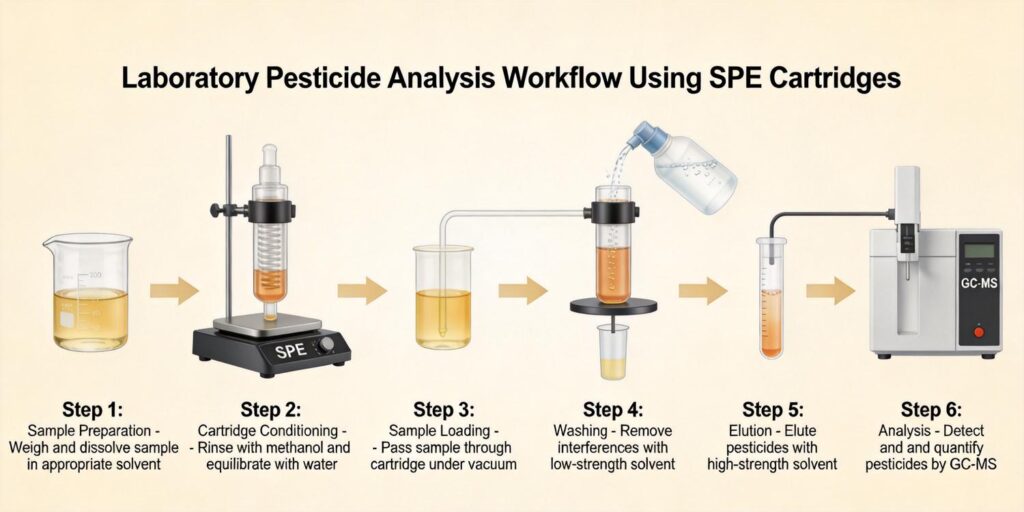
Example Workflow for Chocolate Extract Cleanup
Sample Preparation
- Homogenization: Grind chocolate samples to ensure uniform particle size.
- Extraction: Use appropriate solvents (acetonitrile, ethyl acetate, or acetone-water mixtures) with added salts for phase separation.
- Defatting: For high-fat samples, consider freezing and centrifugation or use of hexane washes to remove excess lipids.
SPE Procedure
- Cartridge Conditioning: Condition appropriate sorbent (500 mg to 1 g bed mass for chocolate samples) with solvent matching the sample matrix.
- Sample Loading: Load chocolate extract at controlled flow rates (1-2 mL/min) to ensure proper interaction with sorbent.
- Washing: Use optimized wash solvents to remove interfering compounds while retaining target analytes. For lipid-rich samples, hexane or hexane-dichloromethane mixtures are often effective.
- Elution: Elute target contaminants with appropriate solvents (typically methanol, acetonitrile, or acetone-based mixtures).
As demonstrated in lipid analysis, “The large sorbent bed is necessary to provide adequate capacity for the lipid load being applied” (Simpson & Wynne, 2000). For chocolate samples, using larger bed masses (500 mg or 1 g) is recommended to handle the high lipid content.
LC-MS Detection of Contaminants
Instrumental Considerations
Liquid chromatography-mass spectrometry (LC-MS) has become the gold standard for contaminant analysis in complex matrices like chocolate. Key considerations include:
- Column Selection: Use C18 or equivalent reversed-phase columns with appropriate dimensions (typically 50-150 mm length, 2.1-3.0 mm ID).
- Mobile Phase Optimization: Employ gradient elution with water and organic modifiers (methanol or acetonitrile) containing additives like formic acid or ammonium acetate.
- Mass Spectrometer Settings: Optimize ionization parameters (ESI or APCI) and collision energies for target compounds.
Data Quality Assurance
To ensure reliable results:
- Use isotope-labeled internal standards for quantification
- Implement matrix-matched calibration curves
- Monitor matrix effects through post-column infusion experiments
- Include quality control samples at multiple concentration levels
Quality Assurance Considerations
Method Validation
Comprehensive method validation is essential for chocolate contaminant analysis:
- Recovery Studies: Assess method efficiency through spiked recovery experiments at multiple concentration levels.
- Precision and Accuracy: Determine intra-day and inter-day variability.
- Limit of Detection/Quantification: Establish method sensitivity based on signal-to-noise ratios.
- Specificity: Confirm absence of interference from matrix components.
Contamination Control
As noted in SPE troubleshooting guides, “If you encounter a contamination problem, suspect everything!” (Forensic and Clinical Applications of Solid Phase Extraction). For chocolate analysis:
- Use high-purity solvents and reagents
- Implement blank controls throughout the analytical process
- Regularly check SPE cartridges for potential contaminants
- Monitor laboratory background levels
Documentation and Traceability
Maintain comprehensive records including:
- Batch numbers of SPE cartridges and reagents
- Instrument calibration and maintenance records
- Sample preparation details and deviations
- Quality control results and corrective actions
Proper SPE cleanup of chocolate samples enables reliable contaminant detection at trace levels while minimizing matrix interference. By selecting appropriate sorbents, optimizing extraction conditions, and implementing rigorous quality control measures, laboratories can achieve accurate and reproducible results for regulatory compliance and food safety monitoring.
For more information about SPE products suitable for chocolate analysis, visit our HLB SPE Cartridges, MCX SPE Cartridges, and 96-well SPE Plates product pages.