Monitoring Veterinary Drug Residues in Dairy Products
Veterinary drug residues in milk and dairy products represent a significant food safety concern worldwide. Antibiotics, anthelmintics, anti-inflammatory drugs, and other veterinary pharmaceuticals can persist in milk from treated animals, potentially leading to antimicrobial resistance, allergic reactions, and other health risks for consumers. According to research from Simpson and Wynne (2000), SPE applications for food and beverages are typically developed for quality control purposes or for the detection of drug and pesticide residues, with the primary goal being consumer safety.
Dairy products present unique challenges due to their nutritional importance and widespread consumption across all age groups. Regulatory agencies worldwide have established maximum residue limits (MRLs) for various veterinary drugs in milk, making reliable detection methods essential for compliance monitoring and public health protection.
Matrix Challenges from Milk Proteins and Lipids
Milk, butter, and cheese present significant analytical challenges due to their high fat and protein content and varying viscosities. As noted in the literature, “Milk, butter and cheese present a bigger problem. They have a high fat and protein content and they are quite viscous or completely solid” (Simpson and Wynne, 2000). The complex matrix composition can interfere with analytical methods, leading to poor recovery, matrix effects, and reduced method sensitivity.
The primary matrix challenges include:
- Proteins: Casein and whey proteins can bind to analytes, reducing extraction efficiency
- Lipids: Milk fat can co-extract with target analytes, causing interference in chromatographic analysis
- Carbohydrates: Lactose and other sugars can affect solvent polarity and extraction efficiency
- Mineral content: Calcium, phosphorus, and other minerals can affect pH and ionic strength
Traditional SPE has been successfully applied in the determination of pesticide residues using solid-supported LLE columns or regular SPE cartridges, demonstrating that with proper method development, these matrix challenges can be overcome.
Protein Precipitation Prior to SPE Extraction
Effective sample preparation begins with protein precipitation to remove interfering proteins before SPE extraction. Various precipitation methods have been developed, each with specific advantages for different analyte classes:
Common Protein Precipitation Methods
- Acid precipitation: Using metaphosphoric acid/methanol mixtures (3:2 v/v) as described by Horie et al. (1991) for antibacterial drug extraction from fish tissue
- Organic solvent precipitation: Acetonitrile or methanol precipitation effectively denatures proteins while maintaining analyte stability
- Enzymatic digestion: Protease treatment can break down proteins without affecting drug stability
Research has shown that samples that exist as suspensions or that are moderately viscous can be blended onto solid support without having to use a mortar or pestle. This approach has been applied to whole blood, plasma, serum, and especially raw and homogenized milk samples (Simpson and Wynne, 2000).
SPE Sorbent Selection for Antibiotic Classes
Selecting the appropriate SPE sorbent is critical for successful extraction of veterinary drug residues from milk matrices. Different antibiotic classes require specific sorbent chemistries for optimal recovery:
Common SPE Sorbents for Veterinary Drug Extraction
Mixed-Mode Sorbents (MCX, MAX, WCX)
Mixed-mode sorbents combine reversed-phase and ion-exchange mechanisms, making them ideal for extracting compounds with both hydrophobic and ionic characteristics. As demonstrated in veterinary applications, “mixed-mode cartridges allow the rapid recovery of such diverse groups as β-blockers, β-agonists, opiates, and other narcotic analgesics” (Simpson and Wynne, 2000).
Reversed-Phase Sorbents (HLB, C18)
Hydrophilic-lipophilic balanced (HLB) and C18 sorbents are effective for non-polar to moderately polar compounds. Research has shown successful applications for sulfonamide residues in milk using C18 material, with Van Poucke et al. (1991) finding they could use 5.0 to 10.0 mL of milk blended with 2.0 g of C18 material for isolation of sulfonamide residues while achieving approximately 95% recovery.
Ion-Exchange Sorbents (SCX, SAX)
Strong cation exchange (SCX) and strong anion exchange (SAX) sorbents are particularly useful for charged compounds. The extraction of bases from plasma samples using SCX or mixed-mode cartridges gives extracts that may be used for screening bases of both high and low polarity without the need for back extraction or other lengthy clean-up procedures.
Sorbent Selection by Antibiotic Class
| Antibiotic Class | Recommended Sorbent | Key Considerations |
|---|---|---|
| Sulfonamides | Mixed-mode (MCX) or C18 | Require careful pH control for optimal recovery |
| Tetracyclines | Mixed-mode (MCX) or HLB | Chelating properties require special elution conditions |
| Macrolides | Mixed-mode (MCX) or HLB | Basic compounds benefit from cation exchange |
| β-Lactams | Mixed-mode (WCX) or HLB | Acidic compounds benefit from anion exchange |
| Quinolones | Mixed-mode (MCX) | Amphoteric compounds require dual retention mechanisms |
LC-MS/MS Detection Workflow
Liquid chromatography-tandem mass spectrometry (LC-MS/MS) has become the gold standard for veterinary drug residue analysis due to its sensitivity, selectivity, and ability to analyze multiple compounds simultaneously. The integration of SPE with LC-MS/MS provides a powerful analytical workflow:
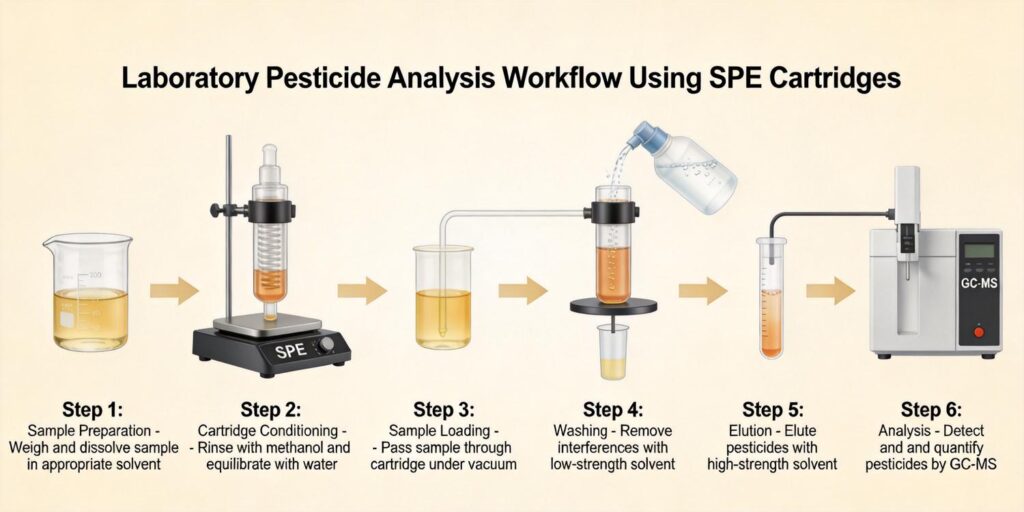
Sample Preparation Workflow
- Sample pretreatment: Milk samples are typically centrifuged or filtered to remove particulates
- Protein precipitation: Organic solvents or acids are added to precipitate proteins
- SPE extraction: The supernatant is loaded onto conditioned SPE cartridges
- Wash steps: Interfering compounds are removed with appropriate wash solvents
- Elution: Target analytes are eluted with optimized solvent mixtures
- Concentration: Eluates are evaporated and reconstituted in mobile phase
- LC-MS/MS analysis: Separation and detection using optimized chromatographic and mass spectrometric conditions
LC-MS/MS Method Optimization
As noted in veterinary drug analysis literature, “Mass spectrometry is currently undergoing a rapid expansion in the area of LC/MS. The LC interface allows the introduction of aqueous samples into the mass spectrometer and may reduce the need for derivatization of some compounds” (Simpson and Wynne, 2000). Key optimization parameters include:
- Chromatographic separation: Selection of appropriate stationary phases and mobile phase compositions
- Ionization technique: Electrospray ionization (ESI) or atmospheric pressure chemical ionization (APCI) based on analyte properties
- Mass transitions: Selection of precursor and product ions for multiple reaction monitoring (MRM)
- Collision energy: Optimization for maximum sensitivity and selectivity
Food Safety Regulations and Detection Limits
Global regulatory agencies have established comprehensive frameworks for veterinary drug residues in milk and dairy products. These regulations dictate both the maximum residue limits (MRLs) and the required analytical performance characteristics:
International Regulatory Standards
- Codex Alimentarius: International food standards established by FAO/WHO
- European Union: Commission Regulation (EU) No 37/2010 on pharmacologically active substances
- United States: FDA tolerance levels and USDA monitoring programs
- China: GB 31650-2019 National Food Safety Standard
Required Analytical Performance
For regulatory compliance, analytical methods must meet specific performance criteria:
| Performance Parameter | Typical Requirement | Importance |
|---|---|---|
| Limit of Detection (LOD) | ≤ 0.5 × MRL | Ensures detection below regulatory limits |
| Limit of Quantification (LOQ) | ≤ MRL | Enables accurate quantification at regulatory levels |
| Recovery | 70-120% | Ensures method accuracy and reliability |
| Precision (RSD) | ≤ 15% | Ensures method reproducibility |
| Selectivity/Specificity | No interference | Ensures accurate identification and quantification |
Method Validation Requirements
Comprehensive method validation is essential for regulatory acceptance. Key validation parameters include:
- Linearity: Demonstrated over the required concentration range
- Accuracy: Assessed through recovery studies at multiple concentration levels
- Precision: Both within-run and between-run variability
- Matrix effects: Evaluation of signal suppression or enhancement
- Stability: Analyte stability in matrix and during sample processing
- Ruggedness: Method performance under varying conditions
Future Trends and Developments
The field of veterinary drug residue analysis continues to evolve with several emerging trends:
- High-throughput methods: 96-well SPE plates and automated systems increasing laboratory efficiency
- Multi-residue methods: Simultaneous analysis of hundreds of compounds in single runs
- Reduced solvent usage: Development of greener extraction methods
- Improved sensitivity: Advances in mass spectrometry enabling lower detection limits
- Rapid screening methods: Development of field-deployable screening tools
As noted in the literature, “SPE can be highly reproducible if a rugged method is developed, and provides clean extracts for analysis by GC/NPD, HPLC, GC/MS, LC/MS and many other analytical techniques” (Simpson and Wynne, 2000). The continued development and optimization of SPE methods for veterinary drug residues in milk products will remain essential for ensuring food safety and regulatory compliance in the global dairy industry.
For laboratories seeking reliable SPE solutions for veterinary drug analysis, Poseidon Scientific offers a comprehensive range of HLB SPE cartridges, MAX SPE cartridges, MCX SPE cartridges, WAX SPE cartridges, WCX SPE cartridges, and 96-well SPE plates designed to meet the specific challenges of dairy matrix analysis.