Overview of SPE Cartridge Format
Solid-phase extraction cartridges represent the traditional format that has been in use for over two decades. These syringe-barrel style devices typically contain sorbent masses ranging from 10 mg to 6 g, housed in plastic or glass barrels with polymer or steel frits. The cartridge format offers several distinct advantages for routine laboratory applications.
Cartridges excel in method development and small-scale applications where flexibility is paramount. They allow analysts to work with varying sample volumes (from microliters to hundreds of milliliters) and provide excellent control over flow rates during manual processing. The vacuum manifold system commonly used with cartridges offers simplicity and convenience, making it ideal for laboratories processing limited numbers of samples.
From a cost perspective, cartridges typically offer lower per-unit pricing compared to 96-well plates, making them economically attractive for laboratories with moderate throughput requirements. They also provide excellent lot-to-lot reproducibility, with studies showing relative standard deviations of less than 5% for drug recoveries across multiple production lots.
96-Well SPE Plates for High-Throughput Analysis
The 96-well plate format represents the evolution of SPE technology toward high-throughput applications. These plates contain individual extraction wells arranged in the standard microplate footprint, with sorbent masses typically ranging from 5 mg to 60 mg per well. This format has become standard in pharmaceutical development, clinical research, and combinatorial chemistry laboratories.
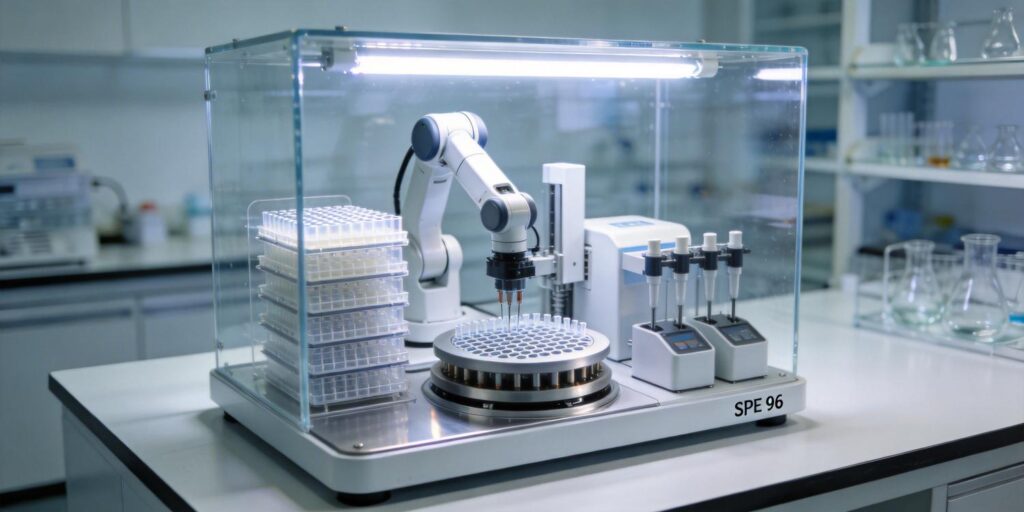
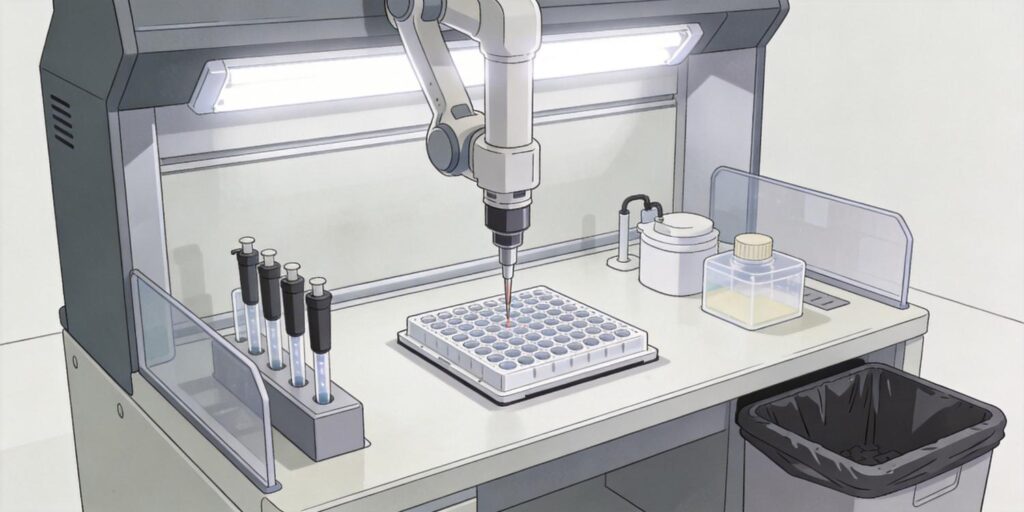
96-well plates offer exceptional throughput capabilities when paired with liquid handling robotics. The parallel processing nature of plate-based systems allows simultaneous extraction of up to 96 samples, dramatically reducing processing time compared to serial cartridge processing. This format is particularly valuable in laboratories where sample preparation has become the rate-limiting step in analysis workflows.
Modern 96-well plates feature innovative designs such as two-stage well configurations and μElution plates that enable elution volumes as low as 25 μL. These advancements eliminate the need for evaporation and reconstitution steps, further streamlining high-throughput workflows. The format’s compatibility with most liquid handling robotic systems makes it ideal for automated, reliable high-throughput SPE applications.
Differences in Workflow and Solvent Consumption
The workflow differences between cartridge and plate formats are substantial and impact both operational efficiency and solvent usage. Cartridge-based workflows typically involve serial processing where each sample is handled individually through conditioning, loading, washing, and elution steps. This approach provides excellent control but limits throughput.
In contrast, 96-well plates enable parallel processing where all samples undergo each extraction step simultaneously. This batch processing approach significantly reduces total processing time but requires careful optimization to ensure consistent performance across all wells. The smaller bed masses in plate formats (typically 5-60 mg versus 10 mg-6 g in cartridges) result in reduced solvent requirements for conditioning and elution.
Solvent consumption represents a critical differentiator between formats. Cartridge systems often require larger solvent volumes for conditioning and elution due to their larger bed volumes. Plate formats, with their miniaturized design, can achieve comparable recoveries with significantly reduced solvent volumes. Studies show that 96-well plate systems can reduce total solvent consumption by 50-80% compared to traditional cartridge systems, leading to substantial cost savings in solvent purchase and waste disposal.
Throughput and Automation Considerations
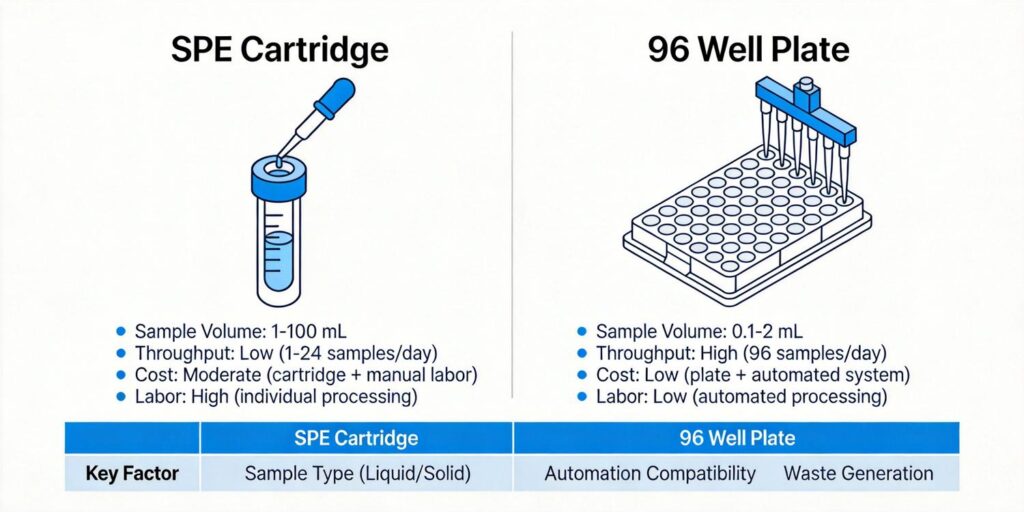
Throughput requirements fundamentally drive the choice between cartridge and plate formats. Cartridge systems typically process 10-30 samples per hour in manual or semi-automated configurations, making them suitable for laboratories with moderate sample volumes. Automated cartridge workstations can increase throughput but often require significant capital investment and dedicated operator training.
96-well plate systems excel in high-throughput environments, capable of processing 96 samples in 30-60 minutes when paired with appropriate automation. This represents a 3-10x improvement in throughput compared to cartridge-based systems. The plate format’s compatibility with standard laboratory automation platforms allows seamless integration into existing high-throughput workflows.
Automation considerations extend beyond throughput to include reproducibility and documentation. Automated SPE systems, whether cartridge or plate-based, provide improved precision by eliminating operator-dependent variables. They also offer formal documentation of extraction parameters, which is increasingly important in regulated environments. However, automation requires careful consideration of fluid path compatibility, carryover prevention, and system maintenance requirements.
Performance Comparison Between Formats
Performance characteristics between cartridge and plate formats show both similarities and important differences. Recovery rates for both formats typically range from 80-110% for well-optimized methods, with plate formats often showing slightly higher recoveries due to better flow control in automated systems. The key performance differentiator lies in reproducibility rather than absolute recovery.
96-well plate systems demonstrate superior inter-well reproducibility when properly automated, with relative standard deviations often below 5% across all 96 positions. Cartridge systems, while capable of excellent reproducibility, show more operator-dependent variability in manual processing. The smaller bed masses in plate formats can provide advantages in mass transfer efficiency, particularly for small sample volumes.
Flow rate control represents another critical performance parameter. Cartridge systems using vacuum manifolds can experience variable flow rates depending on vacuum stability and cartridge packing consistency. Automated plate systems typically use positive pressure displacement, providing more consistent flow rates that can be optimized for maximum recovery. Studies show that reducing flow rates from 1.5 mL/min to 0.33 mL/min can increase recovery from 80% to 95% for certain analytes.
Cost Considerations in Routine Laboratories
Cost analysis must consider both direct consumable costs and indirect operational expenses. Per-sample costs for cartridges typically range from $2-10 depending on sorbent type and bed mass, while 96-well plates range from $5-15 per plate ($0.05-0.16 per sample). The apparent cost advantage of plates disappears when considering low sample volumes, as plates represent a fixed cost regardless of the number of wells used.
Solvent and waste disposal costs significantly favor plate formats. The reduced solvent requirements of plate systems (typically 100-200 μL per well versus 1-5 mL per cartridge) translate to substantial savings in both solvent purchase and hazardous waste disposal. For laboratories processing thousands of samples monthly, these savings can offset the higher initial consumable costs of plate systems.
Labor costs represent the most significant variable in the cost equation. Cartridge-based manual processing requires approximately 10-15 minutes of technician time per sample, while automated plate systems reduce this to 1-2 minutes per sample. The labor savings from automation can justify the capital investment in plate-based systems for laboratories with sufficient sample volumes.
Decision Framework for Laboratory Managers
Choosing between cartridge and plate formats requires a systematic evaluation of laboratory needs and resources. The following decision framework can guide laboratory managers in making informed choices:
1. Sample Volume Assessment
Evaluate your laboratory’s typical and peak sample volumes. Cartridge formats are optimal for laboratories processing less than 50 samples daily, while plate formats become economically viable at 100+ samples daily. Consider both current volumes and projected growth when making format decisions.
2. Throughput Requirements
Determine your required turnaround times and analytical capacity. If sample preparation represents a bottleneck in your workflow, plate-based automation may provide necessary throughput improvements. Cartridge systems work well when analytical instrument capacity, rather than sample preparation, limits overall throughput.
3. Method Development Considerations
Consider where your laboratory falls on the method development to routine analysis spectrum. Cartridge formats offer superior flexibility for method development and optimization, allowing easy modification of parameters and sorbent types. Once methods are validated, plate formats provide efficient transfer to high-throughput routine analysis.
4. Automation Infrastructure
Assess your laboratory’s existing automation capabilities and technical expertise. Plate formats require compatible liquid handling systems and operators trained in automated method development. Cartridge systems offer easier implementation but may require eventual automation as sample volumes increase.
5. Budget and ROI Analysis
Conduct a comprehensive return on investment analysis considering consumable costs, labor savings, solvent reduction, and waste disposal expenses. For many laboratories, a hybrid approach using cartridges for method development and plates for routine analysis provides optimal balance between flexibility and efficiency.
Ultimately, the choice between cartridge and 96-well plate formats depends on your laboratory’s specific needs, resources, and strategic direction. Both formats offer distinct advantages, and many successful laboratories implement both systems to address different stages of their analytical workflows.