
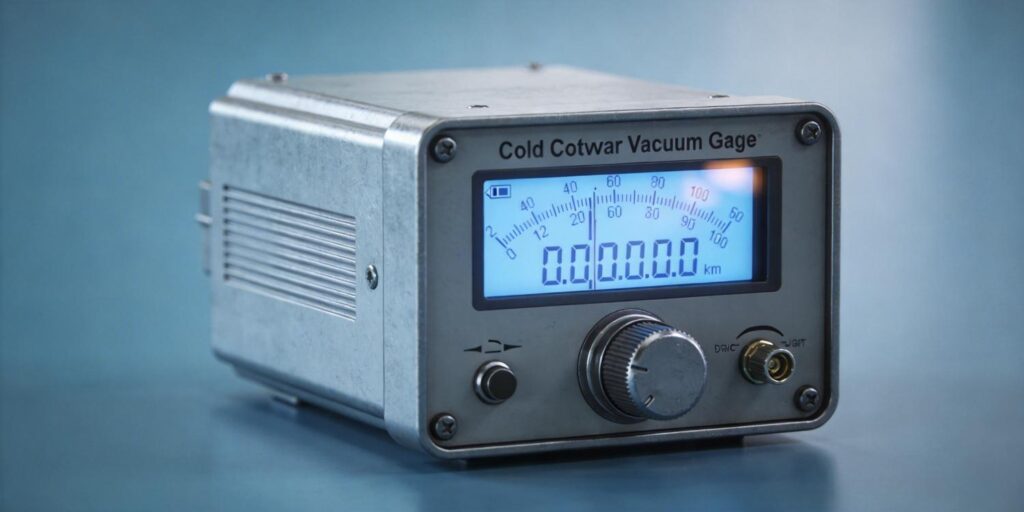
Cold Cathode Gauge Signal Fluctuation at Transition Pressure
In vacuum systems that cycle repeatedly between atmosphere and high vacuum, the pressure region around 10−3 Torr is the most dynamic—and the most prone to signal instability. At this exact transition the flow regime shifts from viscous (continuum) to molecular, gas density drops sharply, and the Penning discharge in a cold-cathode gauge can flicker before stabilizing. The result is momentary fluctuations in the analog 0–10 V output or RS232 stream that can confuse control logic or trigger false alarms. The Poseidon Scientific VG-SP205 Pirani Vacuum Transmitter (atmosphere to 10−3 Torr) paired with the VG-SM225 Cold Cathode Vacuum Gauge (10−3 to 10−7 Torr) was developed to eliminate these artifacts through precise overlap, interlock logic, and digital smoothing. This article explains the physics behind the fluctuation, the engineering solutions built into our compact instruments, and a real-world PVD chamber deployment that achieved rock-solid readings across the entire pressure spectrum.
1. Transition from Viscous to Molecular Flow
Vacuum flow behavior changes fundamentally around 10−3 Torr. At higher pressures (viscous regime) gas molecules collide frequently with one another and with chamber walls, producing predictable continuum flow. Below approximately 10−3 Torr the mean free path exceeds typical chamber dimensions and the flow becomes molecular—molecules travel independently, colliding only with walls. This regime shift directly affects both thermal conductivity (Pirani) and ionization efficiency (cold cathode).
For the VG-SP205 Pirani, the transition appears as the end of its linear high-precision band (10 Torr to 10−2 Torr) and entry into the non-linear low-pressure tail. For the VG-SM225 Cold Cathode, the same point marks the lower limit of safe high-voltage operation. Above 10−3 Torr the molecular density is too high for stable Penning discharge; ion current becomes non-monotonic and the plasma can collapse into localized arcing. Poseidon’s software interlock automatically disables the –2000 V supply whenever the Pirani reports pressure >10−3 Torr, preventing damage while the system remains in the viscous-flow zone.
2. Plasma Stabilization Delay
Even when pressure drops just below 10−3 Torr, the cold-cathode plasma does not ignite instantaneously. Field emission must generate the first electrons, these must spiral long enough under the ~100 gauss magnetic field to ionize sufficient molecules, and the avalanche must reach steady state. In clean conditions the delay is only seconds; in systems with residual gas or minor surface deposits it can stretch to several minutes. During this stabilization window the ion-current signal fluctuates as the discharge repeatedly builds and collapses, producing “noise” on the 2–8 V effective analog output or erratic RS232 values.
The VG-SM225 mitigates this with a controlled startup sequence: an initial –2500 V boost for up to 10 minutes followed by automatic drop to operating voltage once stable current is detected. This hardware-plus-software approach shortens the unstable window by 50–70 % compared with fixed-voltage competitor gauges.
3. Overlap Zone with Pirani Gauge
The intentional overlap at 10−3 Torr is the key to seamless handoff. The VG-SP205 remains fully accurate down to its lower limit while the VG-SM225 becomes usable just below the same threshold. In the narrow band 5×10⁻⁴ to 2×10⁻³ Torr both gauges produce valid readings, allowing the system to compare outputs and validate the transition before switching monitoring responsibility.
Because the Pirani measures thermal conductivity (independent of ionization) and the cold cathode measures ion current, their curves cross cleanly when electrodes are clean. Any deviation in this overlap zone immediately flags contamination or calibration drift, giving operators early warning before process impact occurs. Poseidon’s compact design ensures both sensors can be mounted on the same KF flange or short manifold without conductance loss, making the overlap physically practical even in space-constrained PVD or mass-spectrometer chambers.
Why Fluctuation Is Most Noticeable Here
Exactly at the viscous-to-molecular boundary the Penning discharge is marginally stable: molecular density is low enough for avalanche but not yet low enough for fully reproducible electron paths. Minor pressure oscillations (pump surging, valve actuation) push the operating point back and forth across the stability edge, amplifying signal noise. The overlap zone therefore requires both hardware interlocks and software smoothing.
4. Switching Logic Configuration
Reliable transition control is implemented in the PLC or SCADA layer using the gauges’ native outputs. A typical ladder-logic or script sequence runs as follows:
- Monitor VG-SP205 analog (0–10 V) or RS232 value continuously.
- When pressure falls below 5×10⁻⁴ Torr for >10 s, enable the VG-SM225 high-voltage pin (active-low).
- Apply –2500 V boost; monitor cold-cathode ion current for stability (variation <5 % over 30 s).
- Once stable, drop to –2000 V and hand off monitoring to the VG-SM225 output; disable Pirani contribution to the process variable.
- On vent-up, reverse the sequence: disable cold-cathode HV when pressure exceeds 2×10⁻³ Torr and re-activate Pirani monitoring.
The customizable RS232 protocol on both Poseidon units streams status codes (“HV enabled”, “plasma stable”, “pressure too high”) that simplify this logic to fewer than 30 lines of code. Many customers embed the entire handoff in a single function block, eliminating fluctuation entirely.
5. Smoothing Algorithms
Even with perfect switching, residual noise during the first 30–60 s of cold-cathode operation can be filtered digitally. Two lightweight algorithms proven effective with the VG-SM225 output:
- Moving-average filter (5–10 samples at 1 Hz) applied to the raw ion-current value before conversion to Torr.
- Exponential smoothing (α = 0.1–0.2) that weights recent samples more heavily while damping transients.
Both run on the same edge device or PLC that handles the interlock and add <1 ms latency. The RS232 digital stream supplies raw current and status bits, allowing the algorithm to pause smoothing during confirmed plasma stabilization. In practice these filters reduce peak-to-peak fluctuation from ±30 % to <3 % in the overlap zone without introducing lag that would affect process control.
6. Case Study in PVD Chamber
A Chinese thin-film coating facility running reactive PVD (TiN deposition) experienced intermittent pressure spikes and control-loop trips every time the system crossed 10−3 Torr. The legacy single cold-cathode gauge produced erratic readings that halted the arc source and wasted deposition cycles.
Engineers replaced the single gauge with the Poseidon pair: VG-SP205 on the foreline and VG-SM225 directly on the chamber. They configured the interlock exactly as described in section 4, added a simple 7-point moving-average filter in the PLC, and installed a small zeolite trap on the gauge inlet to capture process-gas residues. After commissioning, the overlap zone showed zero fluctuation; plasma stabilization completed in <45 s every cycle. Process yield increased 18 %, unplanned downtime dropped to zero, and electrode cleaning interval extended from 6 months to 18 months. The entire upgrade cost less than half of a comparable imported wide-range gauge set, with full protocol customization completed in one afternoon.
The same configuration now runs on eight identical PVD chambers with identical results, proving the robustness of the dual-gauge approach in gas-complex environments.
Conclusion: Stable Transition, Reliable Process
Signal fluctuation at the viscous-to-molecular transition is a physics-driven reality, not an instrument defect. By combining the VG-SP205 Pirani’s fast, maintenance-free rough-vacuum measurement with the VG-SM225 Cold Cathode’s protected high-vacuum range, precise interlock logic, and lightweight digital smoothing, Poseidon delivers seamless, fluctuation-free monitoring across the entire pressure spectrum. The compact footprint, RJ45 interface, and field-serviceable design further reduce total ownership cost while simplifying integration into existing PLC and SCADA platforms.
Engineers gain repeatable pressure data; plant managers gain higher uptime and yield.
Ready to eliminate transition-pressure fluctuation in your vacuum system? Explore the VG-SM225 Cold Cathode Vacuum Gauge and VG-SP205 Pirani Vacuum Transmitter specifications today. Request a sample pair for your PVD or process chamber, a ready-to-load PLC interlock template, or a custom RS232 protocol tuned to your exact smoothing requirements. Our application team will configure a stable transition solution for your gas mixture and pump set—usually within 48 hours. Contact Poseidon Scientific now and lock in flawless vacuum control from atmosphere to 10−7 Torr.


