1. Complexity of Fruit Matrices: Sugars, Pigments, and Acids
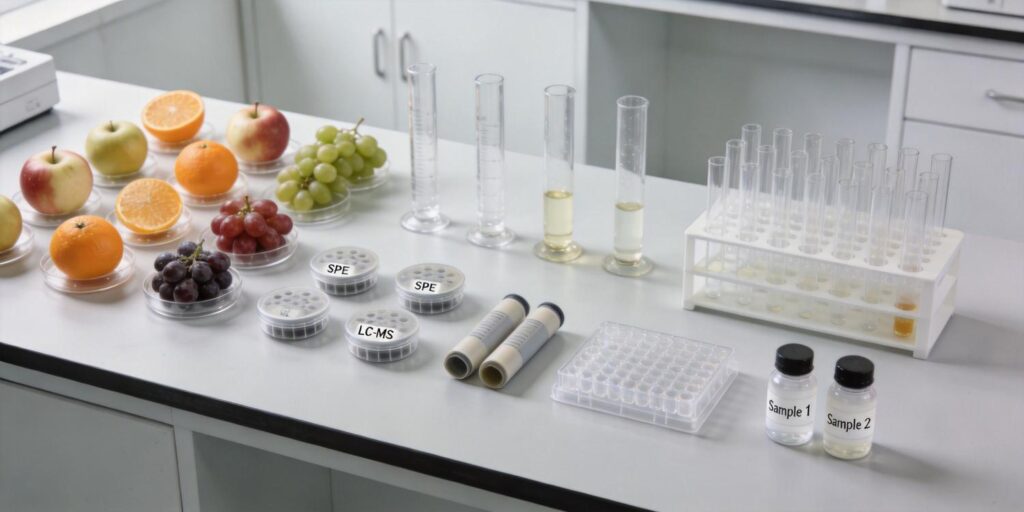
Fruit matrices present unique challenges for multi-residue pesticide analysis due to their complex composition. Fruits typically contain high concentrations of sugars (fructose, glucose, sucrose), natural pigments (anthocyanins, carotenoids), organic acids (citric, malic, tartaric), and varying water content. These components can interfere with analytical detection, cause matrix effects in LC-MS/MS, and reduce method sensitivity. According to research, the high or variable water and fat contents of citrus fruit, berries, and nuts can present capacity problems for SPE methods, requiring careful method optimization.
The presence of waxes in fruits like apples can be particularly problematic. As noted in literature, elimination of co-extracted waxes may sometimes be achieved post-extraction by careful selection of solvents for reconstitution. Since waxes are typically insoluble in methanol, this solvent can be used to redissolve an SPE eluate after evaporation with the resultant precipitation of the waxes, providing cleaner extracts for analysis.
2. QuEChERS Extraction Followed by SPE Cleanup
The QuEChERS (Quick, Easy, Cheap, Effective, Rugged, and Safe) method has revolutionized multi-residue pesticide analysis in fruits. Research shows that QuEChERS offers a simple and straightforward sample preparation technique ideal for multi-residue analysis of pesticides in a wide variety of food and agricultural products. Studies have demonstrated that 229 pesticides can be analyzed using GC-MS and LC-MS/MS with recovery rates of 80-110% and RSDs <5%.
Following QuEChERS extraction, SPE cleanup provides additional purification. The Luke method (1995) represents a comprehensive approach for residue analysis in plant and fruit matrices, exploring the extraction of a large range of pesticides from these matrices. This method requires considerable sample manipulation and LLE, indicating its origins as a LLE method to which other preparation steps and SPE extractions have been added as method goals became more stringent.
3. Sorbent Selection for Broad Pesticide Classes
Selecting the appropriate SPE sorbent is critical for effective cleanup of fruit extracts. For multi-residue pesticide analysis, mixed-mode sorbents often provide the best results:
Primary Sorbent Options:
- C18 Sorbents: Silica-based, trifunctionally-bonded octadecyl sorbent with high carbon load provides excellent hydrolytic stability. Strong hydrophobic sorbent used to adsorb analytes of even weak hydrophobicity from aqueous solutions.
- PSA (Primary Secondary Amine): Effective for removing sugars, organic acids, and fatty acids from fruit extracts. Commonly used in QuEChERS d-SPE cleanup.
- Florisil: Particularly useful for organochlorine pesticide cleanup. Certified Sep-Pak Florisil cartridges have demonstrated superior performance in removing interferences compared to competitor products.
- Mixed-mode Sorbents: Combinations like C18/PSA or C18/SAX provide both reversed-phase and ion-exchange capabilities for comprehensive cleanup.
Research indicates that the extraction of benzimidazole fungicides with acetone from a variety of fruit and vegetables followed by SPE clean-up of the extracts on C18 bonded sorbents has been reported as effective for multi-residue analysis.
4. Example SPE Workflow for Apple or Strawberry Extracts
Apple Extract Cleanup Protocol:
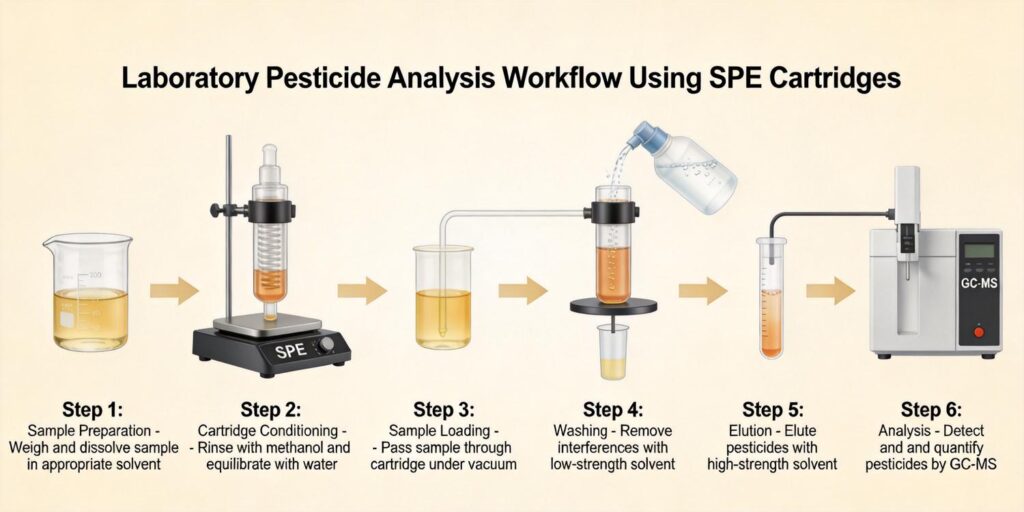
- Sample Preparation: Homogenize 15g apple sample with acetonitrile (15mL) and QuEChERS salts (MgSO4 + NaCl)
- QuEChERS Extraction: Shake vigorously for 1 minute, centrifuge at 4000 rpm for 5 minutes
- SPE Cartridge Preparation: Condition 500mg C18/PSA mixed-mode cartridge with 5mL acetonitrile, followed by 5mL water
- Sample Loading: Load 1mL of acetonitrile extract (diluted 1:1 with water) at 1-2 drops/second
- Wash Step: Wash with 5mL 5% methanol in water to remove sugars and acids
- Elution: Elute pesticides with 5mL acetonitrile containing 1% formic acid
- Concentration: Evaporate to dryness under nitrogen and reconstitute in 1mL methanol:water (1:1) for LC-MS/MS analysis
Strawberry Extract Considerations:
Strawberries require additional attention due to their high pigment content. The workflow is similar but may include an additional cleanup step with graphitized carbon black (GCB) to remove anthocyanins and other pigments that can interfere with detection.
5. LC-MS/MS Detection Improvements After Cleanup
Proper SPE cleanup significantly enhances LC-MS/MS performance for pesticide analysis in fruits:
Key Improvements:
- Reduced Matrix Effects: Ion suppression/enhancement effects are minimized, improving quantification accuracy
- Enhanced Sensitivity: Lower detection limits achievable due to cleaner extracts
- Improved Chromatographic Performance: Reduced column fouling and better peak shapes
- Extended Instrument Life: Less maintenance required due to cleaner samples
Studies have shown that automated on-line SPE combined with LC-MS/MS enables rapid target analysis of micro-contaminants in water samples, with similar principles applying to fruit extracts. The use of polymeric sorbents with high specific surface areas in on-line solid-phase extraction-liquid chromatography systems has been evaluated for improved performance.
Chromatographic data demonstrates that 402 pesticide residues at 10 ppb (ng/g) can be detected in a single 10-minute run using optimized SPE cleanup followed by UPLC-MS/MS analysis, highlighting the power of proper sample preparation.
6. Validation Strategies for Multi-Residue Analysis
Comprehensive validation is essential for reliable multi-residue pesticide analysis in fruits:
Validation Parameters:
- Recovery Studies: Evaluate recovery across multiple pesticide classes at different fortification levels (typically 10, 50, 100 μg/kg)
- Precision: Determine repeatability (intra-day) and reproducibility (inter-day) with RSD targets <20%
- Linearity: Establish calibration curves across relevant concentration ranges
- Matrix Effects: Quantify ion suppression/enhancement using post-extraction addition method
- Limit of Quantification (LOQ): Determine the lowest concentration that can be reliably quantified
- Specificity: Confirm absence of interference from matrix components
Quality Control Measures:
- Include procedural blanks with each batch
- Use matrix-matched calibration standards
- Implement internal standards for quantification
- Participate in proficiency testing programs
- Maintain comprehensive documentation of all method parameters
Research has shown that QuEChERS methods can achieve high recovery rates (mostly 90-110%) with RSDs <5%, making them suitable for multi-residue analysis in various matrices. The method allows processing of 6-12 samples by one analyst within 30-40 minutes, with material costs of approximately $1-3 per sample, generating <12 mL waste and requiring only one centrifuge tube for cleaning.
Conclusion
Optimizing SPE for multi-residue pesticide analysis in fruits requires careful consideration of matrix complexity, appropriate sorbent selection, and method validation. The combination of QuEChERS extraction with SPE cleanup provides an effective approach for handling challenging fruit matrices. By implementing proper SPE protocols and validation strategies, laboratories can achieve reliable, sensitive detection of pesticide residues while maintaining analytical quality and compliance with regulatory requirements.
For laboratories seeking to enhance their pesticide analysis capabilities, Poseidon Scientific offers a comprehensive range of SPE products including HLB SPE cartridges, MAX SPE cartridges, MCX SPE cartridges, and 96-well SPE plates designed to meet the demanding requirements of modern analytical laboratories.