1. Importance of Flavonoids in Plant Chemistry
Flavonoids represent one of the most significant classes of secondary metabolites in plants, with over 8,000 identified compounds that play crucial roles in plant physiology and human health. These polyphenolic compounds serve as natural antioxidants, UV protectants, and signaling molecules in plants, while offering numerous health benefits to humans through their potent antioxidant, anti-inflammatory, and cardioprotective properties.
According to research by Simpson and Wynne (2000), there has been increased focus on highly oxygenated, often water-soluble compounds like flavonoids as potential therapeutic agents and important dietary factors. The extraction of bioflavonoids such as rutin from plants using various sorbents has been extensively investigated, highlighting their importance in both plant chemistry and human nutrition.
2. Extraction Challenges from Plant Tissues
Plant tissues present unique challenges for flavonoid extraction due to their complex matrix composition. Plants consist of aqueous components, fatty portions, and insoluble fibrous material, making selective extraction particularly difficult. The high or variable water and fat contents of plant materials can present capacity problems during extraction, especially with fruits, berries, and nuts.
As noted in the literature, when SPE was in its infancy, plant material extraction often involved simply passing lyophilized, Soxhlet-extracted, or homogenized samples through C18 devices to remove pigments, with the effluent being collected rather than the eluent. This approach demonstrates the complexity of plant matrices and the need for sophisticated purification techniques.
2.1 Matrix Interference Issues
Plant extracts typically contain numerous interfering compounds including pigments, waxes, fats, and other polyphenolic compounds. These co-extractives can significantly interfere with analytical methods and reduce the accuracy of flavonoid quantification. Traditional wet chemistry techniques, such as using zinc acetate to coagulate fats in acetonitrile extracts, have been employed to overcome these challenges.
3. SPE Sorbent Selection for Flavonoid Purification
Proper sorbent selection is critical for successful flavonoid purification. The choice depends on the specific flavonoid class, glycosylation patterns, and the nature of the plant matrix.
3.1 C18 and C8 Sorbents
C18 bonded silica remains the most widely used sorbent for flavonoid extraction due to its excellent retention of moderately polar to non-polar compounds. Research by Buszewski et al. (1992, 1993) demonstrated successful isolation of rutin and esculin from plant material using C18 sorbents. Similarly, C8 cartridges have been used for isolating non-glycosidic anthraquinones from plant cell cultures.
3.2 Mixed-Mode and Ion Exchange Sorbents
For more complex flavonoid mixtures or specific applications, mixed-mode sorbents combining reversed-phase and ion-exchange mechanisms offer enhanced selectivity. Strong anion exchange (SAX) sorbents have proven effective for acidic phytochemicals without the high level of co-extractives often associated with urine samples. Phenolic acids in Echinacea species, for example, have been successfully extracted and further purified using C18 and quaternary ammonium sorbents.
3.3 Specialized Sorbents for Specific Applications
Polyvinylpolypyrrolidone (PVPP) sorbents have been used for cytokinin extraction from plant tissue prior to ion-exchange chromatography. For sterol extraction, specialized approaches including conversion to cyclic boronate derivatives have been employed to improve retention during reversed-phase SPE.
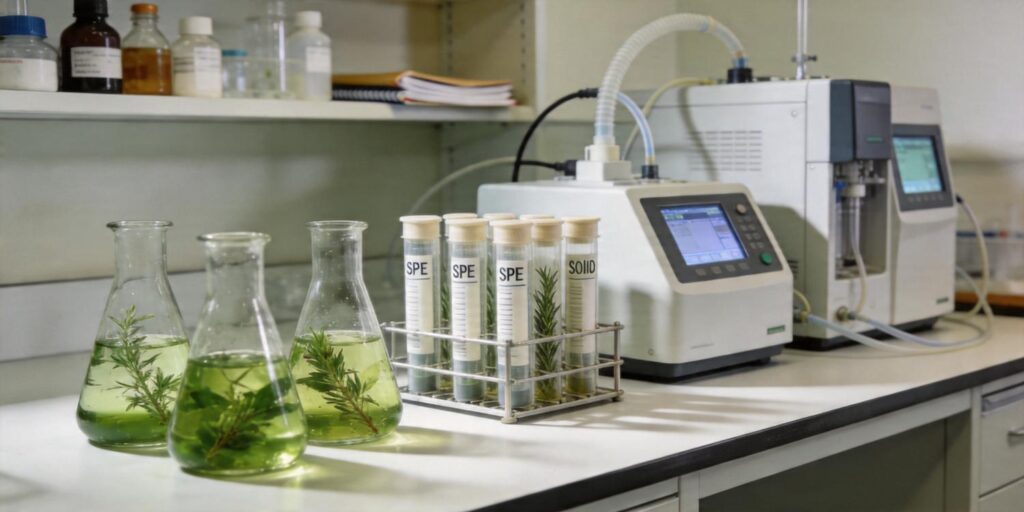
4. Example Plant Extract Cleanup Workflow
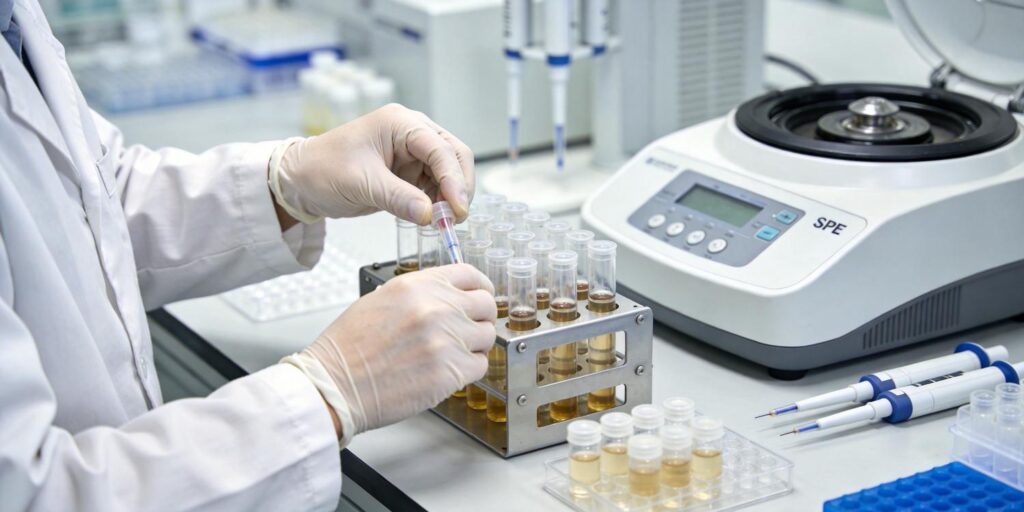
A comprehensive SPE workflow for flavonoid purification typically involves several key steps:
4.1 Sample Preparation
Plant material is typically lyophilized, ground, and extracted with methanol or aqueous methanol. The methanolic extract is filtered, evaporated, and reconstituted in an appropriate buffer before SPE processing. For some applications, samples may be suspended in diluent buffer and allowed to soak before removing residual solids by centrifugation or filtration.
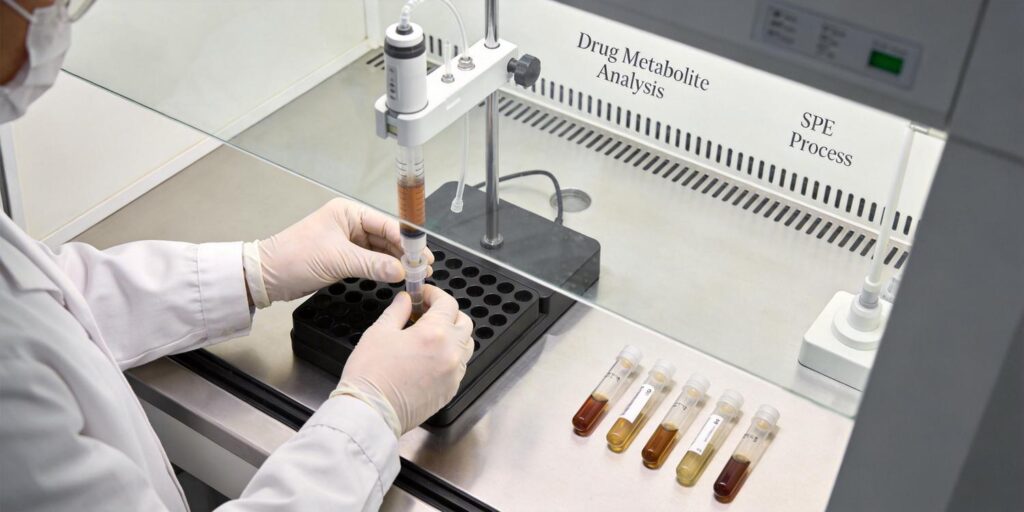
4.2 SPE Procedure
- Conditioning: SPE columns are conditioned with methanol followed by water or buffer solution
- Loading: Sample is applied at controlled flow rates (typically 1-3 drops per second)
- Washing: Interfering compounds are removed using appropriate solvent mixtures
- Elution: Flavonoids are eluted in the smallest possible volume using optimized solvent systems
4.3 Specific Example: Rutin Extraction
Buszewski et al. (1993) demonstrated simultaneous isolation of rutin and esculin from plant material using solid-phase extraction. Their method involved conditioning C18 sorbents with methanol and water, loading methanolic plant extracts, washing with appropriate solvents, and eluting with optimized methanol-water mixtures.
5. HPLC or LC-MS Analysis Methods
Following SPE purification, flavonoids are typically analyzed using HPLC or LC-MS methods for accurate quantification and identification.
5.1 HPLC Analysis
Reversed-phase HPLC with UV detection remains the standard method for flavonoid analysis. Common conditions include:
- Column: C18 columns (150 × 4.6 mm, 5 μm)
- Mobile Phase: Gradient elution with water-acetonitrile or water-methanol mixtures
- Detection: UV at 254-280 nm or diode array detection for spectral confirmation
Tomas-Barberan et al. (1993) developed HPLC methods for honey flavonoid analysis, demonstrating the versatility of these techniques for different plant-derived matrices.
5.2 LC-MS Analysis
For more comprehensive analysis or when dealing with complex mixtures, LC-MS provides superior sensitivity and specificity. Electrospray ionization (ESI) in negative ion mode is commonly used for flavonoid analysis, providing molecular weight information and fragmentation patterns for structural elucidation.
5.3 Method Optimization Considerations
When developing analytical methods, several factors must be considered including column selection, mobile phase composition, flow rate, and detection wavelength. As demonstrated in fat-soluble vitamin analysis, different analytical columns (Atlantis dC18, Nova-Pack C18, MetaChem Polaris C18-A) may be tested to achieve optimal separation.
6. Applications in Nutraceutical Research
The accurate analysis of flavonoids in plant extracts has significant implications for nutraceutical research and product development.
6.1 Quality Control and Standardization
SPE-based methods enable precise quantification of active flavonoid components in herbal preparations, ensuring product consistency and efficacy. This is particularly important for nutraceutical products where specific flavonoid content may be linked to therapeutic claims.
6.2 Bioavailability Studies
Purified flavonoid fractions obtained through SPE can be used in bioavailability and metabolism studies, helping researchers understand how these compounds are absorbed, distributed, metabolized, and excreted in the human body.
6.3 Antioxidant Activity Assessment
As demonstrated by Litridou et al. (1997), SPE fractionation of phenolic compounds from virgin olive oils allows for antioxidant activity assessment of specific flavonoid fractions, linking chemical composition to biological activity.
6.4 Chemotaxonomic Applications
Flavonoid profiling using SPE and HPLC has been successfully applied to chemotaxonomic investigations. Lenheer et al. (1984) used modern HPLC as a tool for chemotaxonomical investigations of iridoid glycosides and acetylated flavonoids in Stachys recta, demonstrating how flavonoid patterns can help classify plant species.
6.5 Product Development and Formulation
Accurate flavonoid analysis supports the development of standardized nutraceutical products with consistent bioactive content. This is particularly valuable for products targeting specific health benefits such as cardiovascular protection, anti-inflammatory effects, or antioxidant support.
Conclusion
Solid-phase extraction represents a powerful tool for flavonoid purification from plant extracts, offering advantages over traditional liquid-liquid extraction including improved throughput, decreased solvent usage, higher recoveries, and cleaner extracts. Proper sorbent selection and method optimization are crucial for successful flavonoid isolation, with C18 sorbents serving as the workhorse for most applications but specialized sorbents offering advantages for specific challenges.
The combination of SPE purification with HPLC or LC-MS analysis provides researchers and nutraceutical developers with robust methods for flavonoid quantification and characterization. As interest in plant-derived bioactive compounds continues to grow, these analytical approaches will remain essential for quality control, standardization, and scientific validation of health benefits associated with flavonoid-rich products.
For laboratories seeking reliable SPE solutions for flavonoid analysis, Poseidon Scientific offers a comprehensive range of HLB SPE cartridges, MAX SPE cartridges, MCX SPE cartridges, and 96-well SPE plates designed to meet the specific needs of plant extract analysis and nutraceutical research.