The Chemical Complexity of Coffee: A Formidable Analytical Challenge
Coffee represents one of the most chemically complex natural products in analytical chemistry, containing over 1,000 identified compounds that span multiple chemical classes. This intricate matrix includes alkaloids (primarily caffeine), phenolic acids (chlorogenic acids), diterpenes (cafestol, kahweol), melanoidins, lipids, carbohydrates, and volatile aroma compounds. The sheer diversity of chemical structures, polarities, and concentrations creates significant challenges for accurate chemical profiling. As noted in forensic extraction literature, “compounds of interest are extracted from complex matrices by addition of organic and aqueous solvents” and require sophisticated separation strategies to isolate target analytes from interfering components.
The chemical composition varies dramatically based on coffee species (Arabica vs. Robusta), geographical origin, processing methods (wet vs. dry processing), roasting degree, and brewing techniques. This variability necessitates robust sample preparation methods that can accommodate different matrix compositions while maintaining analytical precision. The presence of both hydrophilic (sugars, acids) and hydrophobic (oils, diterpenes) compounds in the same sample creates unique challenges for extraction efficiency and selectivity.
Matrix Interference: Oils, Pigments, and Other Challenges
Coffee’s natural oils and pigments represent the most significant interference sources in chemical profiling. Coffee contains 10-20% lipids by weight, primarily triglycerides and diterpenes, which can:
- Foul analytical columns and reduce chromatographic performance
- Create baseline interference in UV and MS detection
- Co-extract with target analytes, affecting quantification accuracy
- Form emulsions during liquid-liquid extraction procedures
The dark pigments (melanoidins) formed during Maillard reactions in roasting present additional challenges. These high-molecular-weight compounds can:
- Absorb strongly in UV-Vis regions, interfering with spectrophotometric detection
- Bind to stationary phases, reducing column lifetime
- Create complex matrix effects in mass spectrometry
As documented in SPE literature, “the removal of interfering impurities by washing with a suitable solvent system and then the selective recovery of the retained analytes with a modified solvent system of suitable elution strength” is essential for overcoming these matrix effects. The presence of both hydrophobic and hydrophilic interferences requires careful sorbent selection and method optimization.
SPE Sorbent Selection for Caffeine and Phenolic Compounds
Understanding Target Analyte Chemistry
Caffeine (1,3,7-trimethylxanthine) is a weakly basic to neutral molecule with moderate hydrophobicity (log P ~ -0.07). Its xanthine structure contains multiple nitrogen atoms capable of hydrogen bonding and weak cation exchange interactions. Coffee phenolics, particularly chlorogenic acids (esters of caffeic and quinic acids), are acidic compounds with multiple hydroxyl groups that can participate in hydrogen bonding and anion exchange interactions.
Sorbent Selection Strategy
Based on the extracted literature and practical experience, several SPE sorbent options prove effective for coffee chemical profiling:
1. Reversed-Phase Sorbents (C18, C8, HLB)
Poseidon Scientific HLB SPE Cartridges offer excellent retention for both caffeine and phenolic compounds due to their hydrophilic-lipophilic balanced polymer structure. HLB sorbents provide:
- High capacity for both polar and moderately non-polar compounds
- Excellent wettability with 100% aqueous samples
- Superior recovery of acidic, basic, and neutral compounds
- Resistance to bed drying during method execution
For coffee extracts, HLB cartridges can retain caffeine and phenolics while allowing sugars and some pigments to pass through in the loading step.
2. Mixed-Mode Sorbents (MCX, MAX, WCX, WAX)
Poseidon Scientific Mixed-Mode SPE Cartridges provide enhanced selectivity through combined mechanisms:
MCX (Mixed-Mode Cation Exchange): Ideal for basic compounds like caffeine. The combination of reversed-phase and strong cation exchange (sulfonic acid) allows selective retention of basic analytes at low pH while removing acidic and neutral interferences.
MAX (Mixed-Mode Anion Exchange): Excellent for phenolic acids. The quaternary amine functionality provides anion exchange capacity for acidic compounds while the reversed-phase component retains less polar interferences.
WCX (Weak Cation Exchange): Useful for compounds with pKa values in the neutral range. The carboxylic acid functionality provides pH-dependent cation exchange capacity.
WAX (Weak Anion Exchange): Suitable for weakly acidic phenolics. The secondary amine functionality offers pH-dependent anion exchange.
3. Normal Phase Sorbents (Silica, Diol, Amino)
For specific applications requiring separation of coffee diterpenes or other non-polar compounds, normal phase sorbents can be employed. As noted in the literature, “the column was washed with two 1-ml portions of n-hexane-dichloromethane (7:3, v/v) and the retained drug was eluted with two 1.5-ml portions of methanol” demonstrating the utility of normal phase approaches for certain compound classes.
Example Coffee Extract Purification Workflow
Sample Preparation
- Coffee Extraction: Grind coffee beans to consistent particle size (400-600 μm). Extract with hot water (90-95°C) at a 1:15 coffee-to-water ratio for 4 minutes. Filter through Whatman No. 1 paper.
- Sample Pretreatment: Adjust pH to 6.0 with phosphate buffer. Centrifuge at 4000 rpm for 10 minutes to remove particulate matter.
- Dilution: Dilute coffee extract 1:10 with deionized water to reduce matrix effects and prevent SPE cartridge overload.
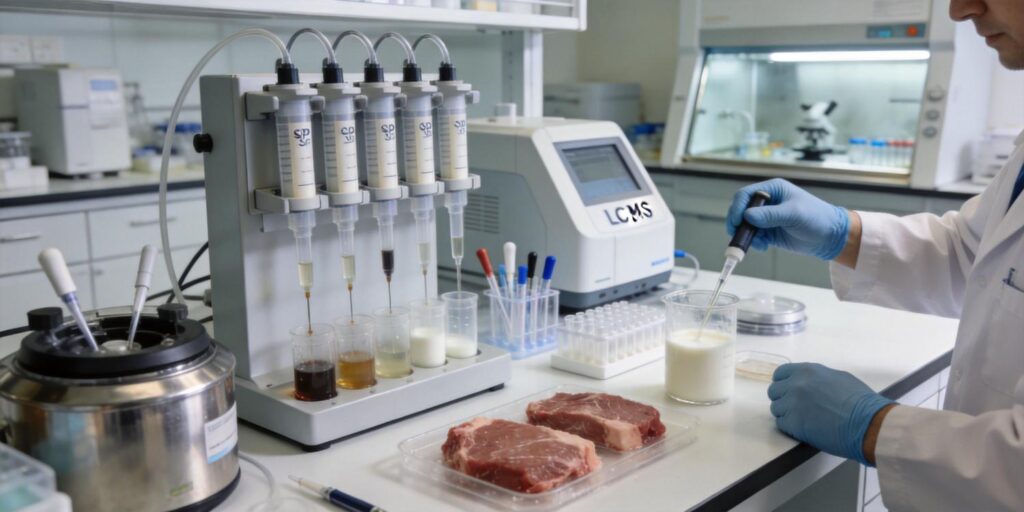
SPE Procedure Using Poseidon Scientific HLB Cartridges (60 mg/3 mL)
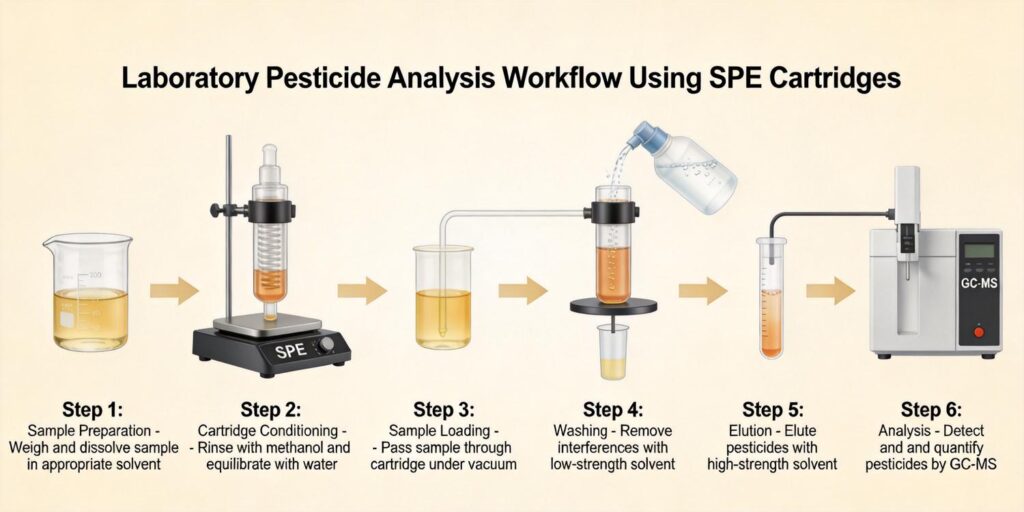
- Conditioning: Pass 3 mL methanol through cartridge, followed by 3 mL deionized water. Do not allow bed to dry.
- Loading: Load 5 mL diluted coffee extract at 1-2 mL/min flow rate.
- Washing: Wash with 3 mL 5% methanol in water to remove sugars and highly polar interferences.
- Drying: Apply vacuum for 5 minutes to remove residual water.
- Elution: Elute with 3 mL methanol containing 2% formic acid. Collect eluate in clean vial.
- Concentration: Evaporate to dryness under gentle nitrogen stream at 40°C.
- Reconstitution: Reconstitute in 1 mL mobile phase initial conditions for LC-MS analysis.
Alternative Method Using Mixed-Mode MCX Cartridges
For selective caffeine isolation:
- Conditioning: 3 mL methanol, then 3 mL 0.1M HCl
- Loading: 5 mL coffee extract adjusted to pH 2.0
- Washing: 3 mL 0.1M HCl, then 3 mL methanol
- Elution: 3 mL 5% ammonium hydroxide in methanol
LC-MS or HPLC Chemical Profiling of Purified Extracts
Chromatographic Conditions
Column: C18 reversed-phase column (150 × 2.1 mm, 1.7 μm)
Mobile Phase: A: 0.1% formic acid in water; B: 0.1% formic acid in acetonitrile
Gradient: 5% B to 95% B over 20 minutes, hold 5 minutes, return to initial conditions
Flow Rate: 0.3 mL/min
Injection Volume: 5 μL
Column Temperature: 40°C
Mass Spectrometry Parameters
Ionization: Electrospray ionization (ESI) in positive and negative modes
Mass Range: m/z 50-1000
Source Temperature: 150°C
Desolvation Temperature: 350°C
Cone Gas Flow: 50 L/h
Desolvation Gas Flow: 800 L/h
Target Compounds and Detection
| Compound | Retention Time (min) | Mass Transition | Ionization Mode |
|---|---|---|---|
| Caffeine | 8.2 | 195→138 | ESI+ |
| 5-Caffeoylquinic acid | 6.5 | 353→191 | ESI- |
| Cafestol | 18.5 | 317→299 | ESI+ |
| Kahweol | 19.2 | 315→297 | ESI+ |
| Trigonelline | 4.8 | 138→92 | ESI+ |
Applications in Quality Control and Process Monitoring
1. Coffee Authenticity and Origin Verification
The chemical profile serves as a fingerprint for coffee origin. Arabica and Robusta coffees show distinct ratios of chlorogenic acids, caffeine, and diterpenes. SPE cleanup enables accurate quantification of these marker compounds, supporting:
- Geographical origin claims verification
- Species authentication (Arabica vs. Robusta blends)
- Detection of adulteration with cheaper substitutes
2. Roasting Process Optimization
Chemical profiling monitors Maillard reaction products and thermal degradation compounds. Key quality indicators include:
- Chlorogenic acid degradation products
- Melanoidin formation markers
- Volatile compound precursors
- Antioxidant capacity changes
3. Decaffeination Process Monitoring
SPE methods accurately quantify residual caffeine levels in decaffeinated products, ensuring compliance with regulatory limits (typically <0.1% caffeine in decaffeinated coffee).
4. Shelf-Life and Stability Studies
Chemical profiling tracks degradation of key compounds during storage:
- Lipid oxidation products
- Chlorogenic acid isomerization
- Volatile compound loss
- Antioxidant capacity reduction
5. Brewing Method Optimization
Different brewing methods (espresso, filter, French press) extract compounds differently. SPE cleanup enables accurate comparison of:
- Extraction efficiency of bioactive compounds
- Diterpene content variations
- Overall chemical profile differences
Conclusion: The Value of Optimized SPE in Coffee Analysis
Effective SPE cleanup strategies transform coffee chemical profiling from a challenging analytical task to a robust, reproducible methodology. By selecting appropriate sorbents from the Poseidon Scientific HLB, MCX, MAX, WAX, and WCX product lines, analysts can achieve the necessary selectivity and recovery for accurate quantification of coffee’s complex chemical constituents.
The optimized workflows presented here, compatible with both manual processing and 96-well SPE plate formats for high-throughput applications, provide laboratories with reliable tools for quality control, authenticity verification, and process optimization in the coffee industry. As with all SPE applications, method development should consider the specific analytical goals, matrix variations, and detection requirements to achieve optimal results.