Technical Deep Dive

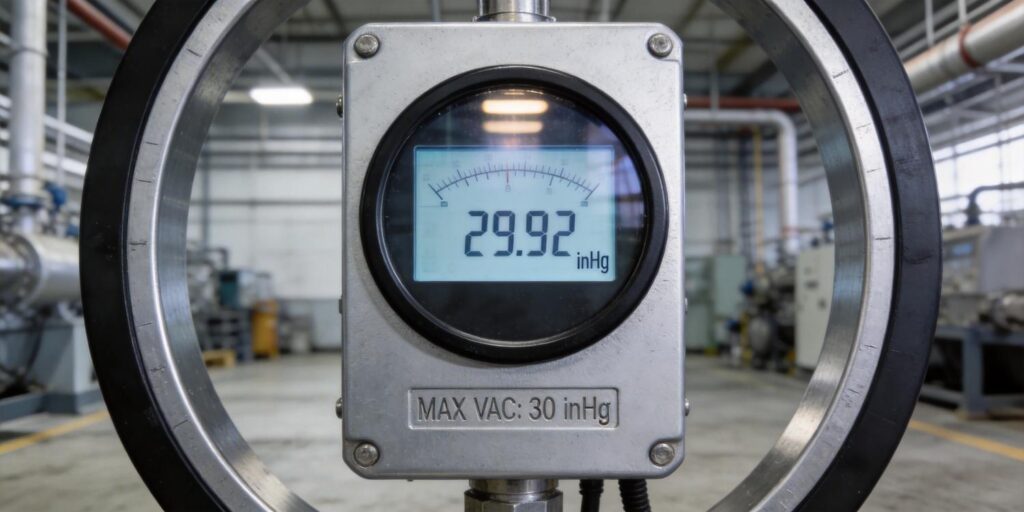
Vacuum gauge signal shown as error range on control panel

Vacuum Gauge Output Error Range Explained

In vacuum systems for mass spectrometry, thin-film deposition, vacuum metallurgy, and pharmaceutical lyophilization, the pressure signal from your gauge is the single most important input to the control system. When that signal enters an error state—whether from sensor failure, over-range pressure, or communication dropout—the entire process can halt, waste batches, or trigger costly safety interlocks. […]

Vacuum Gauge Output Error Range Explained Read More »

Cold cathode vacuum gauge starting up with LED indicator

Cold Cathode Gauge Ignition Delay: Causes and Optimization

In high-vacuum applications such as mass spectrometry, vacuum metallurgy, and electron-beam welding, the cold-cathode gauge is prized for its robustness, lack of hot filament, and ability to measure down to 10⁻⁷ Torr. Yet one operational characteristic consistently draws questions from engineers: ignition delay—the time required for the Penning discharge to establish after high voltage is

Cold Cathode Gauge Ignition Delay: Causes and Optimization Read More »

Engineer reviewing vacuum pressure data beside installed gauge

Understanding Vacuum Gauge Measurement Uncertainty

In vacuum systems for mass spectrometry, pharmaceutical freeze-drying, scanning electron microscopy, and industrial heat treatment, pressure is rarely a single fixed value—it is a measurement with inherent doubt. Engineers and procurement teams often ask: how much can I trust the number on the display? The difference between a gauge’s stated accuracy and its real-world measurement

Understanding Vacuum Gauge Measurement Uncertainty Read More »

Vacuum gauge mounted in different orientations on chamber

Vacuum Gauge Mounting Orientation: Does It Matter?

Installation Direction Guidelines Vacuum gauge mounting orientation is one of the most frequently asked questions during system integration. Engineers want to know whether gravity, gas flow, or magnetic fields will affect readings. The short answer for Poseidon Scientific’s gauges is straightforward: orientation does not matter. Both the VG-SP205 Pirani Vacuum Transmitter and the VG-SM225 Cold

Vacuum Gauge Mounting Orientation: Does It Matter? Read More »

Internal filament of thermostatic Pirani vacuum gauge

Comparing Thermostatic Pirani vs Traditional Pirani Gauges

Constant Temperature Advantage in Pirani Vacuum Gauges In vacuum measurement for thin-film deposition, heat treatment, packaging lines, and analytical instruments, Pirani gauges remain the workhorse for the rough-to-medium vacuum range (atmosphere to 10−3 Torr). Two fundamental operating modes exist: traditional constant-current designs and modern thermostatic (constant-temperature) designs. The Poseidon Scientific VG-SP205 Pirani Vacuum Transmitter belongs

Comparing Thermostatic Pirani vs Traditional Pirani Gauges Read More »

Warning label near high voltage vacuum gauge

Understanding Cold Cathode High Voltage Operation

High Voltage Ionization Principle in Cold Cathode Gauges Cold cathode vacuum gauges measure pressure in the high-vacuum regime (10−3 Torr to 10−7 Torr) using the Penning discharge principle rather than a heated filament. In the Poseidon Scientific VG-SM225 Cold Cathode Vacuum Gauge, a strong electric field (starting at −2500 V, then stabilizing at −2000 V)

Understanding Cold Cathode High Voltage Operation Read More »

Vacuum gauge display reacting to rapid pressure changes

Vacuum Gauge Response Time: Why It Matters in Dynamic Processes

What Is Response Time in Vacuum Gauges? In dynamic vacuum processes, response time is the interval required for a gauge to register a defined fraction—typically 63 % (one time constant) or 90 %—of a sudden pressure change. It is not the same as startup delay or calibration drift; it measures how quickly the sensor output

Vacuum Gauge Response Time: Why It Matters in Dynamic Processes Read More »

Vacuum gauge LED illuminated during startup

How to Interpret Vacuum Gauge Startup Indicators

Understanding Vacuum Gauge Startup Indicators Accurate interpretation of startup indicators is essential for reliable vacuum system operation in thin-film deposition, heat treatment, and analytical instruments. Poseidon Scientific’s VG-SM225 Cold Cathode Vacuum Gauge features clear LED feedback that instantly communicates system status, while the VG-SP205 Pirani Vacuum Transmitter operates without high-voltage circuitry and delivers immediate readings

How to Interpret Vacuum Gauge Startup Indicators Read More »

Industrial power supply connected to vacuum gauge

Vacuum Gauge Power Supply Requirements Explained

Voltage Requirements for Reliable Vacuum Gauge Operation Proper power supply design is often the overlooked foundation of accurate vacuum measurement. In thin-film deposition, semiconductor processing, and analytical instrumentation, even minor deviations in supply voltage can introduce measurement drift that compromises process repeatability. Poseidon Scientific’s VG-SP205 Pirani Vacuum Transmitter and VG-SM225 Cold Cathode Vacuum Gauge have

Vacuum Gauge Power Supply Requirements Explained Read More »

Close-up of vacuum gauge LED indicator lights

Understanding Error Signals in Vacuum Gauge Outputs

Introduction Error signals in vacuum gauge outputs are critical diagnostic tools that protect processes, prevent equipment damage, and reduce downtime. Whether you operate a semiconductor cluster tool, PVD coater, vacuum furnace, or analytical instrument, understanding these signals allows rapid identification of sensor faults, over-range conditions, or plasma ignition issues before they affect product quality or

Understanding Error Signals in Vacuum Gauge Outputs Read More »

Shopping Cart
Poseidon Scientific
Privacy Overview

This website uses cookies so that we can provide you with the best user experience possible. Cookie information is stored in your browser and performs functions such as recognising you when you return to our website and helping our team to understand which sections of the website you find most interesting and useful.