Why Sorbent Drying Affects Analyte Retention
Solid-phase extraction (SPE) relies on precise interactions between analytes and sorbent functional groups. When sorbent beds dry prematurely during workflow steps, the fundamental mechanisms of retention are compromised. As documented in SPE literature, hydrophobic bonding (van der Waals forces of 1-5 kcal/mol) requires solvated alkyl chains for effective interaction. The conditioning step with methanol or similar solvents “wets the surface of the sorbent & penetrates bonded alkyl phases, allowing water to wet the silica surface efficiently.”
When sorbent drying occurs, particularly in reversed-phase applications, the physical accessibility of alkyl chains for hydrocarbon interactions becomes restricted. The bonded phase loses its solvated state, creating a physical barrier that prevents analytes from properly interacting with retention sites. This phenomenon is especially critical when transitioning between aqueous and organic phases, where maintaining continuous solvent contact ensures proper phase transitions.
Effects on Recovery and Reproducibility
Dried sorbents directly impact both recovery percentages and method reproducibility. Research demonstrates that “release of these bonds also requires that the elution solvent have the same accessibility to the retained compound to effect disruption of bonding. If sorbents are dried to the point of desolvation, the analytes are entrapped by physical restriction.”
In practical terms, this means:
- Reduced Recovery: Analytes remain trapped in the sorbent matrix rather than being efficiently eluted
- Increased Variability: Inconsistent drying leads to unpredictable recovery rates between samples
- Carry-over Issues: Incomplete elution can cause contamination in subsequent extractions
- Method Failure: Particularly problematic for basic drugs where optimized elution schemes require precise solvent compatibility
Studies comparing automated systems found that “superior drying of the sorbent prior to elution of both the acid-neutral and basic fraction leads to more effective elution of analytes and less carry over into subsequent eluates.” However, this refers to controlled drying steps, not premature drying during workflow.
Maintaining Continuous Solvent Flow
The key to preventing sorbent drying lies in maintaining continuous solvent contact throughout the SPE process. This principle applies particularly during transitions between steps. As noted in forensic applications, “aspirate at 3 in. Hg to prevent sorbent drying” during buffer application steps.
Critical considerations include:
- Timing Between Steps: Never allow cartridges to sit without solvent for extended periods
- Vacuum Control: Maintain appropriate vacuum levels (typically 1-3 in. Hg) to prevent excessive drying
- Solvent Compatibility: Ensure miscibility between sequential solvents to prevent phase separation
- Flow Rate Management: Controlled flow rates (1-3 drops/second for optimal recovery) help maintain solvent contact
Research shows that “low flow rate is essential to obtain high and reproducible recoveries,” with extraction yield increasing from about 80% to 95% when lowering flow rate from 1.5 to 0.33 mL/minute in some applications.
Workflow Design for Vacuum Manifold Systems
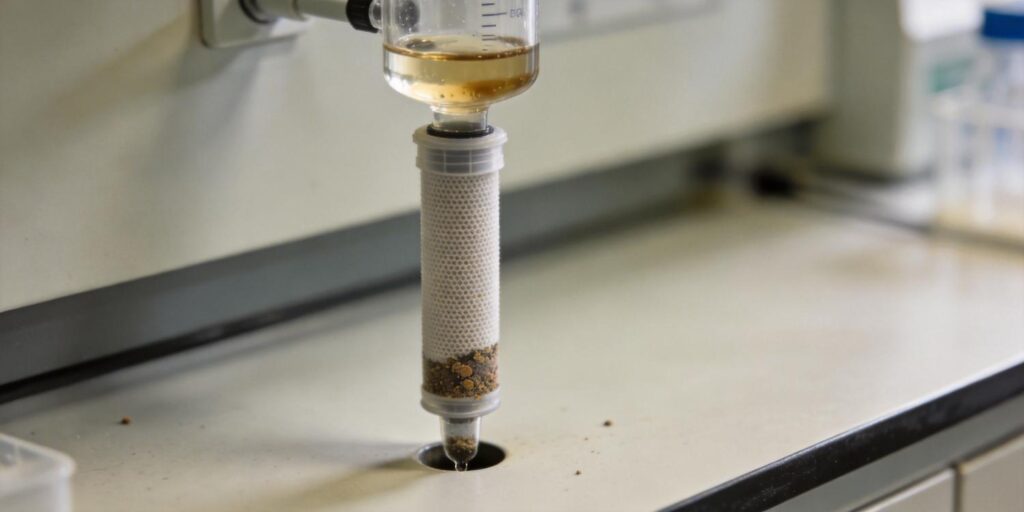
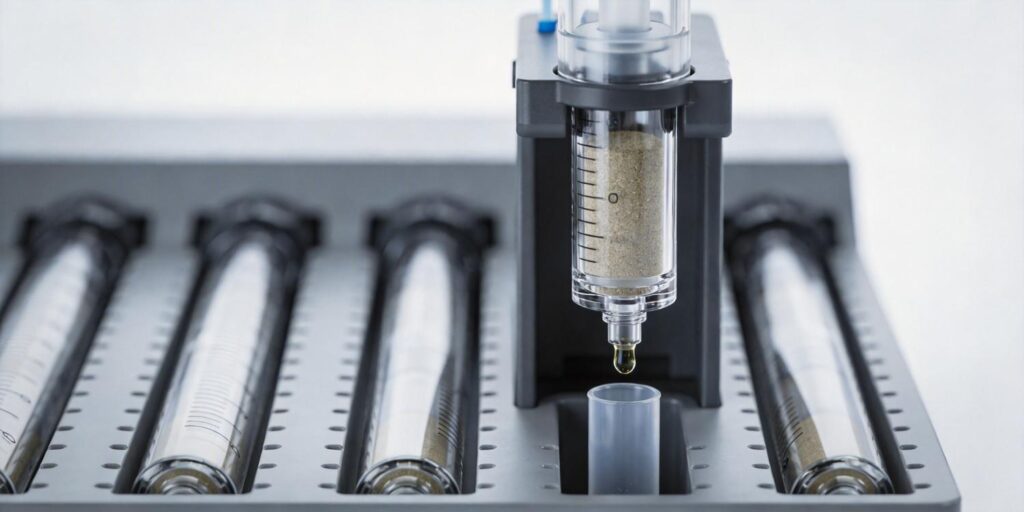
Vacuum manifold systems present specific challenges for preventing sorbent drying. The fundamental design where “the SPE cartridges can remain on the manifold lid throughout the extraction process” creates opportunities for drying if not properly managed.
Key Design Principles:
1. Vacuum Regulation
“It is important for the reproducibility of the procedure that the vacuum is continuously regulated during the elution in order to obtain a near constant flow through the cartridges.” Use vacuum controllers or regulators to maintain consistent pressure.
2. Sequential Processing
Process cartridges in batches small enough to complete all steps without interruption. Avoid loading all cartridges at once if you cannot proceed through conditioning, loading, washing, and elution continuously.
3. Solvent Reservoirs
Keep solvent reservoirs filled and ready for immediate application. The time between solvent depletion and addition should be minimized.
4. Manifold Design Considerations
Modern manifolds with improved sealing mechanisms reduce air exposure. Consider systems that allow for nitrogen purging when working with oxygen-sensitive analytes.
Troubleshooting Dried Cartridges
When sorbent drying occurs despite precautions, specific troubleshooting approaches can salvage the extraction:
1. Reconditioning Strategy
If drying occurs after conditioning but before sample loading, recondition with 1-2 mL of methanol followed by aqueous phase. Monitor flow characteristics to ensure proper rewetting.
2. Partial Drying During Wash Steps
For cartridges that partially dry during wash steps, apply a small volume (0.5-1 mL) of the wash solvent to rewet the bed before proceeding with elution.
3. Complete Drying Before Elution
In cases where cartridges have completely dried before elution:
- Re-wet with 1 mL of elution solvent
- Allow 1-2 minutes for solvent penetration
- Proceed with normal elution volume
- Consider collecting eluate in two fractions to monitor recovery
4. Prevention Monitoring
“It is possible to gauge dryness by touching the cartridge around the sorbent bed; if it feels noticeably cooler than ambient temperature, then drying is not complete.” This simple test helps identify problematic drying before it affects results.
Recommended Timing Between Steps
Optimal timing varies by sorbent type and application, but general guidelines include:
| Step Transition | Maximum Delay | Recommended Action |
|---|---|---|
| Conditioning to Sample Loading | 5 minutes | Load immediately after conditioning solvent passes through |
| Sample Loading to Wash | 10-15 minutes | Proceed directly if possible; keep bed moist |
| Wash to Drying Step | 5 minutes | Begin drying immediately after final wash |
| Drying to Elution | 15-30 minutes | Complete elution promptly after drying |
For specific applications like GHB analysis in forensic toxicology, protocols specify “aspirate at ~1 in. Hg” during wash steps to maintain appropriate flow without drying. These precise vacuum specifications highlight the importance of controlled conditions.
Laboratory SOP Recommendations
Incorporating sorbent drying prevention into Standard Operating Procedures ensures consistent results across laboratory personnel and over time.
1. Vacuum Control Specifications
SOPs should specify exact vacuum pressures for each step. For example:
- Conditioning: 2-3 in. Hg
- Sample Loading: 1-2 in. Hg
- Wash Steps: 1-3 in. Hg (depending on solvent)
- Drying: 10-15 in. Hg for 3-5 minutes
2. Timing Protocols
Establish maximum allowable times between steps based on validation data. Include checkpoints for multi-cartridge processing to ensure no cartridge exceeds time limits.
3. Quality Control Measures
Implement QC samples that monitor recovery variations potentially caused by drying issues. Include positive controls with known susceptibility to drying effects.
4. Equipment Maintenance
Regular calibration of vacuum gauges and regulators ensures consistent performance. Document maintenance schedules and verification procedures.
5. Training Requirements
Train all personnel on:
- Visual indicators of sorbent drying
- Proper vacuum adjustment techniques
- Troubleshooting procedures for dried cartridges
- Documentation requirements for deviations
6. Method Validation Considerations
During method validation, intentionally test drying scenarios to establish robustness limits. Determine maximum allowable drying time before recovery falls outside acceptance criteria.
By implementing these comprehensive strategies, laboratories can prevent sorbent drying issues that compromise SPE results. The investment in proper workflow design, equipment maintenance, and personnel training pays dividends in improved data quality, reduced repeat analyses, and increased confidence in analytical results.
For laboratories using HLB SPE cartridges, MAX SPE cartridges, MCX SPE cartridges, or 96-well SPE plates, these drying prevention principles apply universally across sorbent chemistries and formats.