Principle of Vacuum Manifold Operation
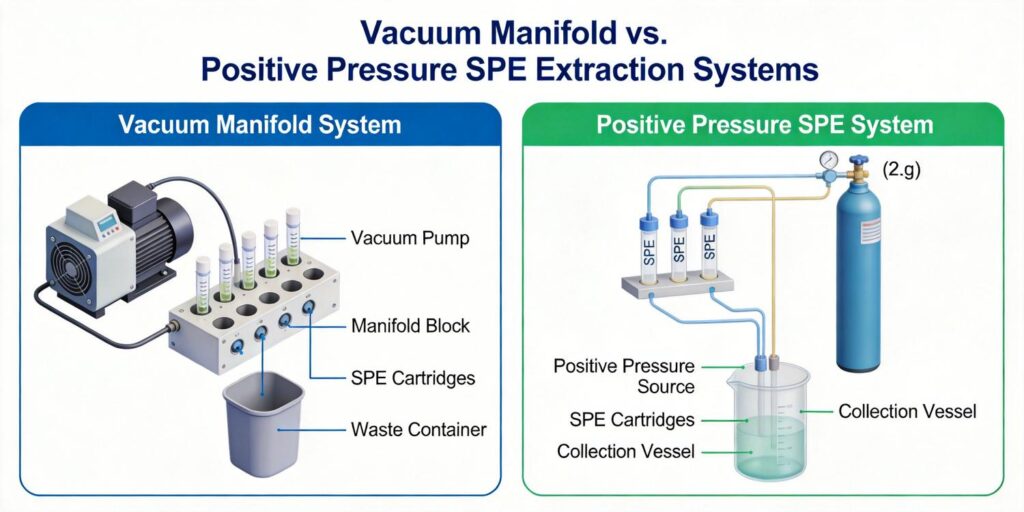
Vacuum manifold systems represent the traditional workhorse of solid-phase extraction (SPE) laboratories, with their origins dating back to 1979 when Analytichem International (now Varian Sample Preparation Products) introduced the first commercial systems for parallel processing. These systems operate on a simple yet effective principle: negative pressure differential drives fluid flow through SPE cartridges.
The fundamental design consists of a sealed chamber, typically constructed of thick-walled glass or inert polymers like acetal, fitted with a vacuum-sealed lid containing multiple ports. Each port accepts an SPE cartridge, and the entire assembly connects to a vacuum source through a trap and vacuum gauge. When vacuum is applied, liquids are drawn through the sorbent bed by negative pressure, with the vacuum force overcoming the surface tension and resistance of the packed bed.
Modern vacuum manifolds feature precision-machined components with Teflon tubes and valves to ensure solvent resistance and minimize contamination. The Waters Vacuum Manifold, for example, incorporates enhanced vacuum control valves designed for optimal performance with various SPE cartridge types, allowing momentary increases in vacuum above the frit bubble point when needed.
Key Operational Characteristics:
- Pressure Control: Operators set specific vacuum pressures, not flow rates
- Flow Dynamics: Flow rates vary based on vacuum pressure, sample viscosity, and cartridge packing characteristics
- Parallel Processing: Multiple samples (typically 12-24) can be processed simultaneously
- Adaptability: Compatible with various cartridge sizes, from 1 mL to 35 mL capacities
Positive Pressure SPE Technology
Positive pressure SPE systems represent a more recent advancement in extraction technology, first commercialized by Applied Separations Inc. in 1987. Unlike vacuum systems that pull liquids through the sorbent bed, positive pressure systems push liquids through using compressed gas or mechanical displacement.
The technology gained significant momentum in 1996 when Varian Inc. introduced a manual positive pressure manifold, offering several distinct advantages over traditional vacuum systems. These systems typically utilize nitrogen or compressed air to generate pressure, though more sophisticated automated workstations employ syringe pumps or stepper motor-driven pistons for precise fluid displacement.
Technical Implementation:
- Pressure Source: Compressed gas (nitrogen preferred for oxygen-sensitive analytes) or mechanical displacement
- Flow Control: More precise regulation of flow rates compared to vacuum systems
- Drying Efficiency: Rapid drying capabilities using clean, pressurized gas
- Automation Compatibility: Naturally suited for integration into automated SPE workstations
Positive pressure operation is particularly valuable in automated systems where precise flow control is essential for reproducibility. As noted in SPE literature, “an automated SPE workstation that uses a pump or syringe to provide positive pressure displacement of a liquid volume will provide the most stable flow.”
Advantages and Limitations of Each System
Vacuum Manifold Advantages:
- Cost-Effectiveness: Lower initial investment and operating costs
- Simplicity: Easy to learn and operate with minimal training
- High Throughput: Capable of processing multiple samples simultaneously
- Established Methodology: Extensive legacy of applications and literature
- Adaptability: Compatible with most SPE accessories and easily automated
Vacuum Manifold Limitations:
- Flow Control Challenges: Limited or complex control over flow rates
- Variable Performance: Flow rates depend on multiple factors including cartridge permeability and sample viscosity
- Drying Limitations: Slower drying compared to positive pressure systems
- Potential for Deconditioning: Risk of cartridges drying out inadvertently
- Skill Dependency: Requires moderately high skill level for optimal results
Positive Pressure System Advantages:
- Superior Flow Control: More precise regulation of flow rates
- Enhanced Reproducibility: Consistent performance across samples
- Rapid Drying: Efficient drying with clean pressurized gas
- Oxygen-Sensitive Applications: Ability to use nitrogen instead of laboratory air
- Automation Readiness: Natural integration with automated systems
Positive Pressure System Limitations:
- Higher Cost: More expensive equipment and potentially higher operating costs
- Complexity: Requires more training and expertise
- Sealing Requirements: Need for proper gas sealing systems
- Limited Legacy: Fewer established applications compared to vacuum systems
Impact on Flow Rate Control and Reproducibility
The fundamental difference between vacuum and positive pressure systems lies in their approach to flow control, which directly impacts method reproducibility and recovery efficiency.
Vacuum System Flow Characteristics:
In vacuum systems, operators set a specific vacuum pressure, not a flow rate. The resulting flow rate is determined by multiple variables: the vacuum pressure setting, sample viscosity, cartridge packing characteristics, and sorbent bed format. This creates inherent variability because “with negative pressure operation, the pressure remains constant, while the flow rate through the SPE cartridge bed may vary.”
This variability becomes particularly problematic in ion-exchange extractions, which are more sensitive to flow rate variations than polar or non-polar extractions. The load and elute steps are typically most sensitive to flow rate changes, with variations potentially leading to lower recoveries or decreased reproducibility.
Positive Pressure Flow Advantages:
Positive pressure systems offer superior flow control capabilities. Advanced systems can monitor flow rates and adjust pressure accordingly to maintain constant flow. As noted in SPE literature, “some workstations that use air to generate the pressure to move liquids through the SPE cartridge bed now use a monitor to determine the flow rate of liquid through the SPE cartridge, and can vary the pressure as necessary to maintain a constant flow rate.”
This precise control is particularly valuable for methods requiring specific flow rates for different extraction steps. Research demonstrates that “a low flow rate is essential to obtain high and reproducible recoveries,” with extraction yields increasing from about 80% to 95% when lowering flow rates from 1.5 to 0.33 mL/minute in certain applications.
Reproducibility Considerations:
- Vacuum Systems: Reproducibility depends on consistent operator technique and stable vacuum sources
- Positive Pressure Systems: Automated flow control enhances inter-sample consistency
- Method Transfer: Positive pressure systems facilitate easier method transfer between laboratories
- Regulatory Compliance: Better documentation and control for regulated environments
Application Differences in High-Throughput Labs
High-Throughput Requirements:
Modern analytical laboratories face increasing pressure to process larger sample volumes with greater efficiency. Both vacuum and positive pressure systems have evolved to meet these demands, but their approaches differ significantly.
Vacuum Manifold High-Throughput Applications:
- Batch Processing: Traditional 24-port manifolds remain popular for medium-throughput labs
- 96-Well Plate Compatibility: Modern vacuum manifolds adapt to 96-well SPE plates
- Large Volume Samples: Specialized vacuum stations handle samples up to 1 liter using 47 or 90 mm discs
- Cost-Effective Scaling: Additional manifolds can be added without significant infrastructure changes
Positive Pressure High-Throughput Advantages:
- Automated Workstations: Integrated systems process hundreds of samples unattended
- Precision at Scale: Maintain consistent flow rates across large sample batches
- Reduced Operator Intervention: Automated systems minimize hands-on time
- Integration Capabilities: Seamless connection with liquid handlers and analytical instruments
Throughput Optimization Strategies:
Both systems benefit from throughput optimization techniques:
- Parallel Processing: Multiple samples processed simultaneously in step-wise fashion
- Reagent Combination: Combining acid or base in salt form to reduce steps
- Small Volume Devices: Using discs or micro-bed cartridges requiring minimal solvent volumes
- Efficient Drying: Rapid drying with smallest bed volumes possible
- Minimal Elution Volumes: Concentrated eluates for faster evaporation
Maintenance Considerations
Vacuum Manifold Maintenance:
- Vacuum Source Maintenance: Regular checking of vacuum pumps and seals
- Gasket Replacement: Periodic replacement of sealing gaskets
- Valve Maintenance: Cleaning and potential replacement of needle valves
- Contamination Prevention: Regular cleaning to prevent cross-contamination
- Tubing Integrity: Checking vacuum tubing for cracks or collapse
Positive Pressure System Maintenance:
- Gas System Maintenance: Regular checking of pressure regulators and gas lines
- Seal Integrity: Ensuring proper sealing of pressure chambers
- Fluid Path Compatibility: Monitoring for reagent compatibility with system components
- Automation Component Maintenance: Regular servicing of pumps, valves, and sensors
- Carryover Prevention: Implementing proper cleaning protocols between samples
Common Maintenance Challenges:
Both systems face similar challenges with sample matrix effects. Viscous samples or those containing particulates, fibrin, mucus, or proteins can clog frits and sorbent pores. Solutions include:
- Sample Pretreatment: Dilution, filtration, centrifugation, or protein precipitation
- Cartridge Selection: Larger sorbent particles, increased surface area, or larger frit pore diameters
- Flow Optimization: Adjusting pressure or vacuum to overcome resistance
Choosing the Right System for Your Lab
Decision Factors:
- Sample Volume and Throughput Requirements:
- Low to medium throughput: Vacuum manifolds offer cost-effective solutions
- High throughput: Positive pressure automated systems provide efficiency
- Large volume samples: Specialized vacuum or positive pressure systems
- Method Sensitivity Requirements:
- Flow-sensitive methods: Positive pressure systems for precise control
- Ion-exchange applications: Positive pressure preferred for reproducibility
- Oxygen-sensitive analytes: Positive pressure with nitrogen gas
- Budget Considerations:
- Limited budget: Vacuum systems offer lower initial investment
- Long-term efficiency: Positive pressure systems may provide better ROI through improved reproducibility
- Operating costs: Consider solvent usage, waste disposal, and labor costs
- Staff Expertise and Training:
- Limited technical staff: Vacuum systems are easier to learn
- Technical expertise available: Positive pressure systems can be fully leveraged
- Training requirements: Consider ongoing training needs
- Future Expansion and Automation:
- Planned automation: Positive pressure systems integrate more easily
- Method transfer needs: Positive pressure offers better consistency
- Regulatory requirements: Consider documentation and control capabilities
Hybrid Approaches:
Many laboratories successfully employ both technologies, using vacuum manifolds for method development and routine applications while reserving positive pressure systems for sensitive methods or high-throughput requirements. This approach leverages the strengths of each technology while managing costs effectively.
Implementation Recommendations:
- Start with Method Evaluation: Assess current and future method requirements
- Consider Total Cost of Ownership: Include maintenance, consumables, and labor
- Evaluate Space Requirements: Consider footprint and hood requirements
- Assess Integration Needs: Consider connections to other laboratory equipment
- Plan for Growth: Choose systems that can scale with laboratory needs
Ultimately, the choice between vacuum manifold and positive pressure SPE systems depends on your specific laboratory requirements, budget constraints, and analytical goals. Both technologies continue to evolve, with manufacturers introducing innovations that enhance performance, reliability, and user experience. By carefully evaluating your needs against the capabilities of each system type, you can select the optimal solution for your solid-phase extraction requirements.
For laboratories seeking to optimize their SPE workflows, consider exploring our comprehensive range of HLB SPE cartridges, MAX SPE cartridges, MCX SPE cartridges, and 96-well SPE plates designed to work seamlessly with both vacuum and positive pressure systems.