Challenges in High-Throughput Analytical Testing
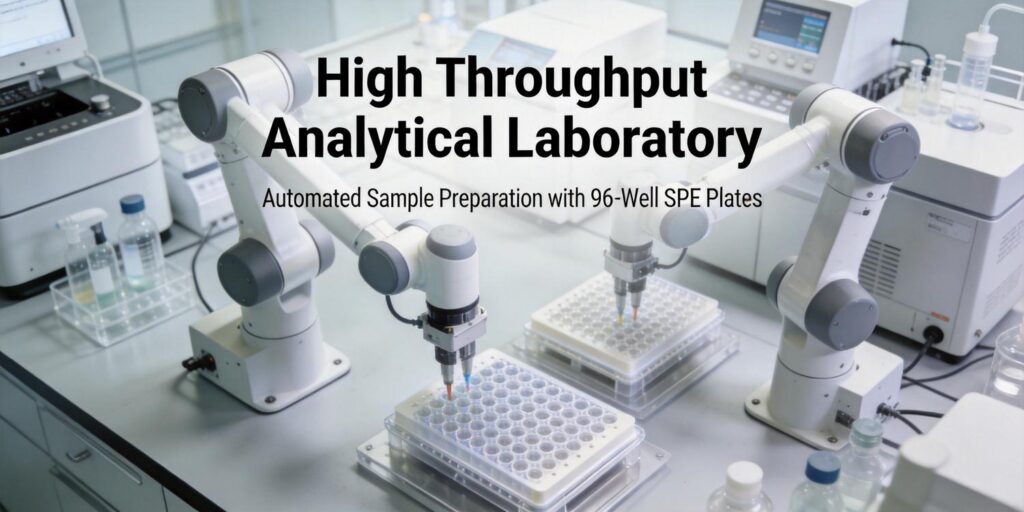
High-throughput laboratories face significant challenges in maintaining analytical efficiency while processing large sample volumes. As noted in the literature, “sample preparation is the rate-limiting step for many analyses” (Simpson, 2000). With modern analytical instruments like LC-MS/MS operating with run times of just 2-3 minutes, laboratories often experience backlogs in sample preparation that prevent these costly instruments from operating at full capacity.
The primary challenges include:
- Sample Volume Management: Handling hundreds to thousands of samples daily while maintaining data integrity
- Time Constraints: Reducing turnaround time from sample receipt to analytical results
- Resource Optimization: Maximizing instrument utilization while minimizing labor costs
- Quality Assurance: Ensuring consistent results across large sample batches
- Solvent Consumption: Managing environmental impact and cost of organic solvents
- Operator Safety: Reducing exposure to potentially hazardous samples and reagents
Selecting 96-Well SPE Plates vs Cartridges
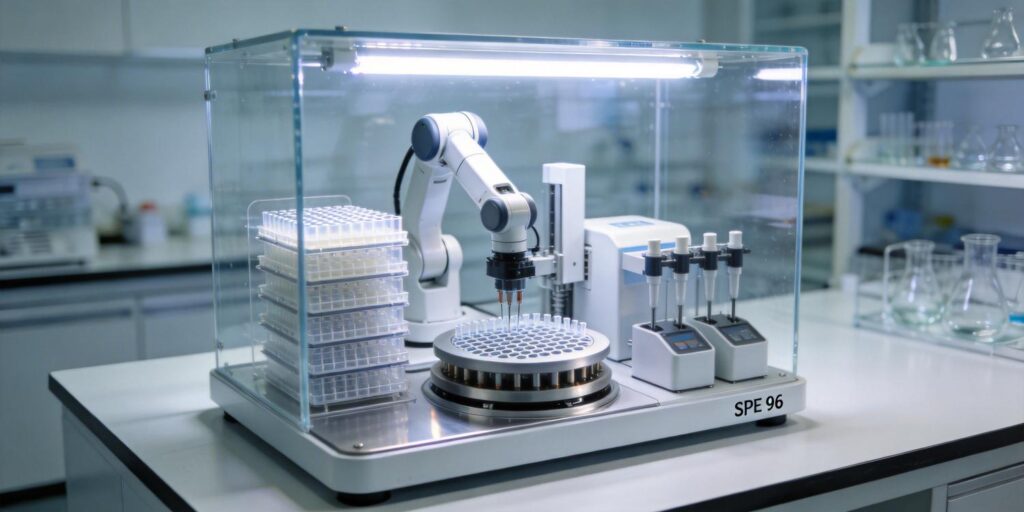
The choice between 96-well SPE plates and traditional cartridges represents a critical decision point for high-throughput laboratories. According to Waters documentation, 96-well extraction plates offer “high throughput and high recovery” with compatibility with most liquid-handling robotic systems for automated, reliable high-throughput SPE (HT-SPE).
96-Well SPE Plates Advantages:
- Parallel Processing: All 96 samples can be processed simultaneously in batch mode
- Automation Compatibility: Designed specifically for robotic liquid handling systems
- Reduced Manual Handling: Minimizes operator intervention and potential errors
- Standardized Format: Compatible with standard laboratory automation equipment
- Space Efficiency: Compact design saves valuable bench space
Traditional Cartridges Advantages:
- Flexibility: Available in various sizes (1 cc to 35 cc) for different sample volumes
- Cost-Effectiveness: Lower per-unit cost for smaller sample batches
- Manual Processing: Suitable for laboratories with limited automation infrastructure
- Method Development: Easier for initial method optimization before scaling up
For laboratories processing more than 50 samples per day, 96-well plates typically offer superior efficiency. As noted in the literature, “96-well plate SPE ‘blocks’ have been employed for combinatorial chemistry synthesis” and represent a standard format in immunoassay screening and combinatorial chemistry labs.
Automation Opportunities in Sample Preparation
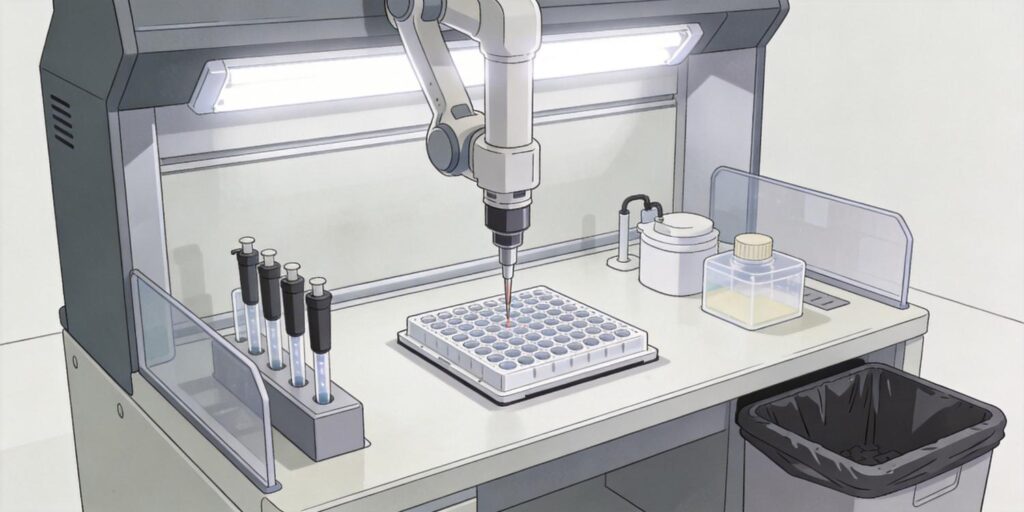
Automation represents the most significant opportunity for workflow optimization in high-throughput laboratories. According to Jordan (2000), “automated SPE sample preparation eliminates many of those variables associated with manual SPE” resulting in improved precision, accuracy, and recovery.
Key Automation Benefits:
- Consistency: Automated equipment performs identical sequences on each sample
- Documentation: Provides formal electronic documentation of every extraction step
- Reduced Reruns: Enhanced consistency leads to fewer sample reruns
- Operator Safety: Reduces exposure to biological fluids and hazardous reagents
- Labor Optimization: Frees technicians for more value-added tasks like data analysis
Automation Considerations:
When evaluating automation needs, laboratories should consider several key questions outlined in the literature:
- How many samples need to be prepared daily?
- What is the expected project duration?
- How quickly are results needed?
- How many people will use the system?
- How many different methods will be run?
- What steps are required before and after SPE?
Workflow Standardization Strategies
Standardization is crucial for maintaining quality in high-throughput environments. The literature emphasizes that “if the chemistry of a manual SPE method is not optimized, automating that method will not correct it.”
Standardization Approaches:
- Method Validation: Start with validated manual methods before automation
- Single Variable Changes: Change only one variable at a time during optimization
- Matrix-Specific Testing: Use spiked samples in the actual sample matrix
- Replicate Analysis: Run samples in triplicate to ensure only the investigated variable changes
- Vendor Consistency: Avoid mixing SPE cartridges from different vendors
Process Standardization:
The literature outlines a five-step process for automating manual SPE methods:
- Initial Experiment: Achieve some recovery
- Minimize Interferences: Eliminate matrix interferences
- Optimize Recovery: Achieve high analyte recovery
- Reduce Carryover: Minimize cross-contamination
- Optimize Throughput: Achieve the final optimized method
Reducing Solvent Consumption
Solvent reduction represents both an economic and environmental imperative. The literature notes that “small volume SPE devices such as discs require minimal amounts (100-200 μL) of solvents” and that “optimization of the wash solvent is important in giving the cleanest sample.”
Solvent Reduction Strategies:
- Miniaturization: Use smaller bed mass cartridges or 96-well plates with reduced sorbent amounts
- Optimized Volumes: Determine minimum effective solvent volumes for each step
- Solvent Selection: Choose solvents that provide adequate precipitation where required
- Flow Rate Optimization: Adjust flow rates to minimize solvent usage while maintaining recovery
- Waste Management: Implement proper solvent recycling and disposal systems
As noted, “bed drying proceeds most rapidly with the smallest bed volume” and “analyte elution with the smallest volumes of solvent is rapid and leads to fast evaporation.”
Quality Control in Large Sample Batches
Maintaining quality control across large sample batches requires systematic approaches. The literature emphasizes that “with automation of SPE, most laboratories experience a reduction in the number of samples that must be rerun because of the enhanced consistency automated SPE can provide.”
QC Strategies:
- Process Controls: Include blanks, standards, and quality control samples in each batch
- Carryover Assessment: Test for carryover using blank samples following high-concentration samples
- Recovery Monitoring: Track recovery rates across batches to identify trends
- Documentation: Maintain complete electronic records of all extraction parameters
- Regular Maintenance: Implement routine cleaning and maintenance schedules for automated systems
Carryover Prevention:
The literature provides specific guidance on carryover assessment: “run two blank samples (containing no analyte), followed by a sample with a very high concentration of analyte. Follow this with two additional blank samples and measure the amount of analyte found in these samples.” Multiple small-volume washes are generally more effective than single high-volume washes for cleaning fluid paths.
Example Automated SPE Workflow
An optimized automated SPE workflow for high-throughput laboratories typically follows this structure:
1. Sample Preparation Phase:
- Sample aliquoting and labeling
- Internal standard addition
- pH adjustment if required
- Centrifugation for sample clarification
2. Automated SPE Processing:
- Conditioning: SPE sorbent activation with appropriate solvents
- Equilibration: Preparation with weak solvent compatible with sample matrix
- Sample Loading: Controlled flow rate application of samples
- Washing: Removal of interfering compounds
- Drying: Removal of residual solvents (if required)
- Elution: Analyte collection in minimal solvent volume
3. Post-Processing:
- Evaporation and reconstitution (if required)
- Transfer to analytical vials
- Storage under appropriate conditions
- Data documentation and archiving
Workflow Optimization Tips:
- Batch vs Serial Processing: Choose processing mode based on sample characteristics and throughput requirements
- Flow Rate Optimization: “Load and elute flow rates and cartridge drying steps are often the most time consuming steps” – optimize these first
- Volume Management: Use the smallest effective volumes for each step
- Timing Coordination: Align SPE processing time with analytical instrument run times
As concluded in the literature, “successful introduction of automation requires the laboratory to realize that an automated SPE workstation is a tool to help the laboratory personnel perform their jobs, but is not a replacement for them.” Proper implementation, following the guidelines outlined in this article, will provide “rugged, reliable, and optimized automated SPE methods” for high-throughput laboratories.
For laboratories considering SPE automation, Poseidon Scientific offers a comprehensive range of HLB SPE cartridges, MAX SPE cartridges, MCX SPE cartridges, WAX SPE cartridges, WCX SPE cartridges, and 96-well SPE plates compatible with most automated systems.