Analytical Challenges in Antidepressant Quantification
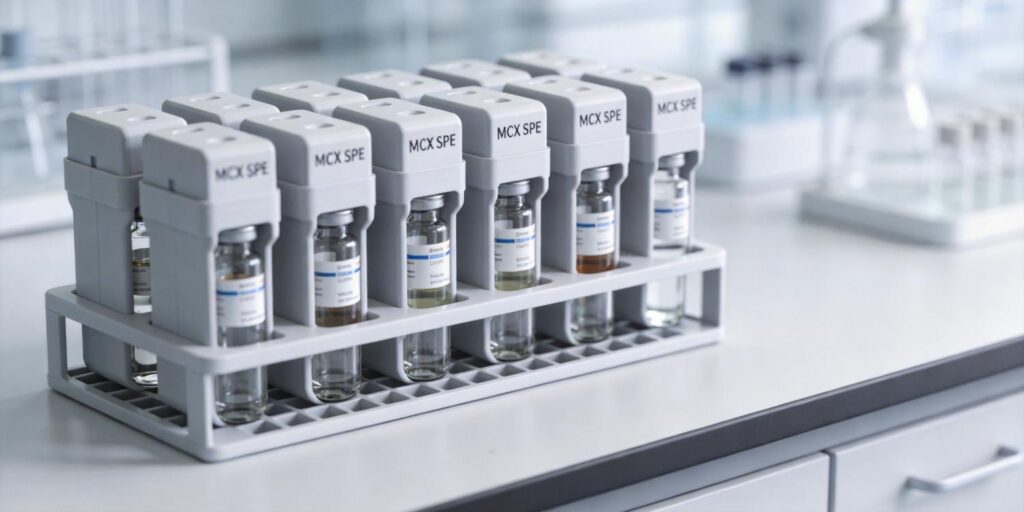
Quantifying antidepressants such as selective serotonin reuptake inhibitors (SSRIs), serotonin-norepinephrine reuptake inhibitors (SNRIs), and tricyclic antidepressants (TCAs) in human plasma presents significant analytical challenges. These compounds are present at low nanogram-per-milliliter concentrations, requiring high sensitivity and selectivity. Plasma is a complex matrix containing proteins, lipids, salts, and other endogenous compounds that can interfere with LC-MS/MS analysis. Ion suppression or enhancement due to co-eluting matrix components is a common issue, leading to inaccurate quantification. Additionally, antidepressants span a range of polarities and pKa values, making simultaneous extraction challenging. A robust solid-phase extraction (SPE) method using mixed-mode cation exchange (MCX) sorbents can effectively clean up the sample while concentrating the analytes.
Plasma Pretreatment: Protein Precipitation vs. Dilution
Before SPE, plasma samples must be pretreated to reduce matrix complexity. Protein precipitation (PPT) using organic solvents like acetonitrile or methanol is a common approach. Adding three volumes of organic solvent to plasma, vortexing, and centrifuging yields a supernatant that can be directly loaded onto the SPE cartridge. However, PPT can dilute the sample and may not fully remove phospholipids, which are major culprits in ion suppression. An alternative is simple dilution with an aqueous buffer, typically at acidic pH to maintain analytes in their ionized form. Dilution reduces viscosity and helps the sample flow through the cartridge but may not adequately remove proteins. For MCX SPE, we recommend a combined approach: precipitate proteins with 2% phosphoric acid in acetonitrile (1:3 ratio), then dilute the supernatant with 2% formic acid in water to reduce organic content below 10% before loading. This ensures the analytes are fully protonated and the matrix is suitably prepared for retention.
Conditioning and Equilibration of MCX Cartridges
Proper cartridge conditioning is critical for reproducible results. For Poseidon MCX SPE cartridges, start by conditioning with 3 mL of methanol to wet the sorbent and remove any contaminants. Follow with 3 mL of deionized water to equilibrate the sorbent in an aqueous environment. Finally, pass 3 mL of 2% formic acid in water (pH ~2) to ensure the sorbent is in the acidic state necessary for cation exchange. Do not let the cartridge dry out between steps; keep the bed wet to maintain optimal retention.
Loading Conditions at Acidic pH for Cation Retention
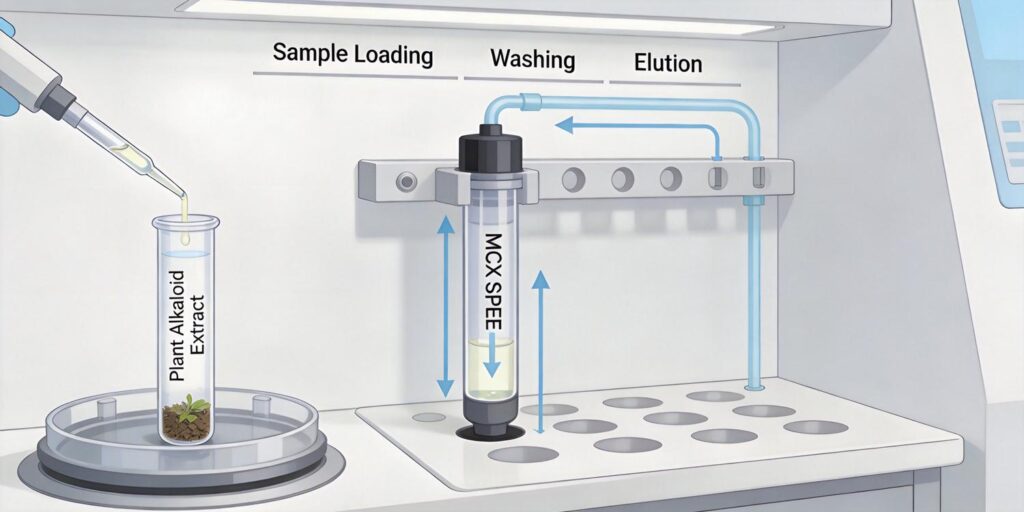
The sample must be loaded at a pH below the pKa of the basic antidepressants (typically pKa 9–10) to ensure they are fully protonated. Adjust the pretreated plasma supernatant to pH 2–3 using formic or phosphoric acid. Load the sample at a slow flow rate of about 1 mL/min to maximize contact time. Antidepressants like fluoxetine (SSRI), venlafaxine (SNRI), and amitriptyline (TCA) are efficiently retained via cation exchange and reversed-phase interactions with the MCX sorbent. The HLB cartridges would retain via reversed-phase only, but MCX adds an extra selectivity dimension.
Washing Sequence: Aqueous Wash Followed by Organic Wash
After loading, wash the cartridge with 3 mL of 2% formic acid in water to remove proteins and salts. Then, apply 3 mL of methanol to elute neutral interferences like lipids and phospholipids. This organic wash is crucial for reducing matrix effects in LC-MS/MS. The MCX sorbent retains the protonated antidepressants even in 100% methanol due to the strong ionic interaction. Optionally, a second wash with 3 mL of 5% ammonium hydroxide in water can remove acidic compounds, but this may cause premature elution of some analytes if not carefully controlled. For antidepressants, the two-step wash (aqueous then organic) is sufficient.
Elution Using Ammoniated Methanol
Elute the antidepressants with 3 mL of 5% ammonium hydroxide in methanol (NH₄OH/MeOH, 5:95, v/v). The basic pH deprotonates the amines, breaking the cation-exchange interaction. Collect the eluate in a clean tube. Evaporate to dryness under nitrogen at 40°C and reconstitute in 100 μL of mobile phase (e.g., 0.1% formic acid in water/acetonitrile, 90:10). This step concentrates the analytes 10-fold, enhancing sensitivity.
LC-MS/MS Considerations: Ion Suppression Mitigation
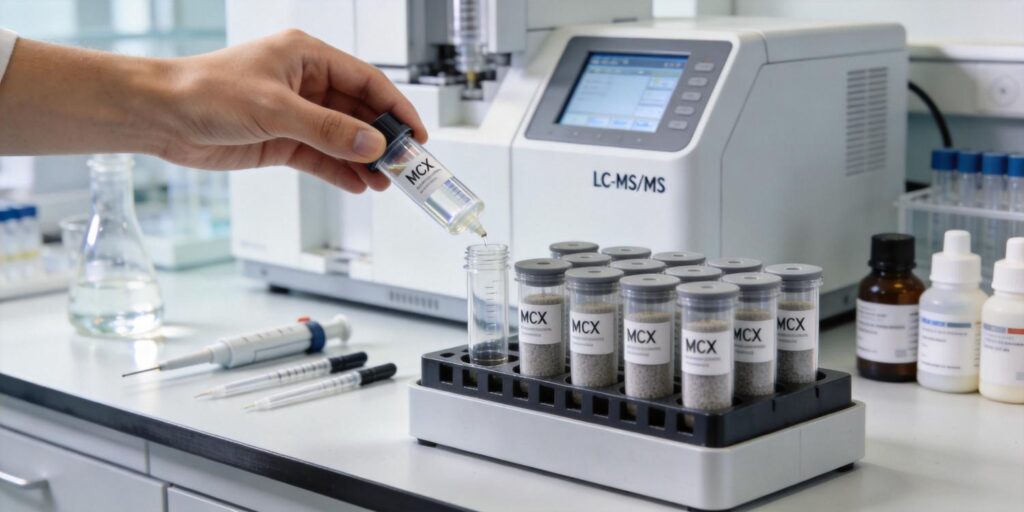
To assess ion suppression, perform a post-column infusion experiment. Compare matrix-matched calibration standards with neat standards. The described MCX SPE method significantly reduces phospholipid content, which is a major source of ion suppression in the early elution region. Use isotopically labeled internal standards (e.g., fluoxetine-d6, venlafaxine-d6, amitriptyline-d3) to compensate for any residual matrix effects. A C18 column (2.1 x 50 mm, 1.7 μm) with a gradient of 0.1% formic acid in water and acetonitrile at 0.3 mL/min provides good separation. Monitor MRM transitions: for example, fluoxetine 310/148, venlafaxine 278/260, amitriptyline 278/233.
Method Validation Parameters and Expected Recoveries
Validate the method according to FDA/EMA guidelines. Key parameters include linearity (1–500 ng/mL, R² > 0.995), accuracy (85–115%), precision (CV 80% with CV < 10%. The method should be free of significant carryover. For 96-well plate formats, see the 96-well SPE plate for high-throughput applications. The combination of acidic loading, efficient washing, and basic elution ensures a clean extract suitable for routine quantification.