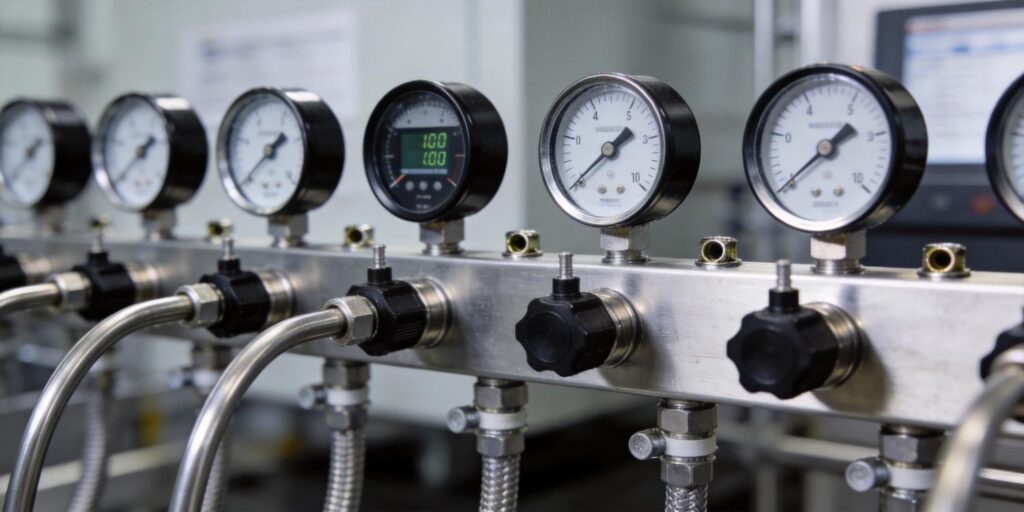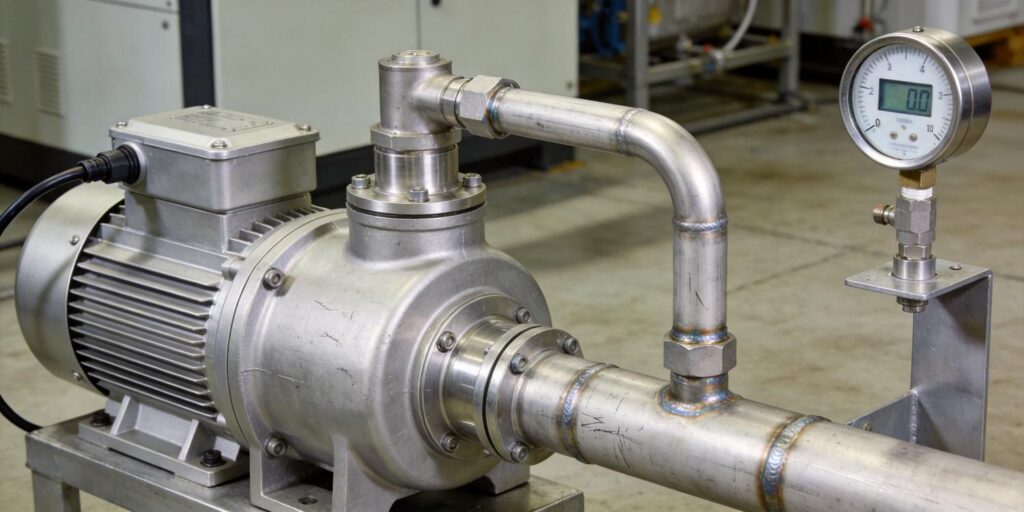
Vacuum Gauge

Industrial wiring connected to vacuum gauge transmitter

Vacuum Gauge Cable Length Limitations and Signal Stability

In vacuum systems ranging from analytical mass spectrometers to large-scale industrial heat-treatment furnaces, reliable signal transmission from the gauge to the control system is non-negotiable. A drifting or noisy pressure reading can trigger false interlocks, extend pump-down times, or compromise process quality. Poseidon Scientific’s VG-SP205 Pirani Vacuum Transmitter and VG-SM225 Cold Cathode Vacuum Gauge support […]

Vacuum Gauge Cable Length Limitations and Signal Stability Read More »

Cold cathode vacuum gauge starting up with LED indicator

Cold Cathode Gauge Ignition Delay: Causes and Optimization

In high-vacuum applications such as mass spectrometry, vacuum metallurgy, and electron-beam welding, the cold-cathode gauge is prized for its robustness, lack of hot filament, and ability to measure down to 10⁻⁷ Torr. Yet one operational characteristic consistently draws questions from engineers: ignition delay—the time required for the Penning discharge to establish after high voltage is

Cold Cathode Gauge Ignition Delay: Causes and Optimization Read More »

Vacuum gauge mounted on metallurgy furnace chamber

Selecting Vacuum Gauges for Vacuum Metallurgy Processes

In vacuum metallurgy processes—vacuum arc melting, vacuum induction melting, electron-beam melting, and high-temperature heat treatment—precise pressure control directly determines material purity, microstructure, and final mechanical properties. Oxygen, nitrogen, or hydrogen partial pressures above 10⁻⁴ Torr can cause embrittlement, inclusions, or unwanted phase changes. Yet the operating environment is punishing: chamber temperatures often exceed 1500 °C,

Selecting Vacuum Gauges for Vacuum Metallurgy Processes Read More »

Multiple vacuum gauges mounted on large industrial vacuum chamber

Vacuum Monitoring Strategy for Large-Scale Industrial Chambers

Large-scale industrial vacuum chambers—whether 10 m³ vacuum heat-treatment furnaces, multi-meter PVD coating systems, or aerospace simulation chambers—present unique monitoring challenges that small analytical instruments simply do not face. With volumes measured in cubic meters rather than liters, pump-down times stretch from minutes to hours, outgassing becomes significant, and pressure gradients across the chamber can reach

Vacuum Monitoring Strategy for Large-Scale Industrial Chambers Read More »

Engineer reviewing vacuum pressure data beside installed gauge

Understanding Vacuum Gauge Measurement Uncertainty

In vacuum systems for mass spectrometry, pharmaceutical freeze-drying, scanning electron microscopy, and industrial heat treatment, pressure is rarely a single fixed value—it is a measurement with inherent doubt. Engineers and procurement teams often ask: how much can I trust the number on the display? The difference between a gauge’s stated accuracy and its real-world measurement

Understanding Vacuum Gauge Measurement Uncertainty Read More »

Two vacuum gauges installed on industrial chamber for redundancy

Why Dual Vacuum Gauge Systems Improve Reliability

In vacuum-dependent processes such as mass spectrometry, pharmaceutical freeze-drying, scanning electron microscopy, and multi-zone heat treatment, a single pressure reading can determine whether a batch succeeds or fails. Yet many systems still rely on one gauge to monitor the entire range from atmosphere to 10⁻⁷ Torr. This creates a classic single point of failure: if

Why Dual Vacuum Gauge Systems Improve Reliability Read More »

Vacuum gauge mounted on pharmaceutical freeze dryer chamber

Vacuum Gauge Selection for Pharmaceutical Freeze Drying Systems

In pharmaceutical freeze-drying (lyophilization) systems, vacuum is the critical process variable that controls sublimation rate, product temperature, and final moisture content. A collapsed cake, excessive residual moisture, or batch rejection can result from even minor pressure deviations. Yet many systems still rely on a single-gauge approach that forces compromises in range, response, or contamination resistance.

Vacuum Gauge Selection for Pharmaceutical Freeze Drying Systems Read More »

Engineer comparing vacuum gauge specifications

Cost vs Performance: Selecting the Right Vacuum Gauge

Engineers and procurement professionals in vacuum-dependent industries face a recurring dilemma: premium imported gauges promise top-tier performance but carry premium price tags, while budget options often compromise reliability or require frequent replacements. At Poseidon Scientific, we designed the VG-SP205 Pirani Vacuum Transmitter and VG-SM225 Cold Cathode Vacuum Gauge specifically to resolve this tension—delivering full-range vacuum

Cost vs Performance: Selecting the Right Vacuum Gauge Read More »

Multiple vacuum gauges across industrial multi-chamber system

Vacuum Measurement Strategy for Multi-Chamber Systems

In multi-chamber vacuum systems—whether load-locked PVD coaters, multi-stage mass spectrometers, or vacuum heat-treatment furnaces—pressure varies dramatically from atmosphere in the load lock to high vacuum in the process chamber. A single-gauge approach quickly fails: Pirani sensors lose accuracy below 10⁻³ Torr, while cold-cathode gauges cannot start or survive exposure to atmosphere. Poseidon Scientific’s complementary pair—the

Vacuum Measurement Strategy for Multi-Chamber Systems Read More »

Laptop connected to RS232 vacuum transmitter

Digital Communication Errors in Vacuum Transmitters

In high-vacuum systems such as mass spectrometers, scanning electron microscopes, and vacuum heat-treatment furnaces, precise pressure data must reach the control system without interruption. Poseidon Scientific’s VG-SP205 Pirani Vacuum Transmitter and VG-SM225 Cold Cathode Vacuum Gauge deliver both analog (0–10 V) and digital RS232 outputs, giving engineers flexible integration options. When digital communication is chosen,

Digital Communication Errors in Vacuum Transmitters Read More »

Shopping Cart
Poseidon Scientific
Privacy Overview

This website uses cookies so that we can provide you with the best user experience possible. Cookie information is stored in your browser and performs functions such as recognising you when you return to our website and helping our team to understand which sections of the website you find most interesting and useful.