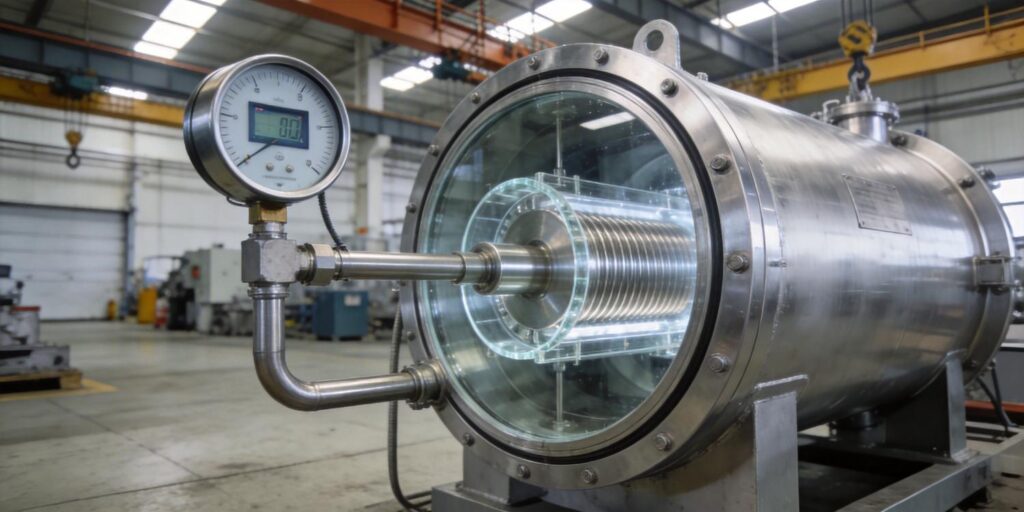
Vacuum Gauge

Technician installing compatible vacuum gauge in industrial system

Why PTR225N Compatibility Matters in Retrofit Projects

In vacuum system retrofits—whether upgrading an aging mass spectrometer, modernizing a thin-film coating line, or extending the life of a research chamber—gauge replacement decisions often hinge on one critical factor: compatibility. The Leybold PENNINGVAC PTR 225 N (commonly referenced as PTR225N) has been a global workhorse for high-vacuum monitoring for decades. Its widespread adoption across […]

Why PTR225N Compatibility Matters in Retrofit Projects Read More »

Pirani and cold cathode gauges installed on same vacuum chamber

Understanding Measurement Range Overlap Between Pirani and Cold Cathode

In high-vacuum systems such as mass spectrometers, scanning electron microscopes, and vacuum heat-treatment furnaces, reliable pressure measurement across multiple orders of magnitude is non-negotiable. Engineers and procurement specialists frequently pair a Pirani gauge for rough vacuum with a cold cathode gauge for high vacuum. At Poseidon Scientific, we engineered the VG-SP205 Pirani Vacuum Transmitter and

Understanding Measurement Range Overlap Between Pirani and Cold Cathode Read More »

Vacuum gauge mounted correctly on vacuum chamber port

Vacuum Gauge Placement: Where Should It Be Installed?

Why Vacuum Gauge Placement Matters More Than Most Engineers Realize In vacuum systems for semiconductor etch, PVD thin-film deposition, mass spectrometry, and vacuum heat treatment, the physical location of a pressure sensor can affect measurement accuracy, response time, contamination rate, and overall system reliability as much as the gauge technology itself. A poorly placed gauge

Vacuum Gauge Placement: Where Should It Be Installed? Read More »

Vacuum gauge wiring connected to PLC cabinet

Analog vs Digital Output in Vacuum Gauges

Signal Types Overview: Analog and Digital Outputs in Vacuum Gauges In vacuum process control—whether for semiconductor etch, PVD thin-film deposition, mass spectrometry, or vacuum heat treatment—reliable pressure data must reach the PLC or SCADA system without distortion or delay. Vacuum gauges therefore offer two primary signal architectures: analog (continuous voltage or current) and digital (serial

Analog vs Digital Output in Vacuum Gauges Read More »

Vacuum gauge installed on industrial load lock chamber

Best Vacuum Gauge for Load Lock Chambers

Load Lock Operational Cycle in High-Throughput Vacuum Systems Load-lock chambers are the high-frequency gateways of modern vacuum tools. In semiconductor etch, PVD coating, and analytical instruments, a typical load-lock cycle repeats every 2–5 minutes: vent to atmosphere, wafer load/unload, rough-pump to transfer pressure (~10-2 to 10-3 mbar), and pressure equalization with the main process chamber

Best Vacuum Gauge for Load Lock Chambers Read More »

Vacuum pump down curve displayed with chamber in background

How to Interpret Vacuum Pump Down Curves Correctly

Phases of the Pump-Down Process Every vacuum system—whether a semiconductor etch chamber, PVD coater, mass spectrometer, or heat-treatment furnace—follows a predictable pump-down curve from atmosphere to base pressure. Understanding its distinct phases is the first step to accurate interpretation and proactive troubleshooting. The curve is not linear; it reflects the physics of gas removal, outgassing,

How to Interpret Vacuum Pump Down Curves Correctly Read More »

Dual vacuum gauges mounted on stainless steel manifold

Using Dual Gauge Strategy for Wide Range Vacuum Monitoring

Why a Single Gauge Is Insufficient for 10-3 to 10-7 mbar Monitoring In semiconductor etch, PVD thin-film deposition, mass spectrometry, and vacuum heat-treatment systems, the working pressure envelope routinely spans 10-3 to 10-7 mbar. A single vacuum gauge cannot deliver accurate, repeatable readings across this entire range without compromising either resolution, reliability, or service life.

Using Dual Gauge Strategy for Wide Range Vacuum Monitoring Read More »

Technician inspecting vacuum gauge in industrial vacuum chamber

Preventing Vacuum Gauge Failure in High Outgassing Systems

Understanding High Outgassing Systems and Vacuum Gauge Reliability High-outgassing vacuum systems—common in semiconductor etch, PVD coating, vacuum heat treatment, and analytical instruments—release significant volumes of water vapor, hydrocarbons, and process by-products during pump-down and operation. These gases not only slow base-pressure recovery but also accelerate sensor contamination, leading to drift, false readings, or outright gauge

Preventing Vacuum Gauge Failure in High Outgassing Systems Read More »

Vacuum gauge mounted on semiconductor plasma etch chamber

Cold Cathode vs Pirani in Semiconductor Etch Chambers

Overview of Semiconductor Etch Vacuum Stages Semiconductor etch chambers operate through tightly sequenced vacuum stages that directly influence etch rate, selectivity, anisotropy, and wafer-to-wafer repeatability. A typical reactive ion etch (RIE) or inductively coupled plasma (ICP) tool cycles through: Load-lock / atmospheric transfer: Chamber vents to atmosphere, wafer loads, then rough-pumped from ~1013 mbar to

Cold Cathode vs Pirani in Semiconductor Etch Chambers Read More »

Vacuum gauge installed on PVD thin film deposition chamber

How to Select a Vacuum Gauge for Thin Film Deposition Systems

Introduction: Why Pressure Accuracy Determines Coating Quality In thin film deposition systems—whether for optical coatings, semiconductor metallization, or advanced materials research—vacuum pressure is the invisible architect of every layer. Even minor deviations in process pressure can compromise film density, adhesion, stoichiometry, and uniformity. A pressure reading that drifts by a single order of magnitude can

How to Select a Vacuum Gauge for Thin Film Deposition Systems Read More »

Shopping Cart
Poseidon Scientific
Privacy Overview

This website uses cookies so that we can provide you with the best user experience possible. Cookie information is stored in your browser and performs functions such as recognising you when you return to our website and helping our team to understand which sections of the website you find most interesting and useful.