Vacuum Gauge

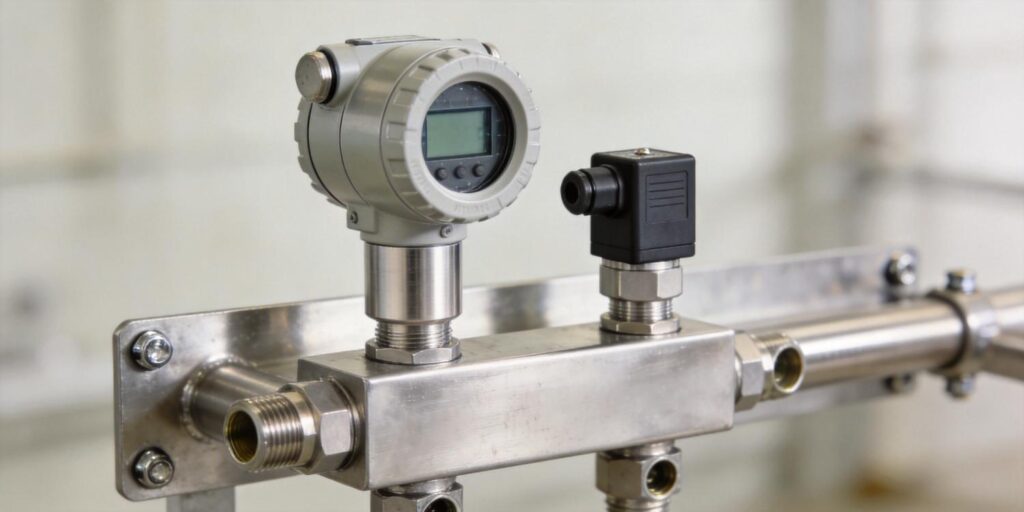
Pirani vacuum gauge installed on roughing pump line

Why Accurate Rough Vacuum Monitoring Improves Pump Protection

Why Accurate Rough Vacuum Monitoring Improves Pump Protection In industrial vacuum systems—whether supporting semiconductor tools, vacuum heat-treatment furnaces, mass spectrometers, or large-scale coating chambers—roughing pumps represent a major capital investment and a frequent source of unplanned downtime. Rotary-vane, scroll, and dry roughing pumps must repeatedly cycle from atmosphere down to the crossover pressure (typically 0.1–10 […]

Why Accurate Rough Vacuum Monitoring Improves Pump Protection Read More »

Technician testing vacuum gauge wiring for interference

Troubleshooting Vacuum Gauge Signal Noise in Industrial Plants

Troubleshooting Vacuum Gauge Signal Noise in Industrial Plants In industrial vacuum environments—ranging from semiconductor fabrication lines and vacuum heat-treatment furnaces to large-scale mass-spectrometry facilities—stable pressure signals are critical for process control, safety interlocks, and product quality. Yet analog outputs from vacuum transmitters are notoriously susceptible to electrical noise, producing jittery readings that trigger false alarms,

Troubleshooting Vacuum Gauge Signal Noise in Industrial Plants Read More »

Vacuum gauge monitoring thin film evaporation chamber

Optimizing Vacuum Measurement in Thin Film Evaporation Systems

Optimizing Vacuum Measurement in Thin Film Evaporation Systems Thin film evaporation remains one of the most widely used physical vapor deposition (PVD) techniques for producing optical coatings, semiconductor metallization, and precision microelectronics. Process success hinges on maintaining stable, reproducible vacuum levels—typically in the high-vacuum regime—where mean free path exceeds source-to-substrate distance. Even small pressure excursions

Optimizing Vacuum Measurement in Thin Film Evaporation Systems Read More »

Technician installing compatible cold cathode vacuum gauge on system

How to Reduce Maintenance Costs with Compatible Replacement Gauges

How to Reduce Maintenance Costs with Compatible Replacement Gauges In high-volume vacuum systems—whether in mass spectrometry, semiconductor tools, vacuum heat treatment, or scientific instrumentation—replacement vacuum gauges represent a recurring and often hidden cost center. Original equipment manufacturer (OEM) gauges from established brands frequently carry premium pricing, long lead times, and proprietary interfaces that lock users

How to Reduce Maintenance Costs with Compatible Replacement Gauges Read More »

Vacuum gauge installed in reactive gas industrial chamber

Vacuum Gauge Material Compatibility in Reactive Gas Environments

Vacuum Gauge Material Compatibility in Reactive Gas Environments In vacuum-dependent industries such as semiconductor processing, thin-film deposition, mass spectrometry, and vacuum heat treatment, the choice of vacuum gauge materials directly determines measurement reliability, maintenance intervals, and total cost of ownership. Reactive gases—including halogens, fluorinated compounds, and hydrogen-bearing species—can accelerate electrode corrosion, filament degradation, or seal

Vacuum Gauge Material Compatibility in Reactive Gas Environments Read More »

SCADA screen displaying vacuum pressure data from transmitters

Integrating Vacuum Transmitters into SCADA Monitoring Systems

Integrating Vacuum Transmitters into SCADA Monitoring Systems In modern industrial vacuum processes—from semiconductor fabrication and mass spectrometry to vacuum heat treatment and scientific instrumentation—real-time monitoring is essential for process stability, safety, and yield optimization. Vacuum transmitters such as the VG-SP205 Pirani Vacuum Transmitter and VG-SM225 Cold Cathode Vacuum Transmitter from Poseidon Scientific deliver reliable, cost-effective

Integrating Vacuum Transmitters into SCADA Monitoring Systems Read More »

Vacuum gauge calibration setup in industrial lab

Best Practices for Vacuum Gauge Calibration in Production Facilities

In high-volume vacuum production environments—semiconductor fabs, PVD coating lines, and vacuum heat-treatment facilities—gauge calibration is not a periodic checkbox but a cornerstone of process capability. A drifting vacuum gauge can introduce pressure offsets that cascade into film-thickness variation, etch-depth errors, or inconsistent hardness profiles, directly eroding yield and increasing scrap costs. Poseidon Scientific designed the

Best Practices for Vacuum Gauge Calibration in Production Facilities Read More »

Vacuum gauge monitoring rapid pressure changes in process chamber

How Vacuum Gauge Response Time Affects Process Stability

In vacuum-based processes such as physical vapor deposition (PVD), reactive-ion etching, and vacuum heat treatment, pressure stability directly determines film uniformity, etch rate repeatability, and part quality. Even brief pressure excursions can produce defects that scrap expensive substrates or require costly rework. The vacuum gauge is the primary process variable sensor feeding the PID control

How Vacuum Gauge Response Time Affects Process Stability Read More »

Dual vacuum gauges installed on stainless steel manifold

Why Wide-Range Vacuum Monitoring Requires Two Technologies

In modern vacuum systems for thin-film deposition, semiconductor processing, analytical instrumentation, and industrial heat treatment, pressure must be monitored continuously from atmosphere down to 10⁻⁷ Torr. A single gauge technology cannot deliver accurate, repeatable readings across this six-decade span without compromising response time, linearity, or durability. Poseidon Scientific developed the VG-SP205 Pirani Vacuum Transmitter specifically

Why Wide-Range Vacuum Monitoring Requires Two Technologies Read More »

Technician diagnosing vacuum gauge showing unstable pressure

Common Causes of False Pressure Readings in High Vacuum Systems

In high-vacuum systems used for thin-film deposition, analytical instrumentation, and semiconductor processing, false pressure readings can trigger unnecessary alarms, disrupt PID control loops, or lead to process defects that reduce yield. Even small offsets—whether 10 % low or one decade high—can extend pump-down times, cause premature valve actuation, or mask real leaks. Poseidon Scientific’s VG-SM225

Common Causes of False Pressure Readings in High Vacuum Systems Read More »

Shopping Cart
Poseidon Scientific
Privacy Overview

This website uses cookies so that we can provide you with the best user experience possible. Cookie information is stored in your browser and performs functions such as recognising you when you return to our website and helping our team to understand which sections of the website you find most interesting and useful.