Vacuum Gauge

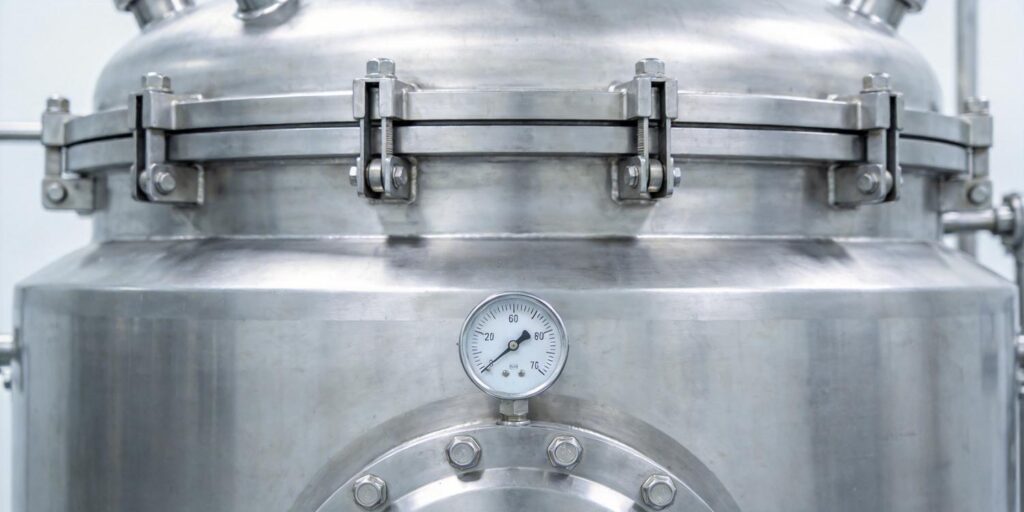
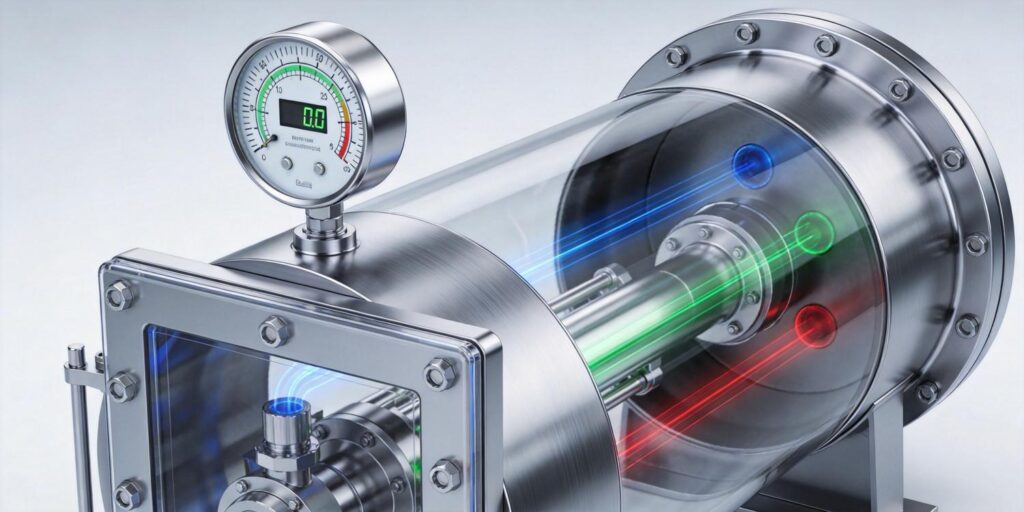
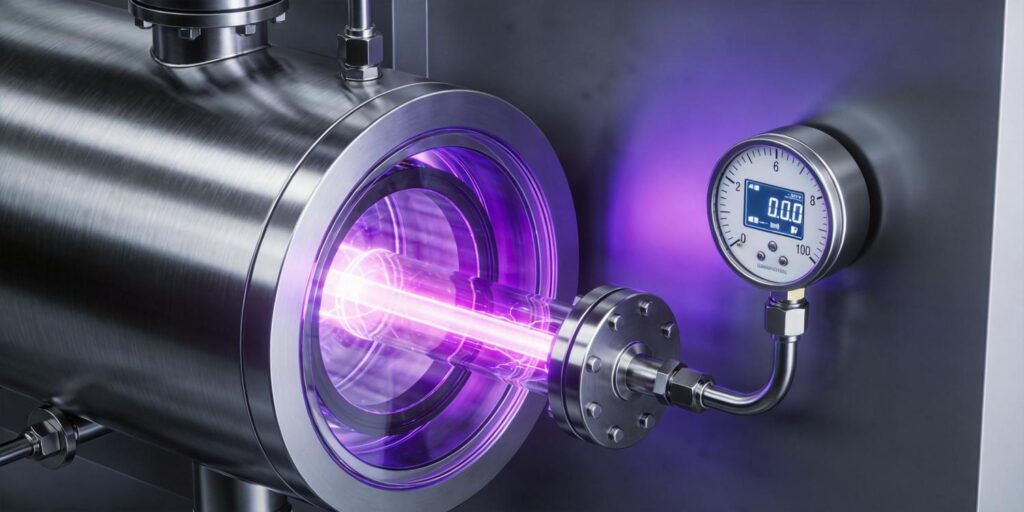
Cold cathode vacuum gauge displaying high vacuum measurement

Understanding Cold Cathode Gauge Sensitivity Limits

Understanding Cold Cathode Gauge Sensitivity Limits Cold cathode vacuum gauges, also known as Penning gauges, provide reliable high-vacuum measurement without the filament-related limitations of hot-cathode designs. Their sensitivity—the ability to produce a measurable ion current proportional to gas pressure—makes them indispensable in applications requiring stable readings from 10-3 to 10-7 Torr. However, every cold cathode […]

Understanding Cold Cathode Gauge Sensitivity Limits Read More »

Vacuum gauge installed on continuous production vacuum system

Vacuum Gauge Reliability in Continuous Production Lines

Challenges in 24/7 Operation of Vacuum Gauges Continuous production lines in semiconductor fabrication, vacuum heat treatment, aerospace component manufacturing, and analytical instrumentation demand vacuum gauges that operate reliably around the clock. Unlike batch processes with scheduled downtime, 24/7 environments expose gauges to constant thermal loads, repeated pressure cycles, and minimal opportunity for preventive intervention. Even

Vacuum Gauge Reliability in Continuous Production Lines Read More »

HMI screen showing vacuum pressure alarm settings

How to Program Alarm Thresholds for Vacuum Gauges

Identifying Critical Pressure Points for Effective Alarm Thresholds Vacuum gauge alarm thresholds are essential for protecting equipment, ensuring process repeatability, and maintaining operator safety in applications ranging from scientific instruments to industrial vacuum furnaces. Properly programmed alarms prevent costly downtime by alerting operators to deviations before they escalate into system failures. At Poseidon Scientific, our

How to Program Alarm Thresholds for Vacuum Gauges Read More »

Vacuum gauge installed on vacuum brazing furnace

Vacuum Gauge Use in Vacuum Brazing Applications

Understanding the Vacuum Brazing Temperature and Pressure Profile Vacuum brazing is a precision joining process widely used in aerospace, medical, and high-performance automotive applications where oxidation-free, high-strength metallurgical bonds are essential. The process follows a carefully controlled temperature and pressure profile to ensure filler metal flows properly without contaminating the base materials. Typical vacuum brazing

Vacuum Gauge Use in Vacuum Brazing Applications Read More »

Shielded cable wiring connected to vacuum gauge in control cabinet

Reducing Electrical Noise in Vacuum Gauge Signals

Why Electrical Noise Matters in Vacuum Gauge Signals In high-vacuum and rough-vacuum systems, accurate pressure readings from vacuum gauges are essential for process control, equipment protection, and product quality. Whether you are monitoring a mass spectrometer foreline with a Pirani gauge or tracking high-vacuum levels in a scanning electron microscope with a cold cathode gauge,

Reducing Electrical Noise in Vacuum Gauge Signals Read More »

Vacuum gauge mounted on cryogenic vacuum pump system

Vacuum Measurement in Cryogenic Pump Systems

Cryopump Operating Principle Cryogenic pumps, commonly called cryopumps, achieve ultra-high vacuum by capturing gas molecules on surfaces cooled to cryogenic temperatures, typically 10–20 K for the primary stage and 40–80 K for the radiation shield. The operating principle relies on two mechanisms: cryocondensation for most gases (N₂, O₂, H₂O, CO₂) and cryosorption on activated charcoal

Vacuum Measurement in Cryogenic Pump Systems Read More »

SCADA screen showing real-time vacuum gauge data

Integrating Vacuum Gauge Data into SCADA Systems

Overview of SCADA Communication Architecture Modern vacuum systems increasingly rely on SCADA (Supervisory Control and Data Acquisition) platforms to provide centralized monitoring, real-time control, and historical data for process optimization. A typical architecture consists of field devices (gauges, pumps, valves), programmable logic controllers (PLCs) or remote terminal units (RTUs), a communications network, human-machine interface (HMI)

Integrating Vacuum Gauge Data into SCADA Systems Read More »

Cold cathode gauge mounted on chamber during venting process

Cold Cathode Gauge Behavior During Rapid Venting

Effect of Sudden Atmospheric Exposure on Cold Cathode Gauges Cold cathode ionization gauges, such as Poseidon Scientific’s VG-SM225, are designed for reliable operation in the high-vacuum regime from 10⁻³ Torr down to 10⁻⁷ Torr. When a vacuum chamber undergoes rapid venting to atmosphere, however, the gauge experiences an abrupt transition into the low-vacuum region where

Cold Cathode Gauge Behavior During Rapid Venting Read More »

Vacuum gauge mounted on industrial metallizing chamber

Vacuum Gauge Selection for Vacuum Metallizing Systems

Introduction: Vacuum Metallizing Process Overview Vacuum metallizing remains one of the most widely adopted physical vapor deposition techniques for applying thin aluminum films to substrates such as plastic films, paper, and molded parts. The process occurs inside a sealed vacuum chamber where aluminum wire or boats are resistively heated to temperatures exceeding 1,000 °C, causing

Vacuum Gauge Selection for Vacuum Metallizing Systems Read More »

Shopping Cart
Poseidon Scientific
Privacy Overview

This website uses cookies so that we can provide you with the best user experience possible. Cookie information is stored in your browser and performs functions such as recognising you when you return to our website and helping our team to understand which sections of the website you find most interesting and useful.