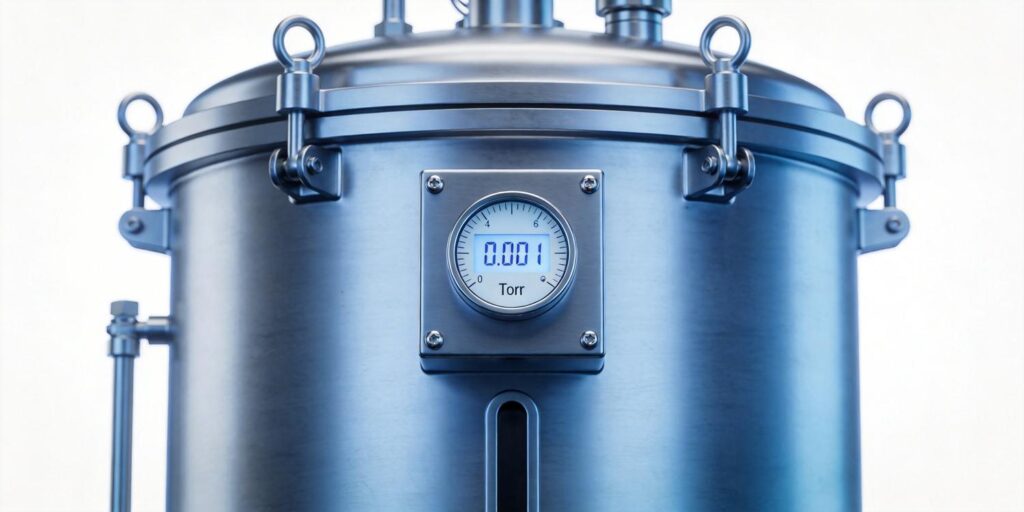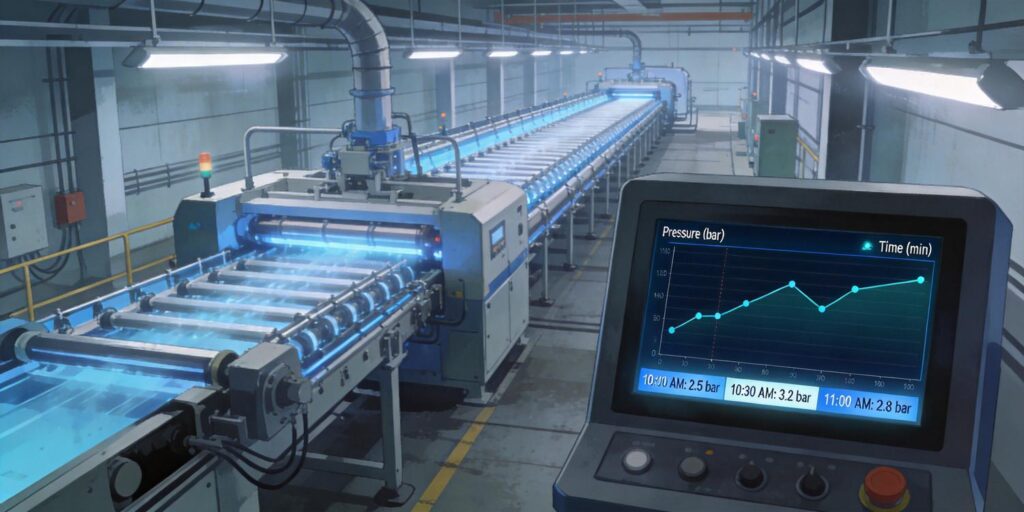
Vacuum Gauge

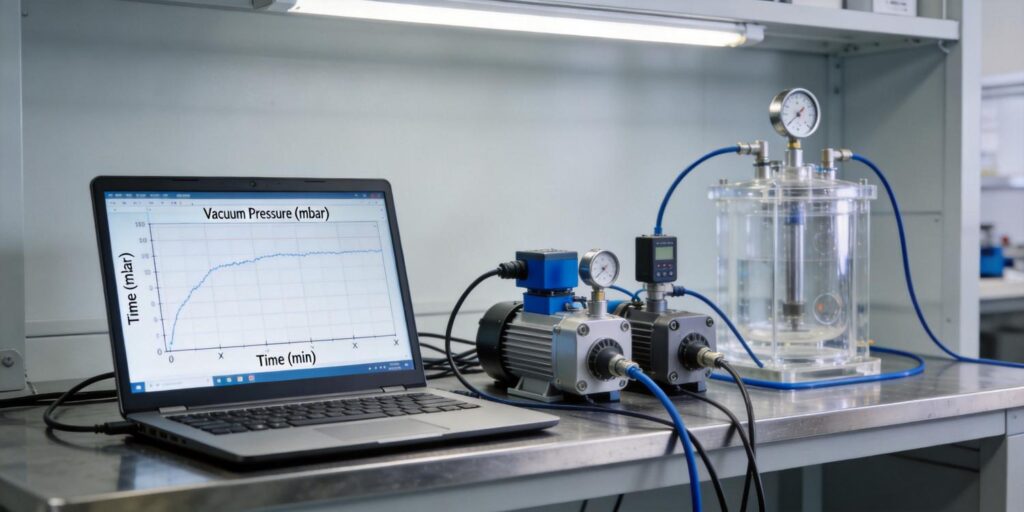
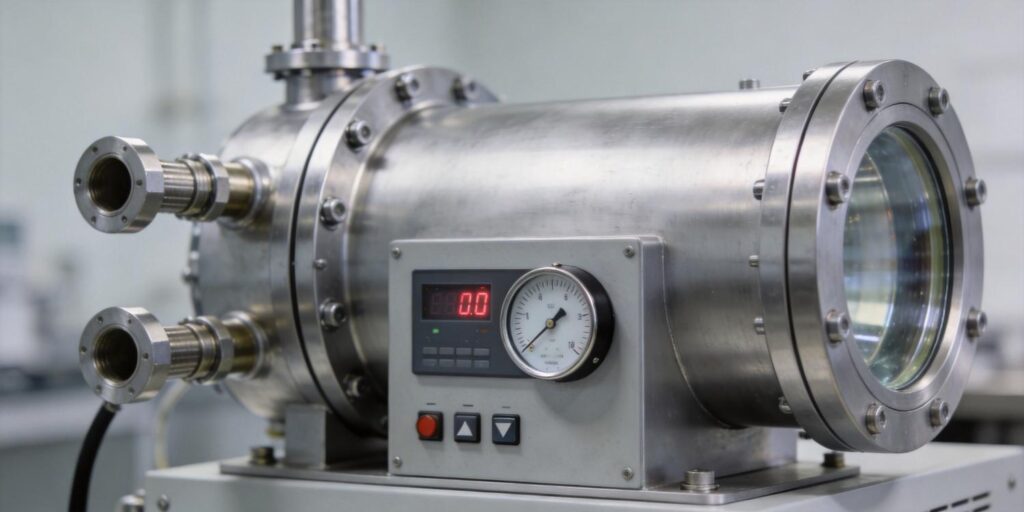
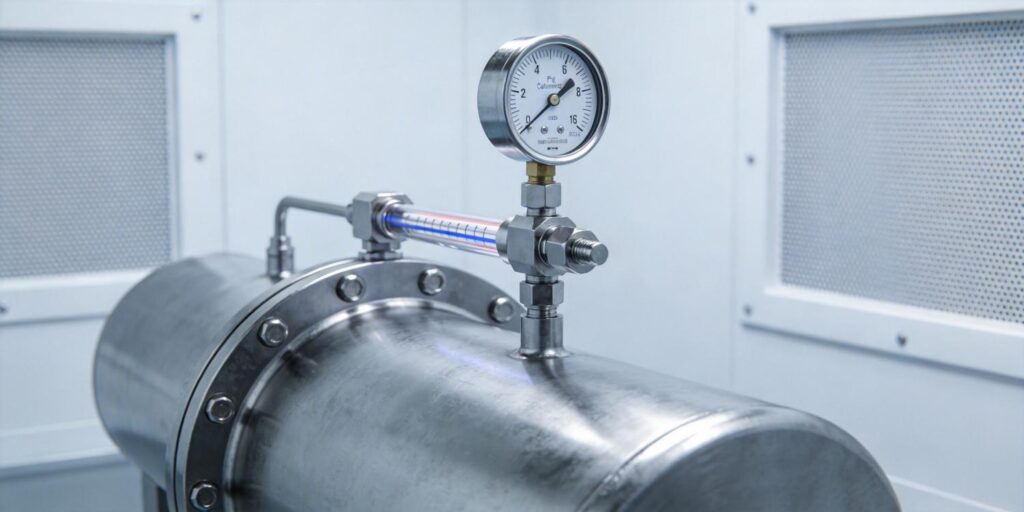
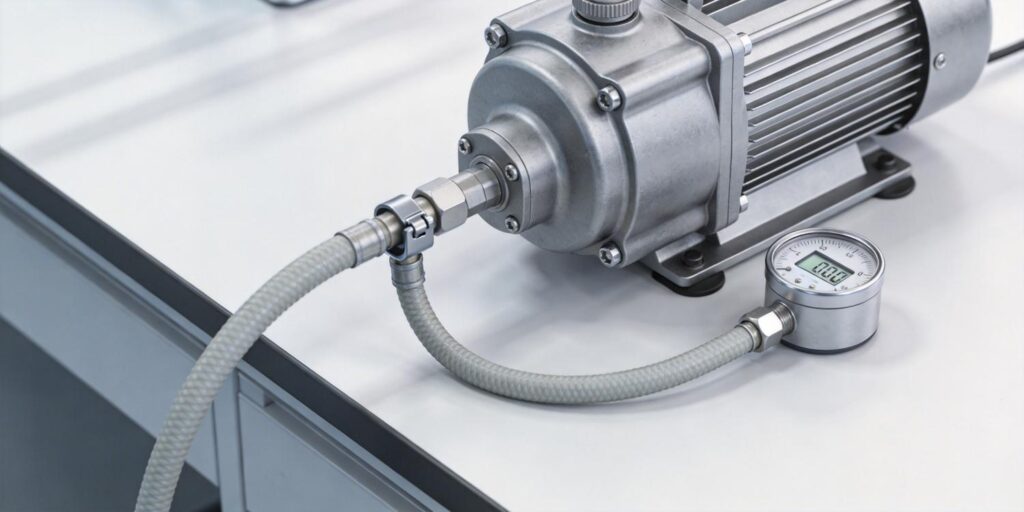
Compact vacuum gauge installed on laboratory R&D equipment

Selecting Vacuum Gauges for Laboratory R&D Equipment

Selecting Vacuum Gauges for Laboratory R&D Equipment In laboratory research and development environments, vacuum measurement is rarely a one-size-fits-all proposition. Scientists and engineers working with mass spectrometers, scanning electron microscopes, vacuum heat-treatment furnaces, and custom analytical instruments require gauges that deliver reliable performance across fluctuating pressures while fitting tight spatial constraints and integrating seamlessly with […]

Selecting Vacuum Gauges for Laboratory R&D Equipment Read More »

Vacuum gauge mounted on solar panel coating chamber

Vacuum Gauge Applications in Solar Panel Manufacturing

The Role of Vacuum in Thin Film Solar Cell Production Thin film solar technologies—including CIGS, CdTe, amorphous silicon, and perovskite tandem cells—rely on vacuum-based deposition to achieve the high-efficiency, uniform layers that define modern photovoltaic performance. Vacuum environments eliminate oxygen and moisture, prevent oxidation of sensitive absorber materials, and enable precise control of plasma or

Vacuum Gauge Applications in Solar Panel Manufacturing Read More »

Vacuum gauge connected to long term data logging system

Reducing Measurement Drift in Long-Term Vacuum Processes

Understanding Measurement Drift in Vacuum Gauges Measurement drift in vacuum systems is the gradual, unintended shift in gauge output over time, even when the actual chamber pressure remains constant. For long-term processes—such as optical coating runs lasting 24–72 hours, vacuum heat treatment cycles, or continuous mass-spectrometer operation—drift as small as ±5 % can compromise film

Reducing Measurement Drift in Long-Term Vacuum Processes Read More »

Technician testing vacuum gauge wiring with multimeter

Vacuum Gauge Troubleshooting: No Signal Output

Troubleshooting No Signal Output on Vacuum Gauges When a vacuum gauge suddenly produces no signal—neither analog voltage nor digital RS232 data—production lines stop, interlocks freeze, and engineers scramble for root cause. For OEMs and end users relying on the VG-SP205 Pirani Vacuum Transmitter or VG-SM225 Cold Cathode Vacuum Gauge, this symptom is rarely catastrophic but

Vacuum Gauge Troubleshooting: No Signal Output Read More »

Vacuum gauge display showing stable high vacuum during coating

Why Stable High Vacuum Measurement Improves Coating Yield

Why Stable High Vacuum Measurement Improves Coating Yield In physical vapor deposition (PVD), chemical vapor deposition (CVD), and optical coating processes, chamber pressure directly governs film density, adhesion, uniformity, and defect rates. Even minor fluctuations in the high-vacuum regime—typically 10⁻⁵ to 10⁻⁷ mbar—can shift stoichiometry, increase pinhole density, or trigger arcing that ruins entire batches.

Why Stable High Vacuum Measurement Improves Coating Yield Read More »

Vacuum gauge installation during OEM system assembly

Vacuum Gauge Installation Checklist for OEM Manufacturers

Why Proper Vacuum Gauge Installation Matters for OEM Manufacturers In high-volume production of vacuum systems—whether for mass spectrometers, electron-beam additive manufacturing platforms, vacuum heat-treatment furnaces, or analytical instruments—gauge installation is often the difference between seamless integration and costly field failures. A poorly mounted or electrically noisy gauge can introduce measurement drift, false interlocks, or EMC

Vacuum Gauge Installation Checklist for OEM Manufacturers Read More »

Pirani vacuum gauge measuring different gas compositions

How Gas Type Influences Pirani Gauge Readings

The Thermal Conductivity Principle Behind Pirani Gauges Pirani gauges measure pressure by exploiting the dependence of gas thermal conductivity on pressure. A thin platinum filament is heated by a constant-temperature control circuit. As gas molecules collide with the filament, they carry heat away to the cooler gauge wall. At higher pressures, more molecules are present,

How Gas Type Influences Pirani Gauge Readings Read More »

Vacuum gauge integrated into industrial safety control system

Improving Vacuum System Safety with Pressure Interlocks

The Critical Role of Pressure Interlocks in Vacuum System Safety Pressure interlocks are among the most effective safeguards in vacuum systems, automatically interrupting hazardous operations when pressure deviates from safe limits. In high-vacuum environments—whether supporting mass spectrometers, vacuum heat-treatment furnaces, or precision coating chambers—interlocks prevent equipment damage, protect personnel, and maintain process integrity. Without them,

Improving Vacuum System Safety with Pressure Interlocks Read More »

Vacuum gauge installed on metal 3D printing chamber

Vacuum Gauges in Additive Manufacturing Systems

The Role of Vacuum in Metal 3D Printing Additive manufacturing, particularly metal powder bed fusion, has transformed high-performance part production in aerospace, medical, and energy sectors. While laser-based systems often operate under inert gas at near-atmospheric pressure, electron beam powder bed fusion (EB-PBF or EBM) demands a true vacuum environment. The electron beam travels at

Vacuum Gauges in Additive Manufacturing Systems Read More »

Vacuum gauge displaying changing pressure during rapid cycle

Vacuum Gauge Response Time: Why It Matters

What Is Response Time in Vacuum Gauges? Response time in vacuum measurement is the interval between a sudden change in chamber pressure and the point at which the gauge output stabilizes within a specified tolerance—typically ±5 % of the final reading. For process engineers and system integrators, this is not an abstract specification; it determines

Vacuum Gauge Response Time: Why It Matters Read More »

Shopping Cart
Poseidon Scientific
Privacy Overview

This website uses cookies so that we can provide you with the best user experience possible. Cookie information is stored in your browser and performs functions such as recognising you when you return to our website and helping our team to understand which sections of the website you find most interesting and useful.