Vacuum Gauge

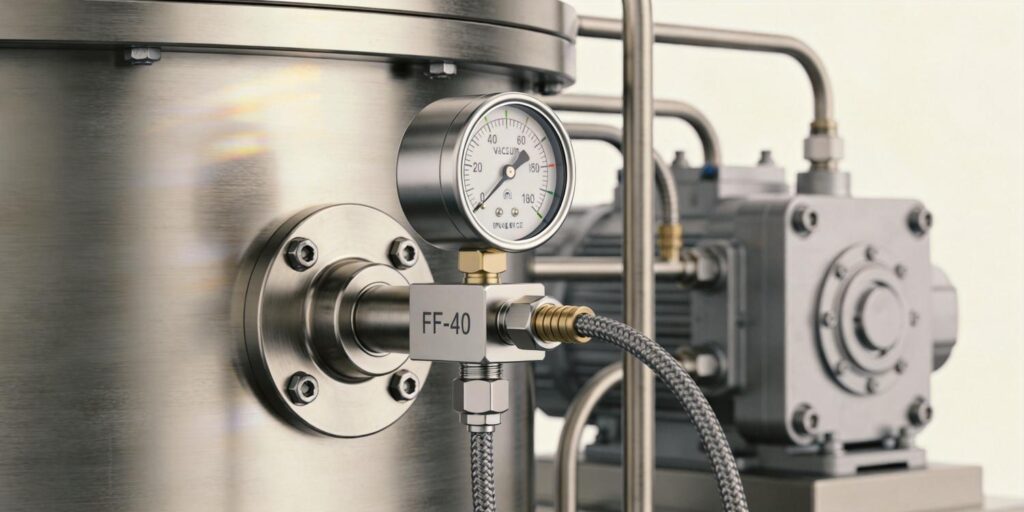
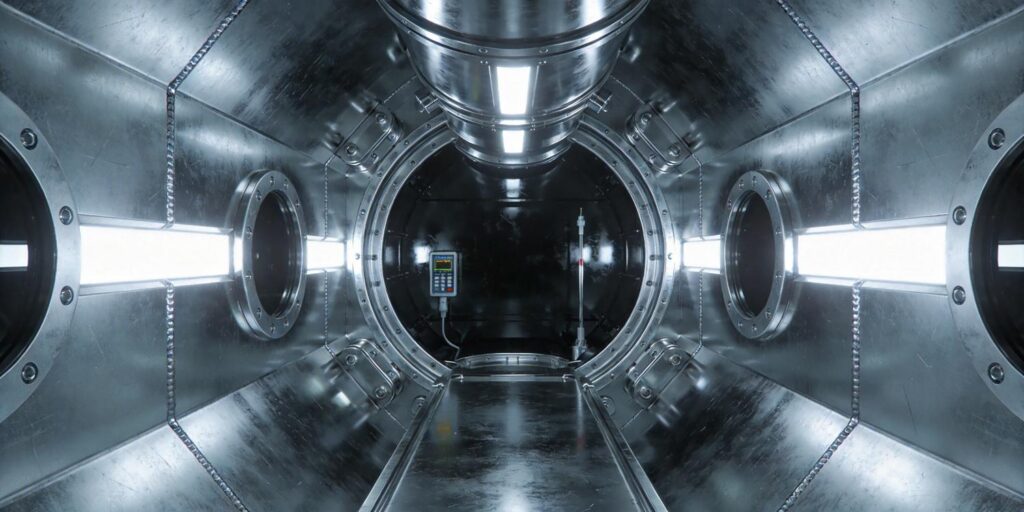
High vacuum chamber with installed vacuum gauge

How Outgassing Skews High Vacuum Measurements

Define Material Outgassing Outgassing is the spontaneous release of trapped or adsorbed gases from the surfaces and bulk of materials inside a vacuum chamber. These gases—primarily water vapor, hydrogen, carbon monoxide, and hydrocarbons—originate from atmospheric exposure, manufacturing residues, or dissolved species within metals, polymers, and ceramics. In high-vacuum systems the dominant source is physisorbed and […]
How Outgassing Skews High Vacuum Measurements Read More »

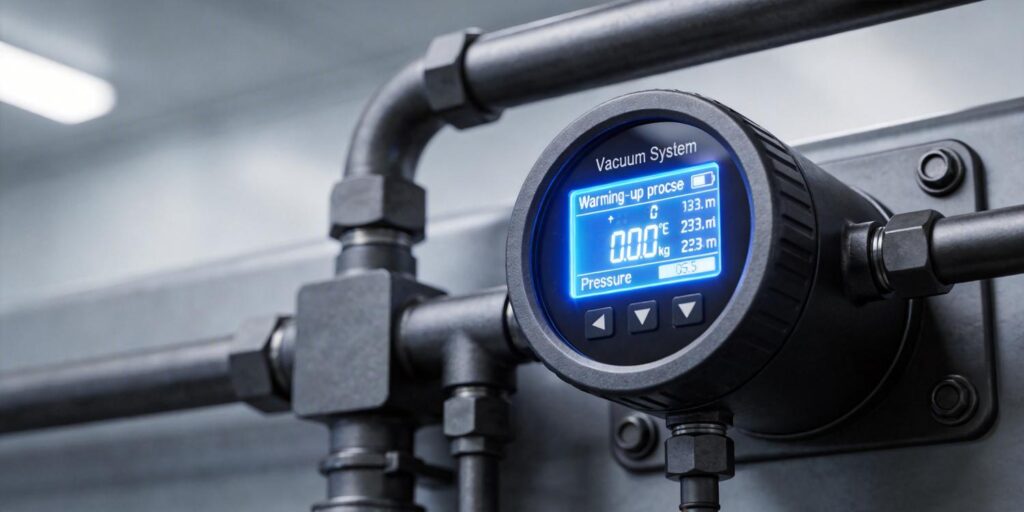
Vacuum gauge digital display during system startup

Vacuum Gauge Warm-Up Time: Why Stability Takes 10-20 Minutes

Sensor Thermal Equilibrium Explanation Vacuum gauges, whether thermal-conductivity or ionization types, require time to reach thermal equilibrium before delivering stable, repeatable readings. In the Poseidon Scientific VG-SP205 Pirani Vacuum Transmitter, a platinum filament is resistively heated to a constant temperature while the electronics monitor the power needed to maintain that set point. Immediately after power-on,

Vacuum Gauge Warm-Up Time: Why Stability Takes 10-20 Minutes Read More »

Pirani vacuum transmitter mounted on laboratory vacuum system

Pirani Gauge Accuracy Limits Below 1E-3 mbar

Thermal Conductivity Limit in Molecular Flow Pirani gauges measure pressure by sensing the heat loss from a heated filament (typically platinum) to the surrounding gas. At higher pressures, in the viscous-flow regime, thermal conductivity increases linearly with gas density, providing excellent sensitivity. As pressure drops into the transition region (roughly 10 Torr to 10⁻² Torr),

Pirani Gauge Accuracy Limits Below 1E-3 mbar Read More »

Cold cathode vacuum gauge installed on industrial vacuum chamber

Cold Cathode Gauge Overpressure Exposure: What Happens Above 1 mbar?

Plasma Discharge Behavior at High Pressure Cold cathode gauges rely on the Penning (magnetron) discharge to ionize gas molecules. A high negative voltage (–2000 V operating, –2500 V for startup) combined with a ~100 gauss magnetic field traps electrons in long spiral paths, creating an avalanche of ions whose current is proportional to pressure. This

Cold Cathode Gauge Overpressure Exposure: What Happens Above 1 mbar? Read More »

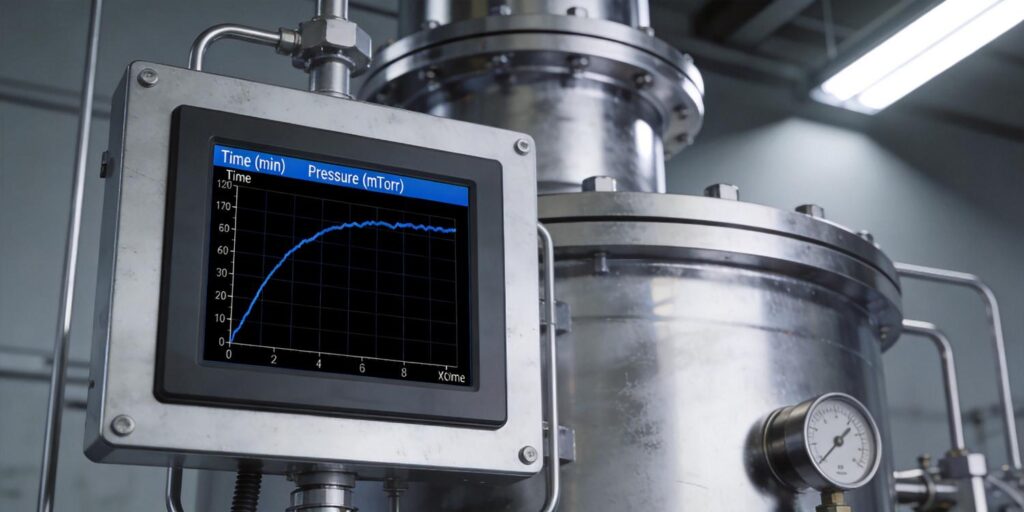
Digital vacuum gauge monitoring industrial pump-down process

How to Size a Vacuum Gauge Based on Your Real Operating Pressure Curve

Analyze Full Pump-Down Curve (Atmosphere to High Vacuum) Every vacuum system tells its story through the pump-down curve: pressure versus time from atmosphere (760 Torr) down to the ultimate base pressure. Plotting this curve—ideally with a data logger or PLC trend—is the first and most critical step in gauge sizing. A typical mechanical-pump + turbo-molecular-pump

How to Size a Vacuum Gauge Based on Your Real Operating Pressure Curve Read More »

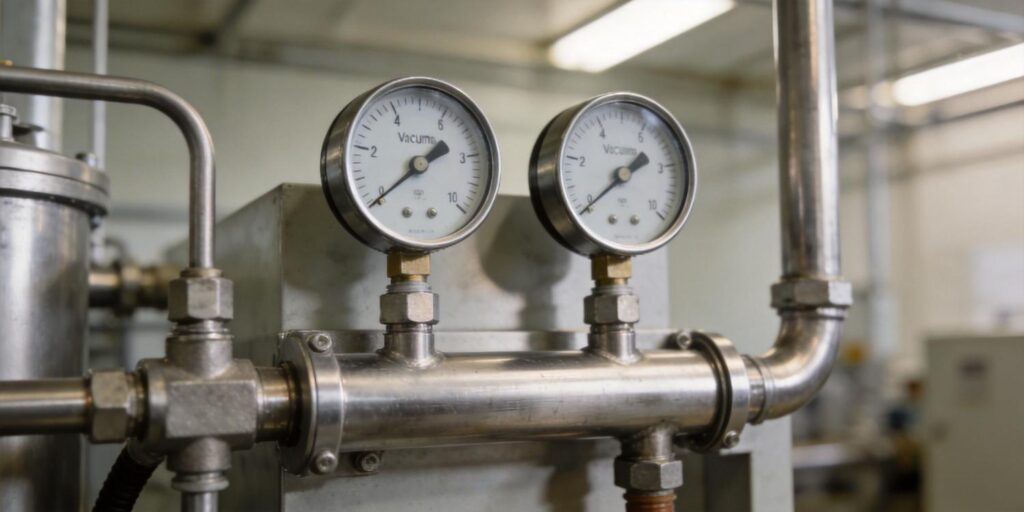
Dual vacuum gauges installed on critical industrial vacuum system

Designing a Redundant Vacuum Monitoring System for Critical Processes

Redundancy Concept In critical vacuum processes—such as mass-spectrometer operation, semiconductor wafer processing, vacuum heat treatment of aerospace alloys, or electron-beam welding—unplanned loss of vacuum monitoring can trigger batch failure, equipment damage, or safety events. Redundancy addresses this by deploying multiple independent sensors whose outputs are continuously cross-checked. The goal is not merely duplication but fault-tolerant

Designing a Redundant Vacuum Monitoring System for Critical Processes Read More »

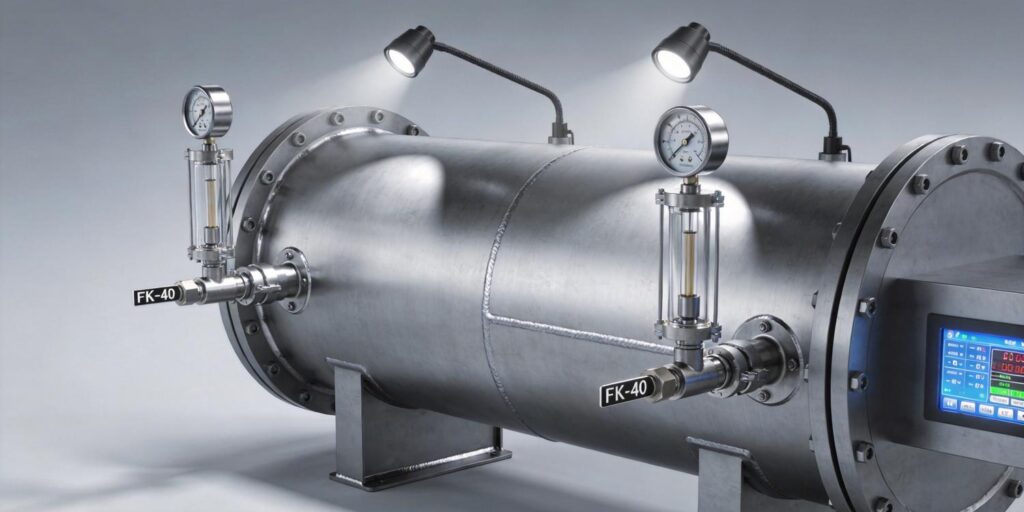
Ionization vacuum gauges mounted on industrial chamber

Cold Cathode vs Hot Cathode Gauges: Cost and Maintenance Comparison

Structural Differences Hot cathode and cold cathode ionization gauges both measure vacuum by ionizing gas molecules and collecting the resulting ion current, but their fundamental designs differ dramatically in how electrons are generated and how the discharge is sustained. A hot cathode gauge, often based on the Bayard-Alpert or triode geometry, relies on a thermionic

Cold Cathode vs Hot Cathode Gauges: Cost and Maintenance Comparison Read More »

Vacuum gauge mounted on industrial high temperature furnace pipeline

Vacuum Gauge Selection for Industrial Furnaces Above 800°C

Remote Mounting Requirement Industrial vacuum furnaces operating above 800 °C—such as vacuum annealing, tempering, or brazing systems—present a fundamental challenge for pressure measurement: the process chamber itself exceeds the safe operating temperature of any electronic vacuum gauge. Poseidon Scientific’s VG-SP205 Pirani Vacuum Transmitter and VG-SM225 Cold Cathode Vacuum Gauge are both rated for 15–50 °C

Vacuum Gauge Selection for Industrial Furnaces Above 800°C Read More »

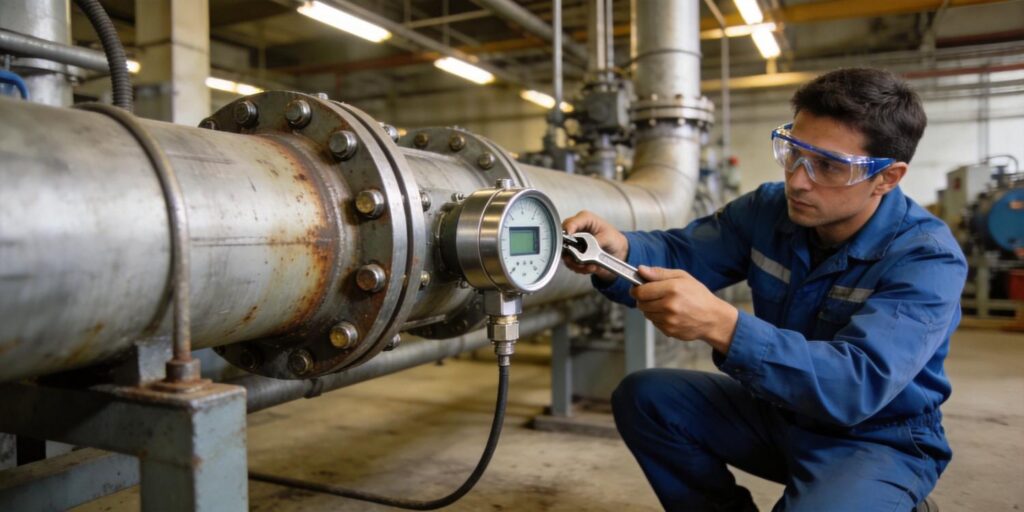
Technician installing vacuum gauge on stainless vacuum pipe

Why Your Vacuum Gauge Reads Differently After Maintenance

Reassembly Sealing Differences Maintenance on a cold-cathode gauge almost always involves disassembly. With the Poseidon Scientific VG-SM225 Cold Cathode Vacuum Gauge, the sensor head is intentionally removable without breaking the vacuum seal on the chamber. Operators unscrew the “工”-shaped electrode stack, lightly abrade the stainless-steel cathode and anode surfaces with 200- or 500-mesh sandpaper to

Why Your Vacuum Gauge Reads Differently After Maintenance Read More »

Interior of high vacuum stainless steel chamber

Understanding Molecular Flow Region in High Vacuum Measurement

Transition from Viscous to Molecular Flow In vacuum systems, gas behavior changes dramatically as pressure drops. At higher pressures (typically above ~1 Torr), gas flow is viscous or continuum: molecules collide far more frequently with each other than with chamber walls. Viscosity and pressure gradients govern transport, much like fluid flow in pipes at atmospheric

Understanding Molecular Flow Region in High Vacuum Measurement Read More »

Shopping Cart
Poseidon Scientific
Privacy Overview

This website uses cookies so that we can provide you with the best user experience possible. Cookie information is stored in your browser and performs functions such as recognising you when you return to our website and helping our team to understand which sections of the website you find most interesting and useful.