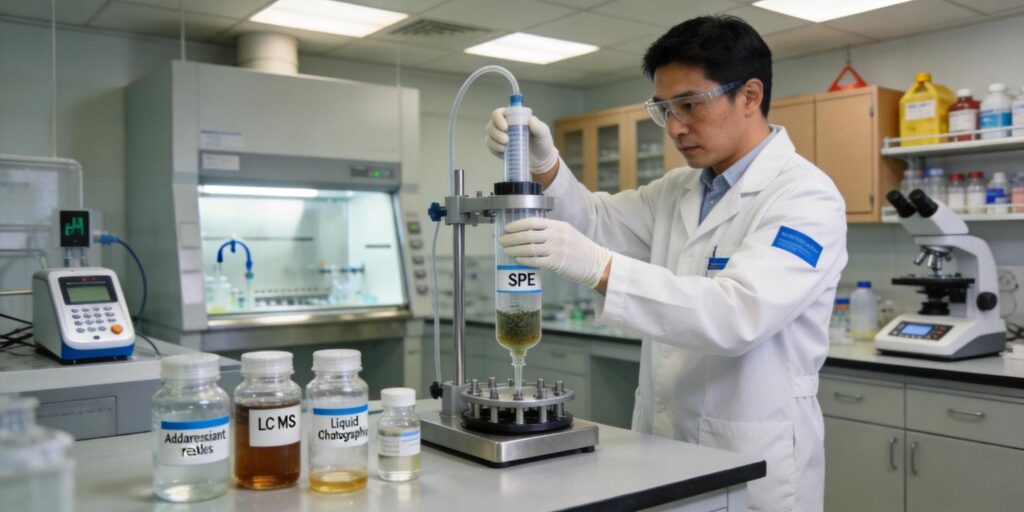
SPE wash step during extraction workflow

Wash Solvent Optimization in SPE Methods

1. Role of Wash Step in Sample Cleanup The wash step in solid-phase extraction (SPE) represents a critical juncture between sample loading and analyte elution, serving as the primary mechanism for selective matrix removal. As described in foundational SPE literature, this intermediate phase “removes unwanted, weakly retained materials” while preserving the target analytes on the […]

Wash Solvent Optimization in SPE Methods Read More »

Vacuum transmitter connected with long shielded cable

How Cable Length Impacts Vacuum Gauge Signal Stability

Signal Attenuation Analog signals from vacuum gauges—particularly the 0–10 V output used by both the Poseidon Scientific VG-SP205 Pirani Vacuum Transmitter and VG-SM225 Cold Cathode Vacuum Gauge—travel as voltage levels referenced to ground. Over distance, two primary mechanisms cause attenuation: resistive voltage drop in the cable conductors and capacitive loading that rounds sharp edges in

How Cable Length Impacts Vacuum Gauge Signal Stability Read More »

conditioning SPE cartridge in laboratory

SPE Cartridge Conditioning Protocols Explained

Purpose of Cartridge Conditioning Cartridge conditioning serves multiple critical functions in solid-phase extraction (SPE) protocols. As a product manager at Poseidon Scientific, I’ve observed that proper conditioning is the foundation of successful SPE applications, whether using our HLB, MAX, MCX, WAX, WCX, or 96-well plate formats. First and foremost, conditioning activates the sorbent functional groups.

SPE Cartridge Conditioning Protocols Explained Read More »

diagram showing pH effect on SPE extraction

Sample pH Optimization Strategies for Ion Exchange SPE

Understanding pKa and Analyte Ionization in Ion Exchange SPE The foundation of successful ion exchange solid phase extraction (SPE) lies in understanding the acid dissociation constant (pKa) of your target analytes. The pKa is defined as the pH at which an analyte is 50% ionized, representing the equilibrium point between ionized and non-ionized forms. This

Sample pH Optimization Strategies for Ion Exchange SPE Read More »

Vacuum gauge installed on PVD coating chamber wall

Vacuum Monitoring in PVD Coating: Where to Place Gauges for Best Film Quality

Pump-down Stage Monitoring Physical vapor deposition (PVD) coating quality starts with a clean, reproducible base vacuum. Residual gases—water vapor, oxygen, or hydrocarbons—can react with sputtered material and degrade film adhesion, stoichiometry, or optical properties. The pump-down phase therefore requires continuous, accurate monitoring from atmosphere down to at least 10−6 Torr. The Poseidon Scientific VG-SP205 Pirani

Vacuum Monitoring in PVD Coating: Where to Place Gauges for Best Film Quality Read More »

Vacuum gauge undergoing calibration on laboratory bench

Vacuum Gauge Calibration Interval: Annual or Process-Based?

ISO Calibration Recommendation Overview Vacuum gauge calibration practices are guided by international standards, but they emphasize risk-based decisions rather than rigid schedules. ISO 3567:2015 specifies the method for calibrating vacuum gauges by direct comparison with a reference gauge under controlled conditions. It defines traceability to national metrology institutes (such as NIST or PTB) and outlines

Vacuum Gauge Calibration Interval: Annual or Process-Based? Read More »

Vacuum gauges installed on semiconductor load lock chamber

Choosing Vacuum Gauges for Semiconductor Load Locks

Load Lock Vacuum Cycle Stages In semiconductor fabrication, load locks serve as critical airlocks between the cleanroom atmosphere and the ultrahigh-vacuum process chambers used for etching, deposition, and lithography. A typical load-lock cycle follows a repeatable sequence that protects wafer integrity while maximizing tool throughput. Stage 1 begins with the outer door open at atmospheric

Choosing Vacuum Gauges for Semiconductor Load Locks Read More »

LC-MS sample preparation using SPE cleanup

Preventing Ion Suppression in LC-MS with Proper SPE Cleanup

Understanding Ion Suppression in LC-MS Analysis Ion suppression remains one of the most challenging issues in liquid chromatography-mass spectrometry (LC-MS) analysis, particularly when dealing with complex biological and environmental matrices. This phenomenon occurs when co-eluting matrix components interfere with the ionization process of target analytes, leading to reduced sensitivity, inaccurate quantification, and potential false negatives.

Preventing Ion Suppression in LC-MS with Proper SPE Cleanup Read More »

troubleshooting SPE extraction workflow

Troubleshooting Low Recovery in SPE Extraction

Breakthrough Due to Low Sorbent Capacity Breakthrough is the ineffective retention of target analytes on the solid phase sorbent, resulting in low analyte recovery. This occurs when the analyte passes through the column unretained during loading or wash phases. The most common cause of breakthrough during sample application is flow rates that exceed the sorbent

Troubleshooting Low Recovery in SPE Extraction Read More »

Cold cathode vacuum gauge mounted on industrial vacuum system

How Contamination Affects Cold Cathode Plasma Stability

Plasma Discharge Principle in Cold Cathode Gauges Cold cathode ionization gauges, such as Poseidon Scientific’s VG-SM225, operate on the Penning discharge principle. A high-voltage electric field (typically –2000 V working, –2500 V startup) combined with an axial magnetic field (~100 gauss from NdFeB permanent magnets) traps electrons in cycloidal or spiral paths. These electrons collide

How Contamination Affects Cold Cathode Plasma Stability Read More »

Shopping Cart
Poseidon Scientific
Privacy Overview

This website uses cookies so that we can provide you with the best user experience possible. Cookie information is stored in your browser and performs functions such as recognising you when you return to our website and helping our team to understand which sections of the website you find most interesting and useful.