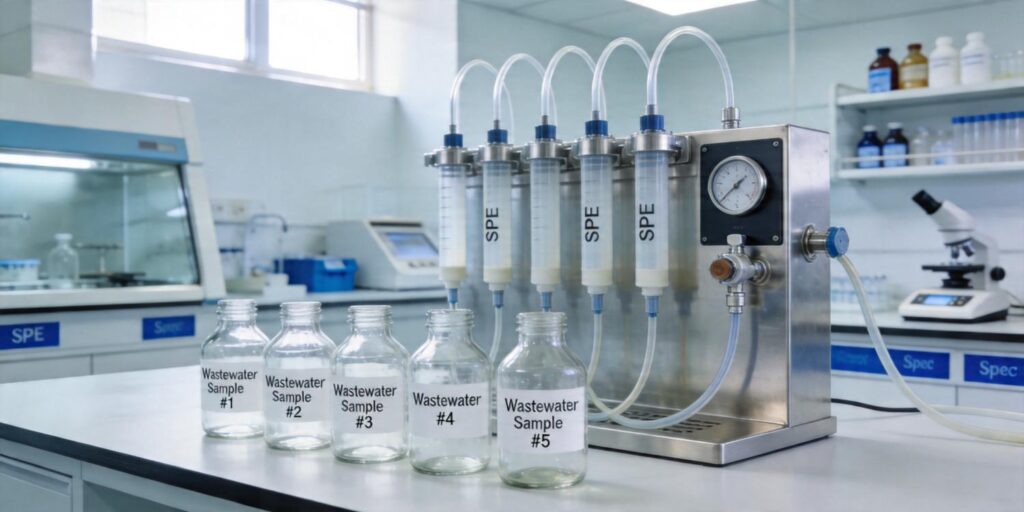
SPE cartridge conditioning with solvent

SPE Cartridge Conditioning: Step-by-Step Guide

Purpose of Conditioning Solid phase extraction (SPE) cartridge conditioning is the critical first step in any SPE protocol, serving multiple essential functions that directly impact extraction efficiency and reproducibility. When silica particles are bonded with hydrophobic phases like C18 or C8, they become “waterproof” and must be conditioned to interact effectively with aqueous samples. The […]

SPE Cartridge Conditioning: Step-by-Step Guide Read More »

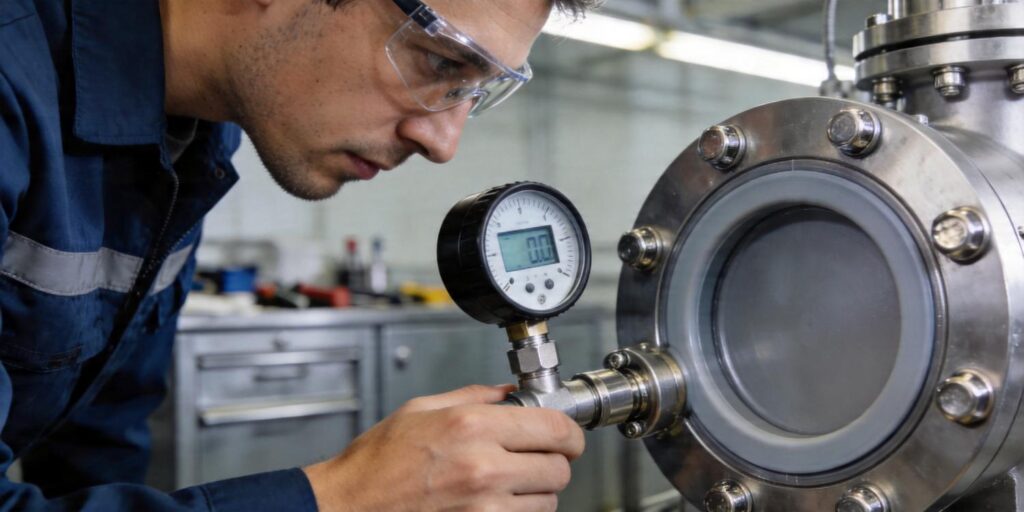
Vacuum gauge being calibrated on laboratory test bench

Vacuum Gauge Calibration Best Practices

Calibration Standards: Achieving Traceable Accuracy Vacuum gauge calibration is the foundation of reliable process control in mass spectrometry, PVD coating, vacuum heat treatment, battery manufacturing, and semiconductor applications. Without traceability to recognized standards, even the most expensive gauge can produce misleading data that compromises yield or experimental integrity. Industry best practice requires calibration against a

Vacuum Gauge Calibration Best Practices Read More »

scientist adjusting sample pH before SPE extraction

Why Sample pH Matters in SPE Extraction

The Critical Role of pH in Solid Phase Extraction Success As a product manager at Poseidon Scientific specializing in SPE technologies, I’ve witnessed firsthand how pH optimization separates successful extractions from failed experiments. Sample pH isn’t just another parameter—it’s the master switch controlling analyte behavior, sorbent interactions, and ultimately, extraction efficiency. Whether you’re working with

Why Sample pH Matters in SPE Extraction Read More »

Cold cathode vacuum gauge compatible replacement installed on system

Choosing a PTR225N Compatible Cold Cathode Gauge Alternative

Compatibility Factors: Ensuring Seamless Drop-In Performance When selecting a cold cathode gauge alternative to the PTR225N, compatibility is the top priority. The PTR225N (a widely used INFICON-style Penning discharge gauge) is designed for high-vacuum monitoring in mass spectrometers, PVD tools, SEMs, and vacuum heat-treatment systems, with a measurement range of 10⁻³ to 10⁻⁷ Torr and

Choosing a PTR225N Compatible Cold Cathode Gauge Alternative Read More »

Industrial vacuum pump with Pirani transmitter installed

Rough Vacuum Monitoring for Industrial Pumps

Rough Vacuum Definition: The Critical First Stage in Industrial Pumping Rough vacuum spans atmospheric pressure (760 Torr) down to approximately 10⁻³ Torr (0.1 Pa). This range covers the initial pump-down phase where mechanical pumps remove the bulk of the gas load from a chamber. In industrial applications—vacuum furnaces, coating systems, battery electrolyte filling, mass-spectrometer load

Rough Vacuum Monitoring for Industrial Pumps Read More »

SPE cartridge sorbent bed close up

SPE Cartridge Bed Mass: How It Affects Recovery

What Is Sorbent Bed Mass in SPE Cartridges? In solid-phase extraction (SPE), the sorbent bed mass refers to the total weight of the stationary phase material packed within a cartridge or column. This parameter is fundamental to SPE performance, as it directly determines the device’s capacity to retain analytes from sample matrices. Commercial SPE cartridges

SPE Cartridge Bed Mass: How It Affects Recovery Read More »

Cold cathode vacuum gauge installed on stainless steel vacuum system

Extending the Lifespan of Cold Cathode Vacuum Gauges

Electrode Wear: The Primary Life-Limiter in Cold Cathode Gauges Cold cathode vacuum gauges measure pressure through a self-sustaining Penning discharge in crossed electric and magnetic fields. In the VG-SM225 Cold Cathode Vacuum Transmitter from Poseidon Scientific, a ~100 Gauss NdFeB magnet and –2000 V (after –2500 V startup) potential drive electrons into long spiral trajectories,

Extending the Lifespan of Cold Cathode Vacuum Gauges Read More »

diagram explaining weak and strong ion exchange SPE

Understanding Weak vs Strong Ion Exchange in SPE

1. Fundamentals of Ion Exchange Ion exchange solid phase extraction (SPE) represents one of the most powerful and selective sample preparation techniques available to analytical chemists. At its core, ion exchange SPE operates on electrostatic interactions between charged functional groups on the sorbent surface and oppositely charged analytes in the sample matrix. This mechanism provides

Understanding Weak vs Strong Ion Exchange in SPE Read More »

comparison of HLB SPE and ion exchange cartridges

When Should You Use HLB Instead of Ion Exchange SPE?

1. HLB Sorbent Chemistry Hydrophilic-Lipophilic Balanced (HLB) sorbents represent a significant advancement in solid-phase extraction technology. Unlike traditional silica-based sorbents, HLB sorbents are constructed from a water-wettable copolymer that combines both hydrophilic and lipophilic retention mechanisms in a single polymeric structure. The fundamental chemistry of HLB sorbents involves a carefully engineered copolymer that provides balanced

When Should You Use HLB Instead of Ion Exchange SPE? Read More »

Digital high vacuum gauge display reading near zero

Why Your High Vacuum Gauge Shows Zero Too Early

Cold Cathode Ignition Threshold: The Physics Behind Premature “Zero” Readings High-vacuum cold cathode gauges, such as the VG-SM225 Cold Cathode Vacuum Transmitter from Poseidon Scientific, rely on a Penning discharge to generate a measurable ion current. A compact NdFeB magnet produces an axial field of ~100 Gauss while a high negative voltage (–2500 V for

Why Your High Vacuum Gauge Shows Zero Too Early Read More »

Shopping Cart
Poseidon Scientific
Privacy Overview

This website uses cookies so that we can provide you with the best user experience possible. Cookie information is stored in your browser and performs functions such as recognising you when you return to our website and helping our team to understand which sections of the website you find most interesting and useful.