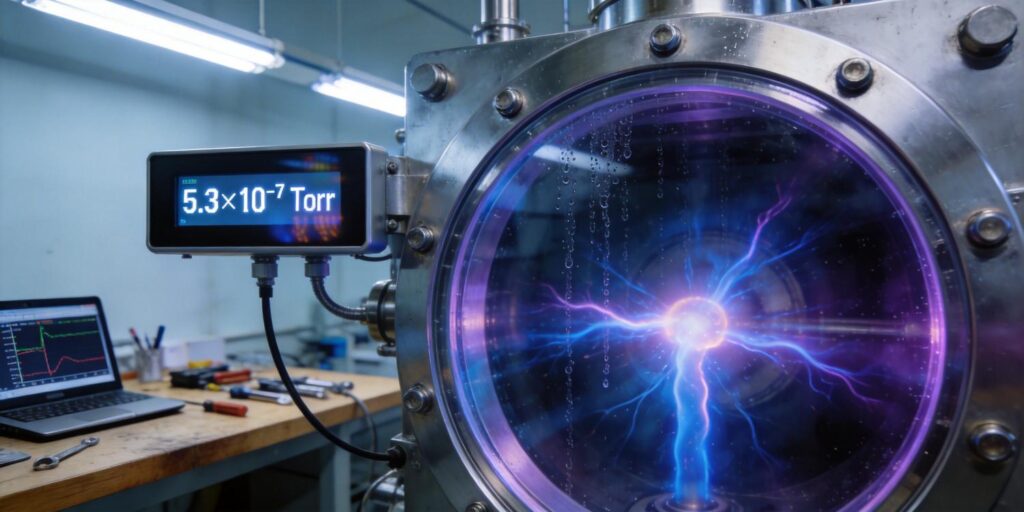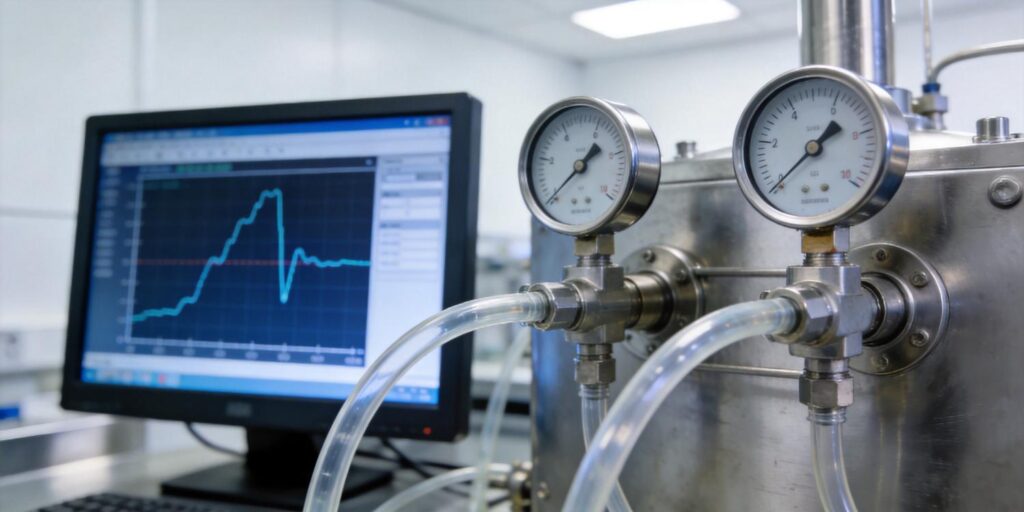
Vacuum pressure scale chart integrated with industrial vacuum system

Understanding Vacuum Measurement Ranges: From Rough to High Vacuum

Introduction Vacuum measurement ranges are the foundation of reliable process control in semiconductor manufacturing, physical vapor deposition (PVD), vacuum furnaces, and countless other industrial systems. Understanding where “rough,” “medium,” and “high” vacuum begin and end—and which gauge technology excels in each regime—helps engineers specify the right sensor the first time, avoid costly crossover errors, and […]

Understanding Vacuum Measurement Ranges: From Rough to High Vacuum Read More »

Side by side comparison of Pirani and cold cathode vacuum gauges

Pirani vs Cold Cathode Vacuum Gauge: How to Choose the Right One

Introduction Vacuum gauges are the eyes of any vacuum system. Selecting the wrong sensor can lead to inaccurate process control, extended pump-down times, or premature equipment failure. Two of the most widely used technologies—Pirani thermal conductivity gauges and cold cathode ionization gauges—cover the majority of industrial high-vacuum applications from 10−3 Torr down to 10−7 Torr.

Pirani vs Cold Cathode Vacuum Gauge: How to Choose the Right One Read More »

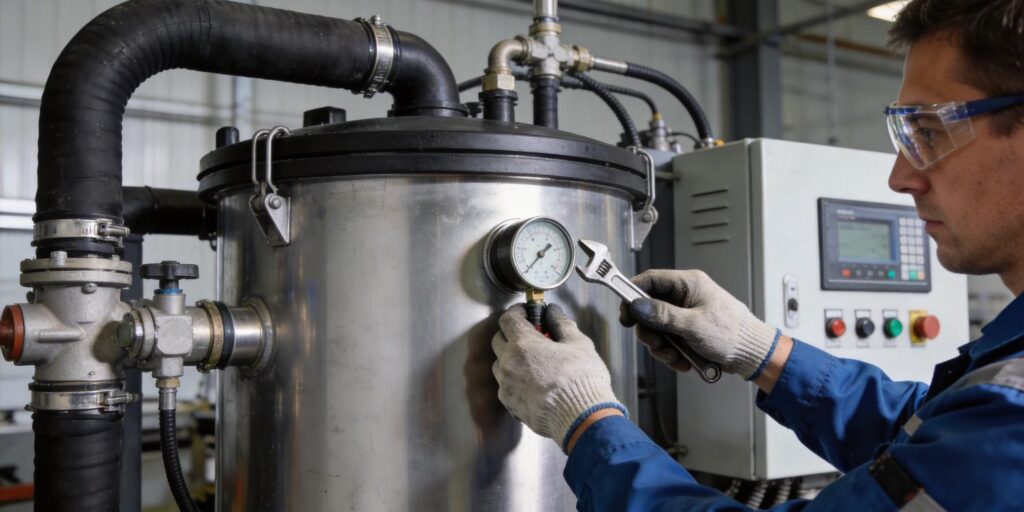
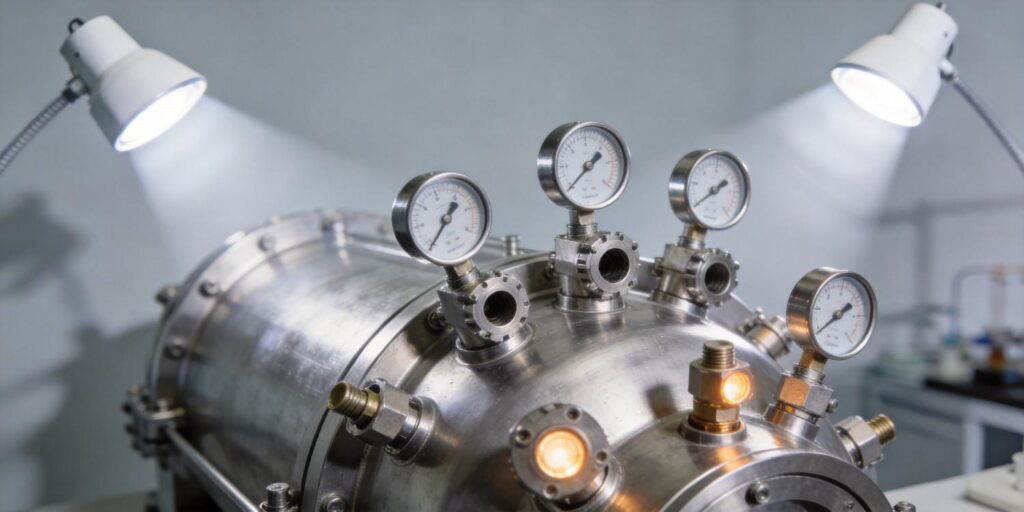
Industrial vacuum gauge installed on stainless steel vacuum chamber in laboratory

Vacuum Gauge Explained: Principles, Types, and Industrial Applications

Introduction to Vacuum Measurement Vacuum measurement is the process of determining the pressure exerted by residual gas molecules inside a sealed system below standard atmospheric pressure (760 Torr). Accurate vacuum readings are essential for process repeatability, product quality, equipment longevity, and personnel safety across a wide range of industrial applications. Without reliable pressure data, contamination

Vacuum Gauge Explained: Principles, Types, and Industrial Applications Read More »

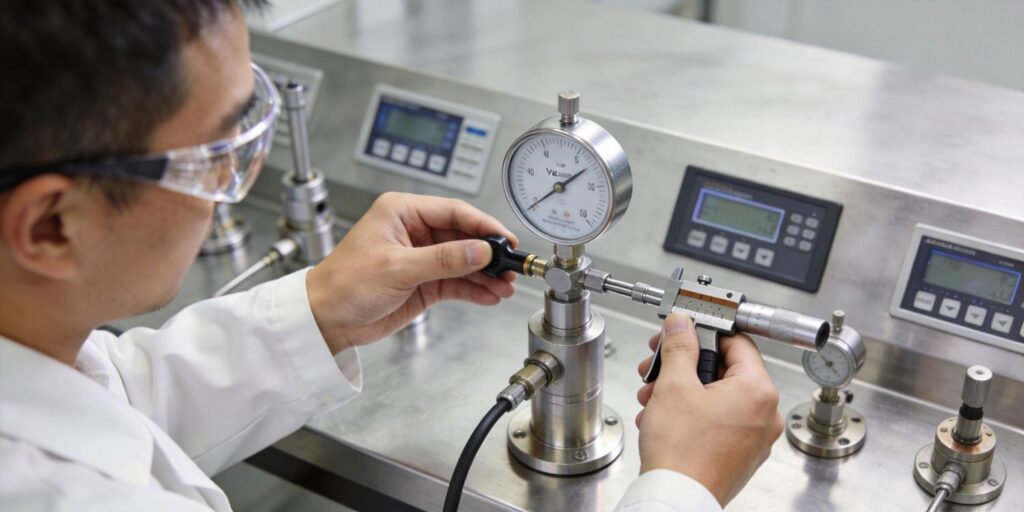
Vacuum Transmitter vs. Vacuum Gauge: Key Differences, Applications, and Selection Guide

When designing or operating a vacuum system, selecting the right pressure measurement device is critical for process stability, safety, and automation.Two terms are frequently encountered—and often confused: Vacuum Gauge and Vacuum Transmitter. Although they are closely related, they serve different functional roles in modern vacuum systems. This article provides a detailed, application-oriented comparison to help

Vacuum Transmitter vs. Vacuum Gauge: Key Differences, Applications, and Selection Guide Read More »

Feature image of Ion Source SCIEX Turbo V

Comprehensive Guide to Electrospray Ionization (ESI) in Modern Mass Spectrometry

Summary: Electrospray Ionization (ESI) is a key technique in LC-MS, enabling the gentle ionization of thermally labile and polar compounds, particularly useful for analyzing biomolecules like small molecules & proteins. Innovations such as the pneumatically assisted nebulizer have stabilized the process and optimized it for liquid chromatography. ESI mechanisms include the Ion Evaporation Model (IEM)

Comprehensive Guide to Electrospray Ionization (ESI) in Modern Mass Spectrometry Read More »

Featured Image Blog Method Development | A Comprehensive Analysis of the Fundamental Differences Between Methanol and Ethanol

Method Development | A Comprehensive Analysis of the Fundamental Differences Between Methanol and Ethanol

For those pressed for time, we’ve condensed the essence of methanol and ethanol distinctions into a concise summary, tailored to maximize your valuable reading experience. Summary: Methanol and acetonitrile are commonly regarded as cornerstone organic solvents in the formulation of mobile phases for reversed-phase liquid chromatography (RPLC), with each occupying a pivotal role in the

Method Development | A Comprehensive Analysis of the Fundamental Differences Between Methanol and Ethanol Read More »

Feature image of a blog post in Poseidon Scientific

Determination of L-carnitine in the foods for export HPLC method and HPLC-MS/MS method

1. Scope This standard specifies the determination of L-carnitine in the foods for export by HPLC and HPLC-MS/MS. This standard applies to the L-carnitine detection in milk powder, beverages, and other foods. Note: lf the D-carnitine is present in the sample, the result of HPLC-MS/MS method is the sum of L-carnitine and D-carnitine. 2. Normative

Determination of L-carnitine in the foods for export HPLC method and HPLC-MS/MS method Read More »

Feature Image of Determination of semicarbazide in flour and its products LCMS method

Determination of semicarbazide in flour and its products LC-MS/MS method

1. Scope This standard specifies the method of determination of semicarbazide in flour and its products for export by LC-MS/MS methodThis standard applies to the determination of semicarbazide in wheat flour, fry powder, fine-dried noodles, bread crumbs, noodles, steamed bread, Fried flour, egg yolk pie, biscuits, instant noodles, bread, wheat flour, and its products for

Determination of semicarbazide in flour and its products LC-MS/MS method Read More »

Feature Image of Exploring the Chemistry Behind SPE Cartridges

Exploring the Chemistry Behind SPE Cartridges

Solid Phase Extraction (SPE) cartridges are instrumental in selectively extracting target analytes from complex sample matrices while eliminating interfering substances. The choice of sorbent material is pivotal, dictating the selectivity, efficiency, and efficacy of the extraction process. Here, we delve into a comprehensive analysis of SPE sorbents and their indispensable role in sample preparation. Overview

Exploring the Chemistry Behind SPE Cartridges Read More »

Shopping Cart
Poseidon Scientific
Privacy Overview

This website uses cookies so that we can provide you with the best user experience possible. Cookie information is stored in your browser and performs functions such as recognising you when you return to our website and helping our team to understand which sections of the website you find most interesting and useful.