Technical Deep Dive

Cold cathode vacuum gauge mounted on industrial chamber

How Cold Cathode Gauges Handle Contamination

Ionization Principle Behind Cold Cathode Gauges Cold cathode vacuum gauges, such as the Poseidon Scientific VG-SM225 Cold Cathode Vacuum Transmitter, operate on the Penning discharge principle—also known as a crossed-field or magnetron discharge. A permanent NdFeB magnet generates an axial field of approximately 100 Gauss while a high negative voltage (startup at –2500 V, steady-state […]

How Cold Cathode Gauges Handle Contamination Read More »

Pirani vacuum transmitter installed on laboratory vacuum pipeline

Understanding Pressure Drift in Pirani Gauges

Pirani Thermal Conductivity Principle Pirani vacuum gauges measure pressure by exploiting the thermal conductivity of residual gas molecules. In the VG-SP205 Pirani Vacuum Transmitter from Poseidon Scientific, a thin platinum filament is resistively heated and maintained at constant temperature by a precision feedback circuit. As gas pressure changes, the rate at which heat is conducted

Understanding Pressure Drift in Pirani Gauges Read More »

Cold cathode vacuum gauge with magnetic warning sign

Understanding Magnetic Field Influence on Cold Cathode Gauges

Magnetic Field Role in Ionization Cold cathode vacuum gauges, such as the VG-SM225 Cold Cathode Vacuum Transmitter from Poseidon Scientific, rely on a controlled magnetic field to enable reliable pressure measurement in the high-vacuum range (typically 10⁻³ to 10⁻⁷ Torr). The operating principle is the Penning discharge—also known as a crossed-field or magnetron discharge—where a

Understanding Magnetic Field Influence on Cold Cathode Gauges Read More »
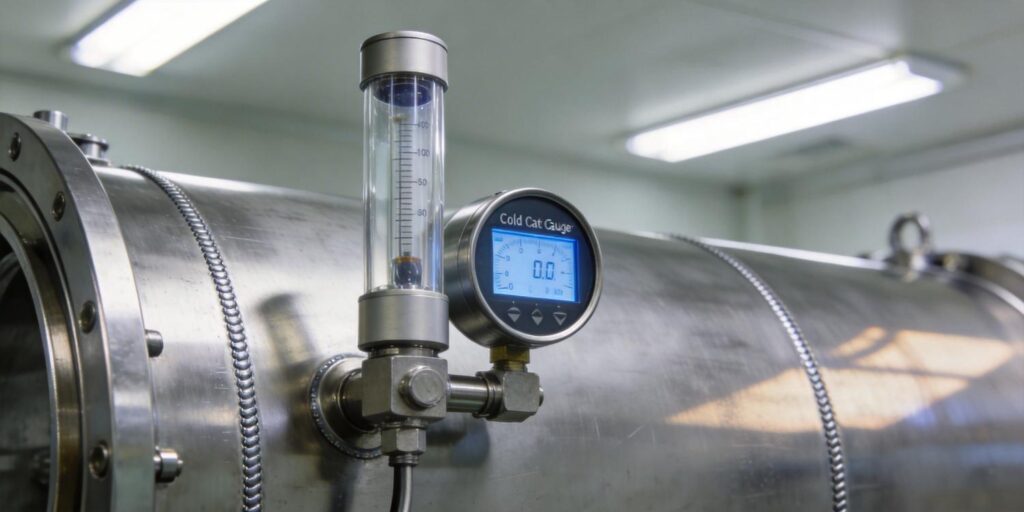
Vacuum gauge installed in humid industrial environment

Vacuum Gauge Performance in High Humidity Environments

In high-humidity environments—whether coastal manufacturing plants, tropical research labs, pharmaceutical cleanrooms with steam sterilization cycles, or outdoor vacuum test stands—moisture poses a silent threat to vacuum measurement accuracy and long-term reliability. Condensation, corrosion, and altered gas thermal conductivity can shift readings, trigger false alarms, or shorten sensor life. Poseidon Scientific’s VG-SP205 Pirani Vacuum Transmitter (atmosphere

Vacuum Gauge Performance in High Humidity Environments Read More »

Vacuum gauge signal shown as error range on control panel

Vacuum Gauge Output Error Range Explained

In vacuum systems for mass spectrometry, thin-film deposition, vacuum metallurgy, and pharmaceutical lyophilization, the pressure signal from your gauge is the single most important input to the control system. When that signal enters an error state—whether from sensor failure, over-range pressure, or communication dropout—the entire process can halt, waste batches, or trigger costly safety interlocks.

Vacuum Gauge Output Error Range Explained Read More »

Cold cathode vacuum gauge starting up with LED indicator

Cold Cathode Gauge Ignition Delay: Causes and Optimization

In high-vacuum applications such as mass spectrometry, vacuum metallurgy, and electron-beam welding, the cold-cathode gauge is prized for its robustness, lack of hot filament, and ability to measure down to 10⁻⁷ Torr. Yet one operational characteristic consistently draws questions from engineers: ignition delay—the time required for the Penning discharge to establish after high voltage is

Cold Cathode Gauge Ignition Delay: Causes and Optimization Read More »

Engineer reviewing vacuum pressure data beside installed gauge

Understanding Vacuum Gauge Measurement Uncertainty

In vacuum systems for mass spectrometry, pharmaceutical freeze-drying, scanning electron microscopy, and industrial heat treatment, pressure is rarely a single fixed value—it is a measurement with inherent doubt. Engineers and procurement teams often ask: how much can I trust the number on the display? The difference between a gauge’s stated accuracy and its real-world measurement

Understanding Vacuum Gauge Measurement Uncertainty Read More »

Vacuum gauge mounted in different orientations on chamber

Vacuum Gauge Mounting Orientation: Does It Matter?

Installation Direction Guidelines Vacuum gauge mounting orientation is one of the most frequently asked questions during system integration. Engineers want to know whether gravity, gas flow, or magnetic fields will affect readings. The short answer for Poseidon Scientific’s gauges is straightforward: orientation does not matter. Both the VG-SP205 Pirani Vacuum Transmitter and the VG-SM225 Cold

Vacuum Gauge Mounting Orientation: Does It Matter? Read More »

Internal filament of thermostatic Pirani vacuum gauge

Comparing Thermostatic Pirani vs Traditional Pirani Gauges

Constant Temperature Advantage in Pirani Vacuum Gauges In vacuum measurement for thin-film deposition, heat treatment, packaging lines, and analytical instruments, Pirani gauges remain the workhorse for the rough-to-medium vacuum range (atmosphere to 10−3 Torr). Two fundamental operating modes exist: traditional constant-current designs and modern thermostatic (constant-temperature) designs. The Poseidon Scientific VG-SP205 Pirani Vacuum Transmitter belongs

Comparing Thermostatic Pirani vs Traditional Pirani Gauges Read More »

Warning label near high voltage vacuum gauge

Understanding Cold Cathode High Voltage Operation

High Voltage Ionization Principle in Cold Cathode Gauges Cold cathode vacuum gauges measure pressure in the high-vacuum regime (10−3 Torr to 10−7 Torr) using the Penning discharge principle rather than a heated filament. In the Poseidon Scientific VG-SM225 Cold Cathode Vacuum Gauge, a strong electric field (starting at −2500 V, then stabilizing at −2000 V)

Understanding Cold Cathode High Voltage Operation Read More »

Shopping Cart
Poseidon Scientific
Privacy Overview

This website uses cookies so that we can provide you with the best user experience possible. Cookie information is stored in your browser and performs functions such as recognising you when you return to our website and helping our team to understand which sections of the website you find most interesting and useful.