How to Select the Right SPE Cartridge for LC-MS Sample Preparation
How to Select the Right SPE Cartridge for LC-MS Sample Preparation Read More »
Sources of LC-MS Matrix Effects Liquid chromatography-mass spectrometry (LC-MS) has revolutionized analytical chemistry with its exceptional sensitivity and specificity, but it remains vulnerable to matrix effects that can compromise analytical accuracy. Matrix effects in LC-MS refer to the suppression or enhancement of analyte ionization caused by co-eluting components from the sample matrix. These effects are
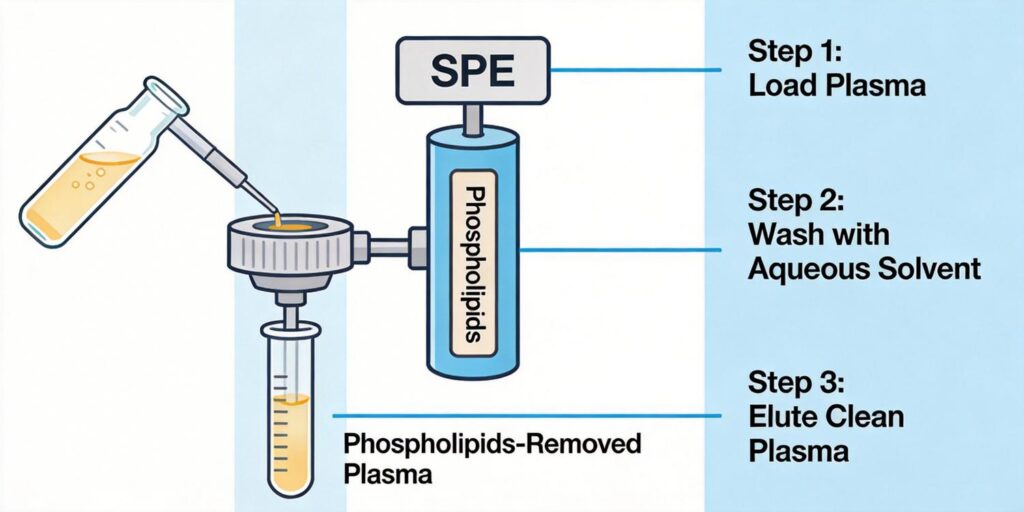
Phospholipid Interference in LC-MS Analysis Phospholipids represent one of the most significant challenges in liquid chromatography-mass spectrometry (LC-MS) analysis of biological samples, particularly plasma. These endogenous compounds can cause severe matrix effects, leading to ion suppression or enhancement, increased analytical variability, and reduced method sensitivity. According to Waters documentation, phospholipids are “major causes of matrix
Requirements of LC-MS/MS Detection Liquid Chromatography-Tandem Mass Spectrometry (LC-MS/MS) represents one of the most powerful analytical techniques available today, combining the separation capabilities of liquid chromatography with the exceptional sensitivity and specificity of mass spectrometry. However, this sophisticated instrumentation places stringent demands on sample quality that cannot be overlooked. LC-MS/MS systems are particularly vulnerable to
Sample Preparation Strategies for LC-MS/MS Analysis Read More »
Understanding Ion Suppression in LC-MS Analysis Ion suppression remains one of the most challenging issues in liquid chromatography-mass spectrometry (LC-MS) analysis, particularly when dealing with complex biological and environmental matrices. This phenomenon occurs when co-eluting matrix components interfere with the ionization process of target analytes, leading to reduced sensitivity, inaccurate quantification, and potential false negatives.
Preventing Ion Suppression in LC-MS with Proper SPE Cleanup Read More »
Challenges of Plasma Matrices: Proteins and Phospholipids Plasma and serum represent some of the most challenging biological matrices for analytical chemists. These complex fluids contain approximately 7% protein content, with albumin, globulins, and fibrinogen being the major constituents that increase sample viscosity and promote clot formation. More critically, plasma contains significant concentrations of phospholipids—typically 1-2
Optimizing HLB SPE for Biological Samples (Plasma and Serum) Read More »
1. Matrix Effect Overview in LC-MS Analysis Matrix effects represent one of the most significant challenges in liquid chromatography-mass spectrometry (LC-MS) analysis, particularly when dealing with complex biological and environmental samples. These effects occur when co-eluting compounds from the sample matrix interfere with the ionization process of target analytes, leading to either suppression or enhancement
1. Importance of Clean Extracts for LC-MS Liquid chromatography-mass spectrometry (LC-MS) has become the gold standard for sensitive and selective analysis across pharmaceutical, environmental, and clinical applications. However, the success of any LC-MS analysis hinges on the quality of sample preparation, particularly the cleanliness of extracts. Clean extracts are not merely desirable—they are essential for
Overview of Environmental Sample Matrices Environmental sample preparation presents unique challenges that distinguish it from clinical or pharmaceutical applications. As noted in the literature, environmental chemists routinely deal with large volume samples – often liters rather than milliliters – due to the trace-level concentrations of pollutants typically found at part-per-billion (ppb) or part-per-trillion (ppt) levels.
Types of Biological Matrices in SPE Applications Solid-phase extraction (SPE) has become an indispensable tool for biological sample preparation across diverse fields including clinical chemistry, forensic science, and pharmaceutical research. The technique’s popularity stems from its ability to achieve high selectivities and recoveries while minimizing hazardous solvent consumption. Biological matrices present unique challenges that require