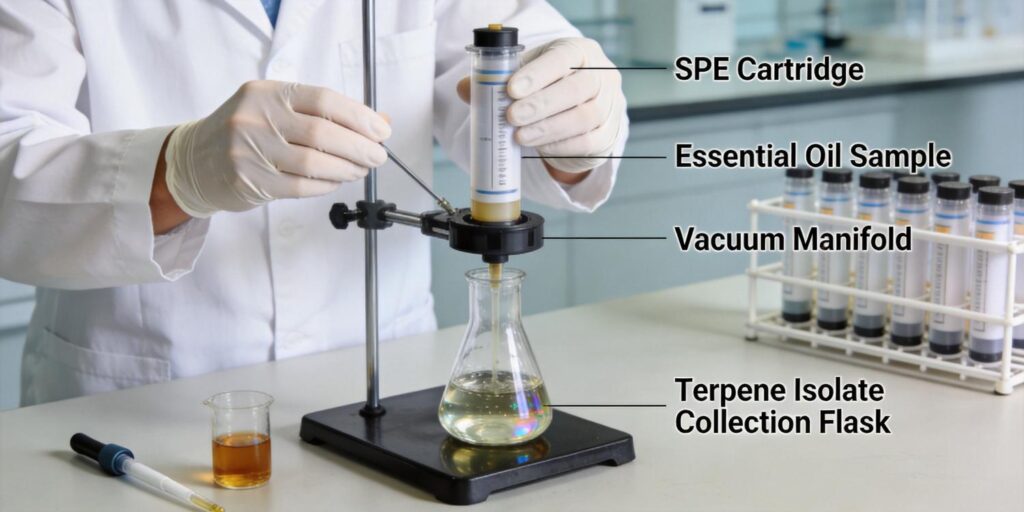
veterinary drug extraction from meat using SPE

Extracting Veterinary Drug Residues from Meat Using SPE

Regulatory Monitoring of Veterinary Drugs Veterinary drug residue monitoring in meat products represents a critical public health safeguard implemented by regulatory agencies worldwide. The detection of antibacterial drugs, sulfonamides, and other therapeutic agents in animal tissues requires robust analytical methodologies that can achieve detection limits at parts-per-billion (ppB) levels. As noted in the literature, “antibacterial […]

Extracting Veterinary Drug Residues from Meat Using SPE Read More »

Vacuum transmitter wired to PLC with alarm lights

Designing Interlock Logic Using Vacuum Gauge Threshold Signals

Define Process Critical Pressure Thresholds Effective interlock logic begins with a clear understanding of the vacuum pressures that directly impact process safety, quality, and equipment protection. In most analytical and production vacuum systems, three critical thresholds emerge from the pump-down curve and recipe requirements: Roughing threshold (atmosphere to 10⁻³ Torr): Protects turbomolecular pumps from operation

Designing Interlock Logic Using Vacuum Gauge Threshold Signals Read More »

antibiotic residue extraction from milk using HLB SPE

Using HLB SPE for Antibiotic Residue Analysis in Milk

Antibiotic Residue Regulations Overview Antibiotic residue analysis in milk represents a critical component of food safety monitoring worldwide. Regulatory frameworks such as the European Union’s Maximum Residue Limits (MRLs), the U.S. Food and Drug Administration’s tolerances, and China’s GB standards establish stringent requirements for veterinary drug residues in dairy products. These regulations typically specify detection

Using HLB SPE for Antibiotic Residue Analysis in Milk Read More »

High vacuum chamber with installed vacuum gauge

How Outgassing Skews High Vacuum Measurements

Define Material Outgassing Outgassing is the spontaneous release of trapped or adsorbed gases from the surfaces and bulk of materials inside a vacuum chamber. These gases—primarily water vapor, hydrogen, carbon monoxide, and hydrocarbons—originate from atmospheric exposure, manufacturing residues, or dissolved species within metals, polymers, and ceramics. In high-vacuum systems the dominant source is physisorbed and

How Outgassing Skews High Vacuum Measurements Read More »

PFAS extraction workflow using SPE cartridge

SPE Sample Preparation for PFAS Analysis in Drinking Water

Overview of PFAS Contamination in Drinking Water Per- and polyfluoroalkyl substances (PFAS) represent a class of synthetic chemicals that have become a significant environmental concern in drinking water systems worldwide. These compounds, characterized by their strong carbon-fluorine bonds, exhibit exceptional thermal and chemical stability, making them persistent in the environment and resistant to conventional water

SPE Sample Preparation for PFAS Analysis in Drinking Water Read More »

Vacuum gauge digital display during system startup

Vacuum Gauge Warm-Up Time: Why Stability Takes 10-20 Minutes

Sensor Thermal Equilibrium Explanation Vacuum gauges, whether thermal-conductivity or ionization types, require time to reach thermal equilibrium before delivering stable, repeatable readings. In the Poseidon Scientific VG-SP205 Pirani Vacuum Transmitter, a platinum filament is resistively heated to a constant temperature while the electronics monitor the power needed to maintain that set point. Immediately after power-on,

Vacuum Gauge Warm-Up Time: Why Stability Takes 10-20 Minutes Read More »

Pirani vacuum transmitter mounted on laboratory vacuum system

Pirani Gauge Accuracy Limits Below 1E-3 mbar

Thermal Conductivity Limit in Molecular Flow Pirani gauges measure pressure by sensing the heat loss from a heated filament (typically platinum) to the surrounding gas. At higher pressures, in the viscous-flow regime, thermal conductivity increases linearly with gas density, providing excellent sensitivity. As pressure drops into the transition region (roughly 10 Torr to 10⁻² Torr),

Pirani Gauge Accuracy Limits Below 1E-3 mbar Read More »

analytical chemistry laboratory SPE workflow

Why SPE Is Essential for Modern Analytical Laboratories

The Evolution of Sample Preparation Techniques Sample preparation has undergone a remarkable transformation over the past century, evolving from rudimentary separation methods to sophisticated, automated techniques. The journey began with early forms of chromatography that can be traced back to 23 AD, though the modern era truly began with Tswett’s 1906 work on chromatography. However,

Why SPE Is Essential for Modern Analytical Laboratories Read More »

SPE sample preparation before LC MS MS analysis

Sample Preparation Strategies for LC-MS/MS Analysis

Requirements of LC-MS/MS Detection Liquid Chromatography-Tandem Mass Spectrometry (LC-MS/MS) represents one of the most powerful analytical techniques available today, combining the separation capabilities of liquid chromatography with the exceptional sensitivity and specificity of mass spectrometry. However, this sophisticated instrumentation places stringent demands on sample quality that cannot be overlooked. LC-MS/MS systems are particularly vulnerable to

Sample Preparation Strategies for LC-MS/MS Analysis Read More »

Cold cathode vacuum gauge installed on industrial vacuum chamber

Cold Cathode Gauge Overpressure Exposure: What Happens Above 1 mbar?

Plasma Discharge Behavior at High Pressure Cold cathode gauges rely on the Penning (magnetron) discharge to ionize gas molecules. A high negative voltage (–2000 V operating, –2500 V for startup) combined with a ~100 gauss magnetic field traps electrons in long spiral paths, creating an avalanche of ions whose current is proportional to pressure. This

Cold Cathode Gauge Overpressure Exposure: What Happens Above 1 mbar? Read More »

Shopping Cart
Poseidon Scientific
Privacy Overview

This website uses cookies so that we can provide you with the best user experience possible. Cookie information is stored in your browser and performs functions such as recognising you when you return to our website and helping our team to understand which sections of the website you find most interesting and useful.