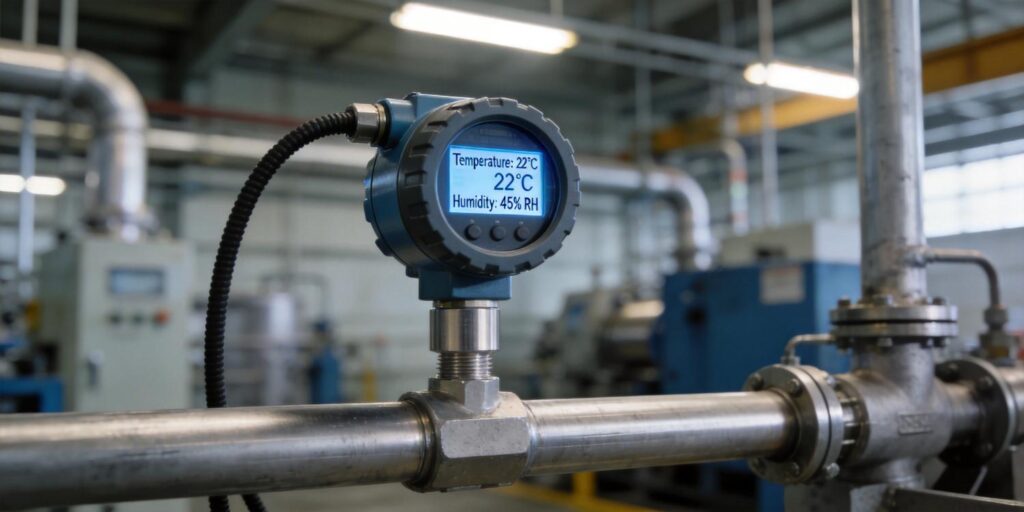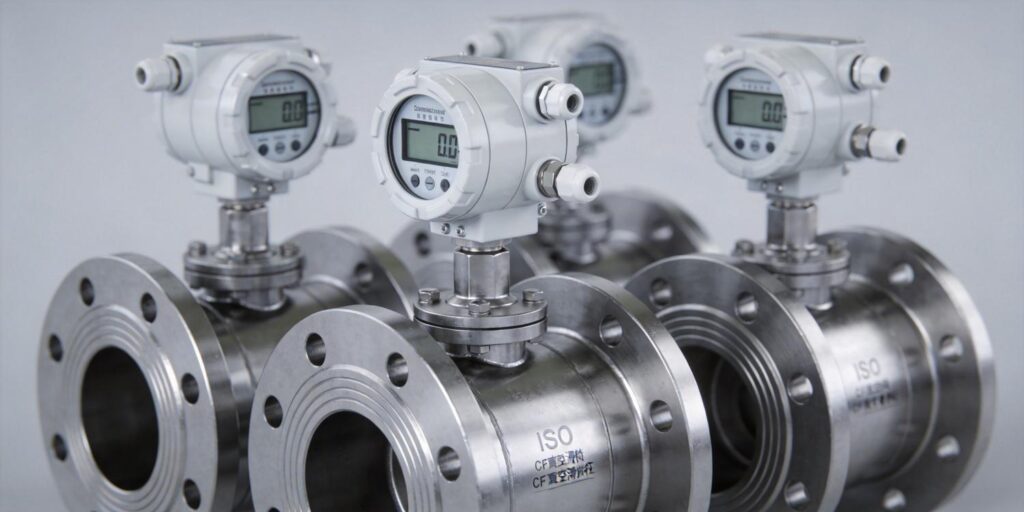
Vacuum gauge digital display during system startup

Vacuum Gauge Warm-Up Time: Why Stability Takes 10-20 Minutes

Sensor Thermal Equilibrium Explanation Vacuum gauges, whether thermal-conductivity or ionization types, require time to reach thermal equilibrium before delivering stable, repeatable readings. In the Poseidon Scientific VG-SP205 Pirani Vacuum Transmitter, a platinum filament is resistively heated to a constant temperature while the electronics monitor the power needed to maintain that set point. Immediately after power-on, […]

Vacuum Gauge Warm-Up Time: Why Stability Takes 10-20 Minutes Read More »

Pirani vacuum transmitter mounted on laboratory vacuum system

Pirani Gauge Accuracy Limits Below 1E-3 mbar

Thermal Conductivity Limit in Molecular Flow Pirani gauges measure pressure by sensing the heat loss from a heated filament (typically platinum) to the surrounding gas. At higher pressures, in the viscous-flow regime, thermal conductivity increases linearly with gas density, providing excellent sensitivity. As pressure drops into the transition region (roughly 10 Torr to 10⁻² Torr),

Pirani Gauge Accuracy Limits Below 1E-3 mbar Read More »

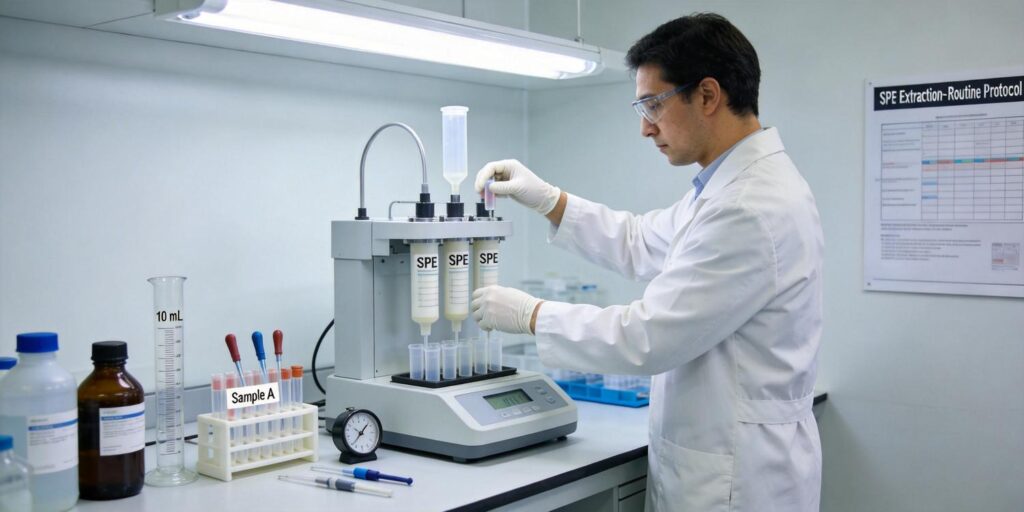
analytical chemistry laboratory SPE workflow

Why SPE Is Essential for Modern Analytical Laboratories

The Evolution of Sample Preparation Techniques Sample preparation has undergone a remarkable transformation over the past century, evolving from rudimentary separation methods to sophisticated, automated techniques. The journey began with early forms of chromatography that can be traced back to 23 AD, though the modern era truly began with Tswett’s 1906 work on chromatography. However,

Why SPE Is Essential for Modern Analytical Laboratories Read More »

SPE sample preparation before LC MS MS analysis

Sample Preparation Strategies for LC-MS/MS Analysis

Requirements of LC-MS/MS Detection Liquid Chromatography-Tandem Mass Spectrometry (LC-MS/MS) represents one of the most powerful analytical techniques available today, combining the separation capabilities of liquid chromatography with the exceptional sensitivity and specificity of mass spectrometry. However, this sophisticated instrumentation places stringent demands on sample quality that cannot be overlooked. LC-MS/MS systems are particularly vulnerable to

Sample Preparation Strategies for LC-MS/MS Analysis Read More »

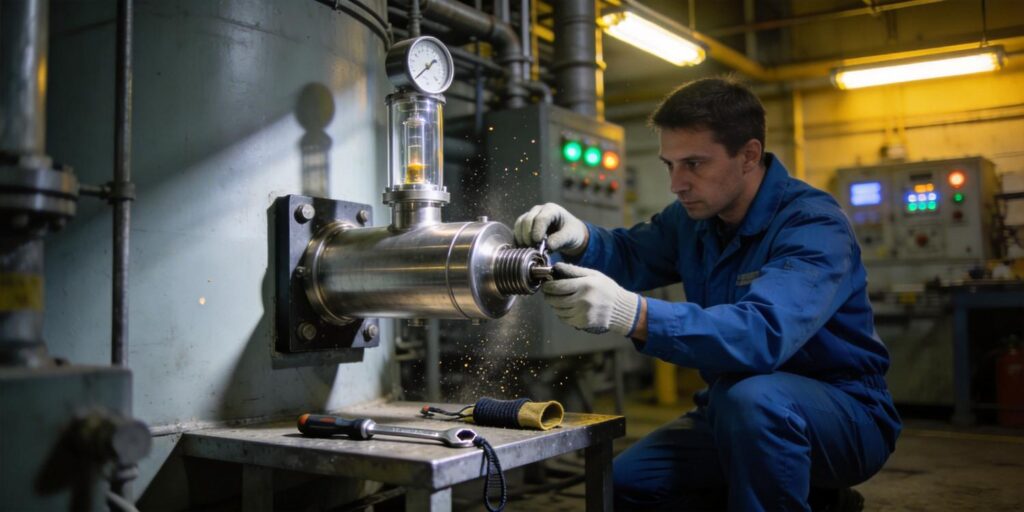
Cold cathode vacuum gauge installed on industrial vacuum chamber

Cold Cathode Gauge Overpressure Exposure: What Happens Above 1 mbar?

Plasma Discharge Behavior at High Pressure Cold cathode gauges rely on the Penning (magnetron) discharge to ionize gas molecules. A high negative voltage (–2000 V operating, –2500 V for startup) combined with a ~100 gauss magnetic field traps electrons in long spiral paths, creating an avalanche of ions whose current is proportional to pressure. This

Cold Cathode Gauge Overpressure Exposure: What Happens Above 1 mbar? Read More »

trace contaminant extraction using SPE

Using SPE to Concentrate Trace Environmental Contaminants

Trace Analysis Challenges in Environmental Monitoring Environmental contaminants often exist at ultratrace levels—typically in the part-per-billion (ppb) to part-per-trillion (ppt) range—posing significant analytical challenges. Unlike clinical samples where drug concentrations might be in the ppm or ppb range, environmental matrices require handling large sample volumes to obtain detectable analyte quantities. According to research from Tennessee

Using SPE to Concentrate Trace Environmental Contaminants Read More »

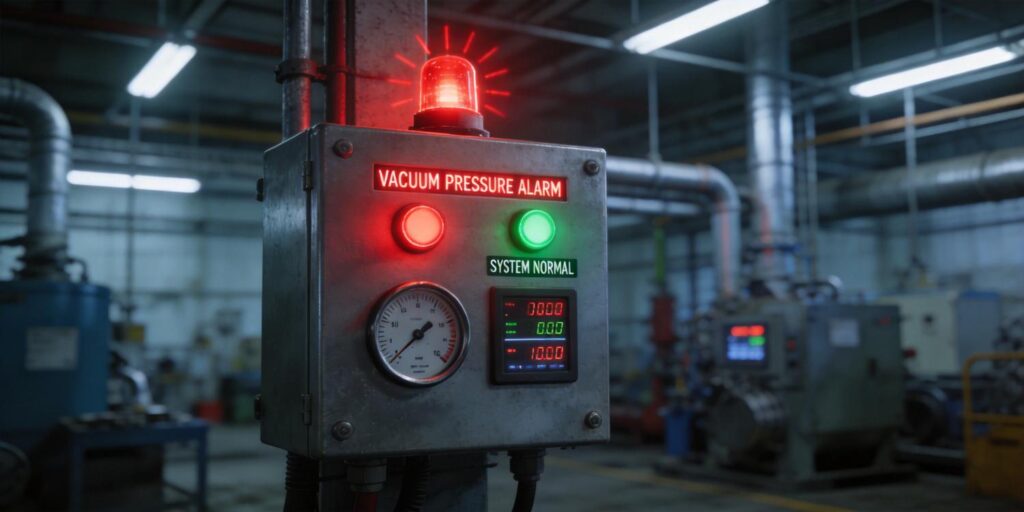
Digital vacuum gauge monitoring industrial pump-down process

How to Size a Vacuum Gauge Based on Your Real Operating Pressure Curve

Analyze Full Pump-Down Curve (Atmosphere to High Vacuum) Every vacuum system tells its story through the pump-down curve: pressure versus time from atmosphere (760 Torr) down to the ultimate base pressure. Plotting this curve—ideally with a data logger or PLC trend—is the first and most critical step in gauge sizing. A typical mechanical-pump + turbo-molecular-pump

How to Size a Vacuum Gauge Based on Your Real Operating Pressure Curve Read More »

Dual vacuum gauges installed on critical industrial vacuum system

Designing a Redundant Vacuum Monitoring System for Critical Processes

Redundancy Concept In critical vacuum processes—such as mass-spectrometer operation, semiconductor wafer processing, vacuum heat treatment of aerospace alloys, or electron-beam welding—unplanned loss of vacuum monitoring can trigger batch failure, equipment damage, or safety events. Redundancy addresses this by deploying multiple independent sensors whose outputs are continuously cross-checked. The goal is not merely duplication but fault-tolerant

Designing a Redundant Vacuum Monitoring System for Critical Processes Read More »

comparison of SPE and LLE workflows

SPE vs Liquid-Liquid Extraction: A Practical Comparison

Overview of LLE Workflow Liquid-Liquid Extraction (LLE) represents one of the most fundamental sample preparation techniques in analytical chemistry. The traditional LLE workflow involves several sequential steps that have remained largely unchanged for decades. First, the aqueous sample is placed in a separatory funnel with an immiscible organic solvent. The mixture is then vigorously shaken

SPE vs Liquid-Liquid Extraction: A Practical Comparison Read More »

Ionization vacuum gauges mounted on industrial chamber

Cold Cathode vs Hot Cathode Gauges: Cost and Maintenance Comparison

Structural Differences Hot cathode and cold cathode ionization gauges both measure vacuum by ionizing gas molecules and collecting the resulting ion current, but their fundamental designs differ dramatically in how electrons are generated and how the discharge is sustained. A hot cathode gauge, often based on the Bayard-Alpert or triode geometry, relies on a thermionic

Cold Cathode vs Hot Cathode Gauges: Cost and Maintenance Comparison Read More »

Shopping Cart
Poseidon Scientific
Privacy Overview

This website uses cookies so that we can provide you with the best user experience possible. Cookie information is stored in your browser and performs functions such as recognising you when you return to our website and helping our team to understand which sections of the website you find most interesting and useful.