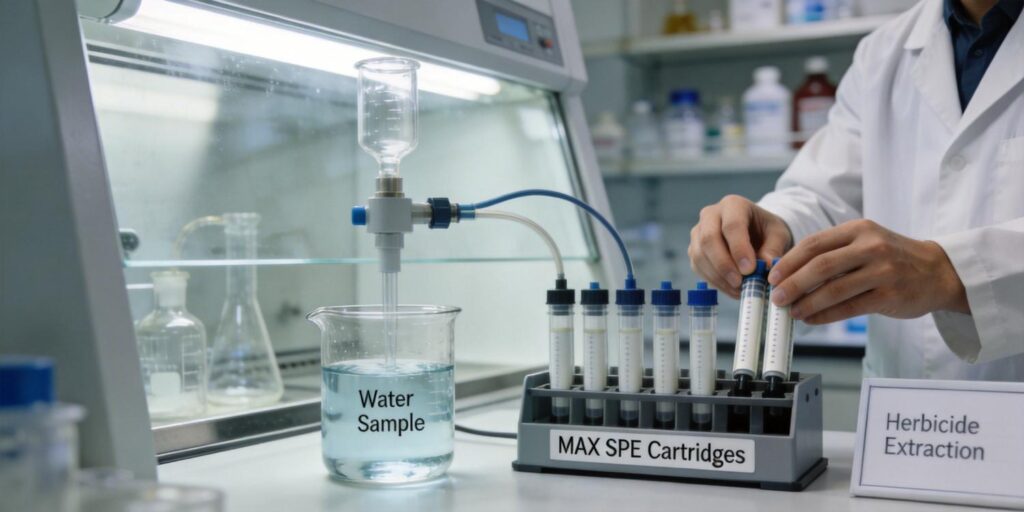
MCX and WCX SPE cartridges used for extracting basic drugs in a laboratory workflow

Choosing Between MCX and WCX SPE for Basic Drugs

Overview of Mixed-Mode Cation Exchange SPE Mechanisms Mixed-mode solid phase extraction represents a sophisticated approach to sample preparation that combines multiple retention mechanisms within a single sorbent. For basic drug analysis, mixed-mode cation exchange (MCX and WCX) cartridges provide superior selectivity and sensitivity compared to traditional reversed-phase materials. These sorbents operate through a dual mechanism: […]

Choosing Between MCX and WCX SPE for Basic Drugs Read More »

Vacuum transmitter connected with shielded cables in industrial setting

Vacuum Gauge Electrical Isolation in High EMI Environments

EMI Sources in Factories High-EMI environments are the norm in modern vacuum-dependent manufacturing. Plasma power supplies operating at 13.56 MHz in sputtering or PECVD tools generate strong RF fields. Variable-frequency drives on turbo pumps and roughing pumps produce switching transients. Arc-welders, induction heaters, and nearby CNC machines add broadband noise. In semiconductor cluster tools or

Vacuum Gauge Electrical Isolation in High EMI Environments Read More »

Multiple vacuum gauges installed on industrial multi-chamber system

Optimizing Vacuum Measurement in Multi-Chamber Systems

Shared Pump Configuration Multi-chamber vacuum systems—cluster tools for semiconductor processing, load-lock furnaces, glovebox-integrated dry rooms, and vacuum-assisted additive manufacturing lines—commonly share a single roughing or turbo pump stack to reduce footprint and capital cost. A central pump manifold connects multiple chambers through isolation valves, allowing sequential pump-down, transfer, and venting while one set of pumps

Optimizing Vacuum Measurement in Multi-Chamber Systems Read More »

comparison of HLB and MAX SPE cartridges

Choosing Between HLB and MAX SPE for Acidic Drugs

Chemical Properties of Acidic Pharmaceuticals Acidic pharmaceuticals represent a diverse class of compounds characterized by their ability to donate protons in aqueous solutions. These drugs typically contain carboxylic acid (-COOH), sulfonic acid (-SO3H), or phenolic hydroxyl (-OH) functional groups that can dissociate to form negatively charged species. Understanding their chemical properties is fundamental to selecting

Choosing Between HLB and MAX SPE for Acidic Drugs Read More »

Industrial vacuum gauges installed on production line

Vacuum Gauge MTBF: What Reliability Metrics Should You Track?

Define MTBF in Industrial Context Mean Time Between Failures (MTBF) quantifies the average operating hours a vacuum gauge can deliver before requiring replacement or major service. In industrial vacuum applications—mass spectrometers, vacuum furnaces, PVD coating lines, battery dry rooms, and electron-beam systems—MTBF is not a laboratory ideal but a practical reliability metric tied directly to

Vacuum Gauge MTBF: What Reliability Metrics Should You Track? Read More »

SPE cleanup before LC MS analysis

LC-MS Matrix Effect Reduction Using SPE Cleanup

Sources of LC-MS Matrix Effects Liquid chromatography-mass spectrometry (LC-MS) has revolutionized analytical chemistry with its exceptional sensitivity and specificity, but it remains vulnerable to matrix effects that can compromise analytical accuracy. Matrix effects in LC-MS refer to the suppression or enhancement of analyte ionization caused by co-eluting components from the sample matrix. These effects are

LC-MS Matrix Effect Reduction Using SPE Cleanup Read More »

Vacuum gauge mounted on plasma sputtering chamber

How Plasma Processes Influence Vacuum Gauge Readings

Plasma Density Effect on Ionization Gauges In plasma-enhanced processes such as reactive sputtering, PECVD, and plasma etching, the vacuum chamber contains a dense cloud of ions, electrons, and excited neutrals. This external plasma directly influences ionization-type vacuum gauges because their measurement principle already relies on electron–molecule collisions to generate a measurable ion current. The VG-SM225

How Plasma Processes Influence Vacuum Gauge Readings Read More »

endocrine disruptor extraction using SPE

SPE Sample Preparation for Endocrine Disruptor Analysis

Overview of Endocrine Disrupting Compounds Endocrine disrupting compounds (EDCs) represent a diverse class of chemical contaminants that interfere with the normal functioning of the endocrine system in humans and wildlife. These compounds mimic, block, or otherwise disrupt hormonal signaling pathways, potentially leading to reproductive abnormalities, developmental disorders, and increased cancer risks. EDCs encompass a wide

SPE Sample Preparation for Endocrine Disruptor Analysis Read More »

Vacuum gauge installed on industrial metal 3D printer chamber

Vacuum Monitoring in Additive Manufacturing Systems

Vacuum-Assisted Metal Printing Requirements Additive manufacturing of metal parts—particularly electron-beam melting (EBM) and vacuum-assisted laser powder-bed fusion—relies on controlled vacuum environments to eliminate oxidation, improve melt-pool stability, and ensure defect-free microstructures. Build chambers must reach and hold pressures low enough to prevent oxygen and nitrogen pickup while still allowing efficient powder spreading and electron or

Vacuum Monitoring in Additive Manufacturing Systems Read More »

Vacuum gauge calibrated at atmospheric pressure

Vacuum Gauge Zero Offset Adjustment Procedure

When Zero Adjustment Is Required Zero offset in vacuum transmitters refers to a systematic shift where the gauge reads a non-zero pressure at true atmosphere (≈760 Torr) or fails to approach zero at base vacuum. For Poseidon Scientific’s VG-SP205 Pirani Vacuum Transmitter and VG-SM225 Cold Cathode Vacuum Gauge, such offsets are rare thanks to factory

Vacuum Gauge Zero Offset Adjustment Procedure Read More »

Shopping Cart
Poseidon Scientific
Privacy Overview

This website uses cookies so that we can provide you with the best user experience possible. Cookie information is stored in your browser and performs functions such as recognising you when you return to our website and helping our team to understand which sections of the website you find most interesting and useful.